Homeschool Haters? Handle Them Without Losing Your Cool
Let’s talk about it: homeschool haters. Yep, they exist. Sometimes they lurk in Facebook comment sections, sometimes they show up at family dinners with unsolicited opinions and a dramatic sip of wine, and sometimes... they're sitting across from you saying things like,
"I think it’s cruel to homeschool your kids."
Yup. That was said to my face.
By a family member.
And you know what? I wanted to scream. Not just a little indignant huff—I mean full-on, "HOW DARE YOU" fire. Because I pour my life into these kids. I teach them, read with them, pray with them, clean up after their science experiments, and try not to cry when math takes longer than it should. And someone’s out here calling it... cruel?
But I took a breath, looked her in the eye, and said:
"Honestly, if I wasn’t homeschooled myself and didn’t know much about it, I might feel the same way."
It totally disarmed her.
And that’s the power of grace.
At no extra cost to you, using these affiliate links helps support our work — and we truly appreciate it.
Why People Criticize Homeschooling (and What’s Really Going On)
Let’s break it down, because these reactions usually come from three places:
1. Ignorance
Most people just don’t know what modern homeschooling looks like.
They picture kids locked indoors, socially awkward and raised by wolves (or YouTube).
They don’t see the thriving co-ops, nature walks, real-world learning, or the ridiculous number of books your kids devour in a week.
Or that some families use super solid programs like BJU Press, which basically turns your home into a high-quality Christian school—minus the uniforms and cafeteria pizza.
BJU Press Homeschool is actually what we use, and we love it for the assurance that we’re using an academically robust program, without needing to be super structured all the time.
So a homeschool haters judgment often isn’t based on truth—it’s based on misconception.
2. Fear
Some people are genuinely afraid for your kids.
They worry they won’t be "normal" or that they won’t keep up academically.
Others are scared for you—they’re worried you’ll burn out or regret it. And some of them?
They’re afraid that if your homeschool works, it will make them question their own educational choices.
3. Pride
This is the hardest one.
When someone spent their life supporting the public school system or raised their own kids differently, your choice to homeschool can feel like a judgment on them.
It doesn’t matter how gentle you are. It can sting their pride.
And pride doesn’t usually respond with curiosity—it responds with critique.
How to Respond (Without Losing Your Jesus)
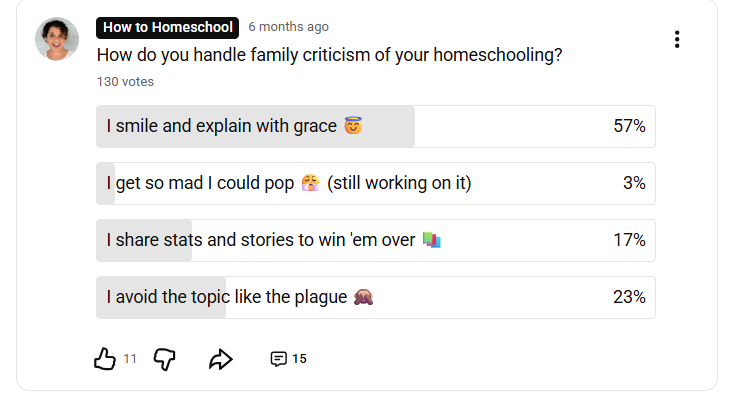
So what do you do when a relative drops a comment like, "I feel sorry for your kids"?
You could go full mama bear.
You could start a PowerPoint presentation with data, research, and Bible verses. Or... You could do what Jesus did. You respond with grace and truth.
Try something like this:
"Yeah, I used to wonder the same thing about homeschooling. Until I saw what it actually looks like from the inside."
Or:
"I totally get why you feel that way. I probably would too if I hadn’t seen how much my kids are thriving."
You’re not caving.
You’re just leaving the door open.
Real Moms, Real Stories
In one Christian homeschool group I follow, a mom shared that she had posted a sweet picture of her homeschool co-op: seven families, eleven happy kids. Her sister commented with a sad face emoji.
Because... she "felt sorry" for them.
Sigh.
But the encouraging replies from other mama bears were amazing:
"I wrote this in my Bible: ‘To inoculate me from the PRAISE of man, God baptized me in the CRITICISM of man.’" —Francis Frangipane
And also: "If you let compliments go to your head, you’ll let insults go to your heart."
One mom (a retired public school teacher!) said she used to be completely against homeschooling... until she saw it done well.
Now? She tells everyone to homeschool their kids.
Another woman, a former college admissions officer, said homeschoolers were consistently the most prepared students in her programs. And that completely flipped her mindset.
People do come around. Not always quickly, but it happens.
What NOT to Do (Even Though It's Really Tempting)
Don’t launch into a full-blown curriculum defense: "Well, if you refer to the Scope & Sequence in Appendix B..."—girl, no.
Don’t throw their parenting back in their face: "Oh really, Sharon? Your son still lives at home and thinks Pop-Tarts are a vegetable." (Yes, I’ve thought it. No, I didn’t say it.)
Don’t write a Facebook essay with 27 bullet points: You’re homeschooling, not applying for a PhD in Internet Arguments.
What Actually Works
Instead—live it out.
Let your kids' joy be your testimony.
Let your calm speak louder than any defense.
Let the peace in your home whisper, "This works."
You don’t have to prove anything to anyone. Just walk it out with grace, confidence, and the occasional dramatic eye-roll in private…if you have to.
And If You're Still Feeling Unsure...
Look, if you’re new to homeschooling or still feel rattled when people throw shade, you don’t have to figure it all out alone.
That’s exactly why I created Curriculum Confidence.
It’s a simple, step-by-step guide that helps you choose the right Christian homeschool curriculum for your family—without the overwhelm, the tears, or the late-night Googling spiral. You’ll walk away with clarity, peace, and actual confidence that you’re on the right path.
Really, it’s what I wish I had when I was starting out.
(And maybe it will saved you from that one time you want to buy a $600 curriculum you’ll hate by week three.)
Check it out here.
Final Word of Encouragement
If you're facing pushback from people who just don't get it—you are not alone.
You are walking a brave path.
You are answering a calling.
You are sowing into something eternal.
So smile, sip your coffee, and let them wonder.
Because the fruit will speak for itself.
And that, my friend, is the best mic drop of all.