Sonlight vs. Abeka: Which One Actually Fits Your Homeschool?
I remember staring at curriculum catalogs thinking, Why does everything look amazing… and why does everyone online sound so confident except me? Two of the biggest names I wrestled with early on were Sonlight and Abeka. They’re both well-known. They’re both Christian. They both promise a solid education.
And yet… they give your homeschool completely different vibes.
So let’s talk about it — practically, and without pretending there’s one magical “best” option for everyone.
Before we dive in, quick context so you know where I’m coming from. I’m Rebecca — a Christian homeschool mom, second-generation homeschooler, and the kind of person who reads curriculum guides for fun. I’m also the creator of the Curriculum Confidence course, which basically means I spend an unreasonable amount of time helping parents sort through decisions exactly like this one.
Okay. Onward.
At no extra cost to you, using these affiliate links helps support our work — and we truly appreciate it.
Bible & Worldview: Where the Differences Show Up Fast
Let’s start with worldview, because this is where Abeka and Sonlight part ways almost immediately.
With Abeka, the Bible isn’t a side subject — it’s everywhere.
History? God’s hand all over it.
Bible class? Unapologetically Protestant and creationist, included right in the core package.
Science? Creation, Creator, no hedging.
Spelling? Yes… somehow even spelling manages to stay biblical.
The worldview isn’t implied. It’s baked right in.
Abeka doesn’t ask you to “add” a Christian lens — it assumes one from the start. For families who want strong, explicit creationist teaching without constantly stopping to clarify, this is a big win.
Sonlight, on the other hand, takes a different approach.
Sonlight has been critiqued by some Christian parents for leaning a little too secular at times — for example, outsourcing spelling to All About Spelling, which isn’t a Christian program.
Sonlight does offer creationist or old-earth science options, but they tend to sit on the fence rather than take a hard theological stance.
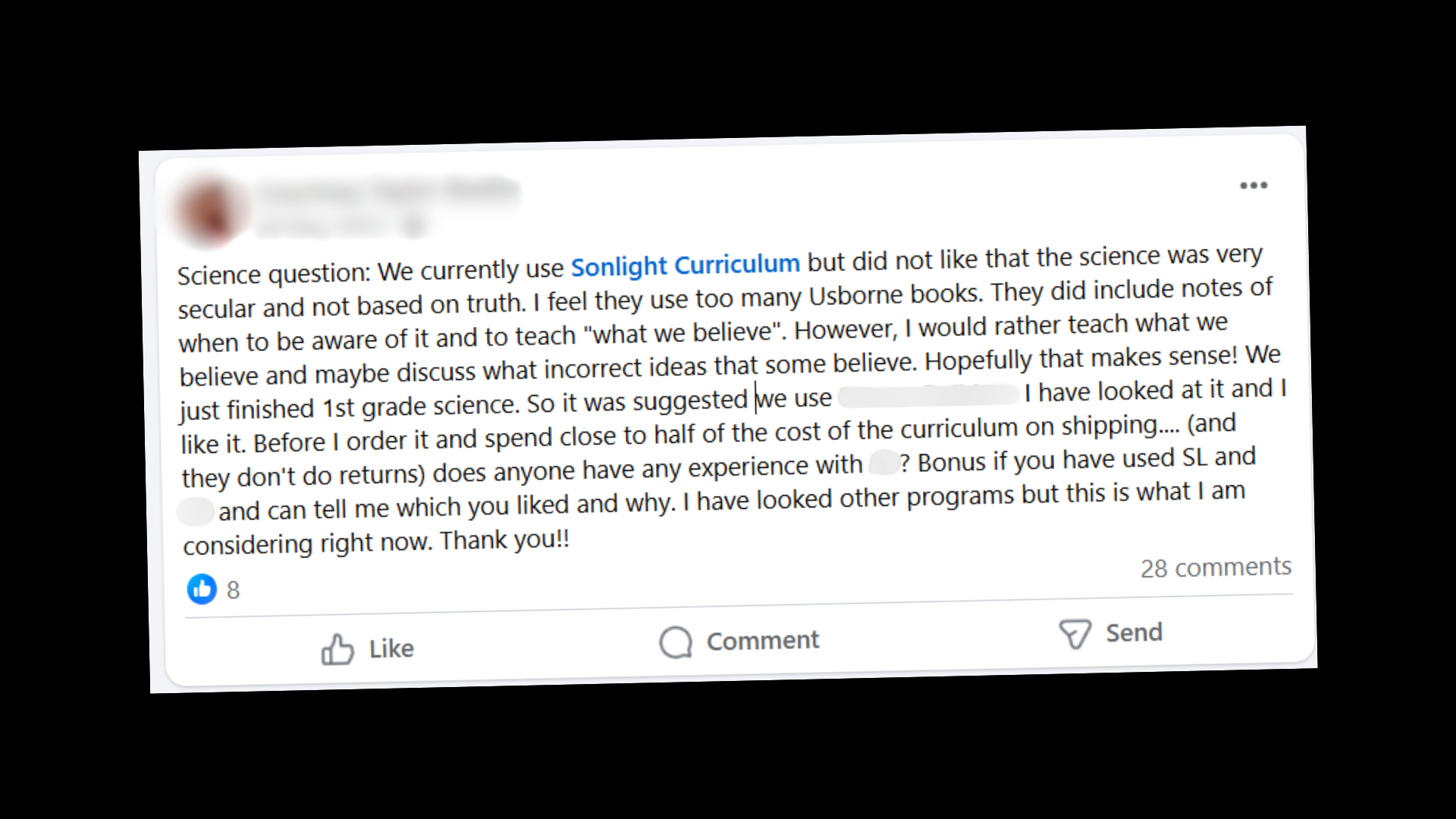
One mom summed it up like this in a Christian homeschool forum:
“We currently use Sonlight Curriculum, but did not like that the science was very secular and not based on the truth. They did include notes of when to be aware of it and to teach ‘what we believe,’ but I’d rather teach what we believe first.”
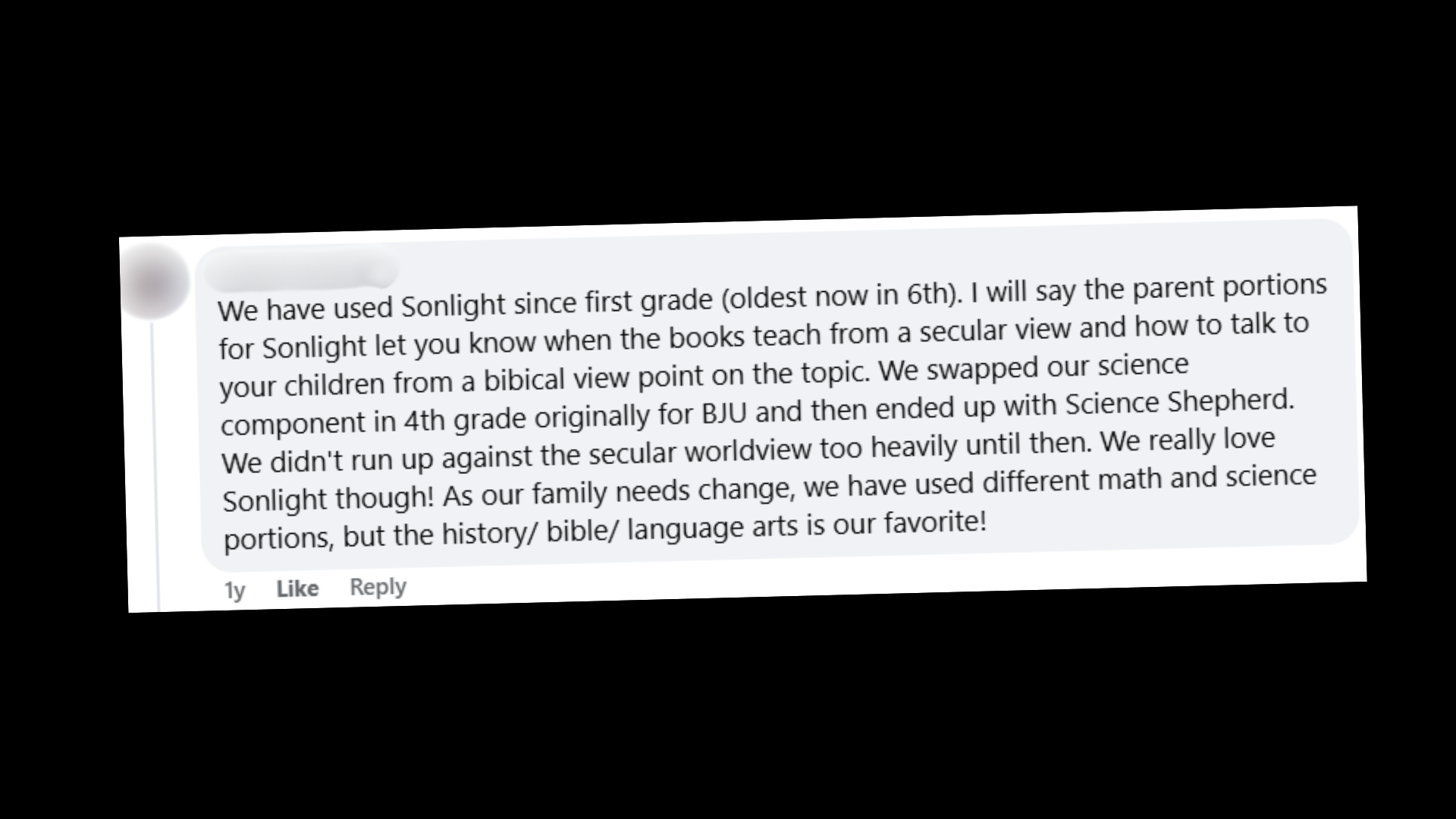
Another parent shared a more positive experience:
“We’ve used Sonlight since first grade, and the parent notes help you know when books teach from a secular viewpoint and how to talk to your children from a biblical one.”
So here’s the takeaway:
If you want clear, upfront creationist teaching with minimal filtering, Abeka wins here.
If you’re comfortable discussing worldview as you go — and even enjoy those conversations — Sonlight can still work well.
Personally, I also love alternatives like Science Shepherd and BJU Press Science that stay firmly Christian without constant footnotes.
Learning Style: Couch Readers vs. Desk Learners
Now let’s talk learning style — because this is where these two curricula feel like they’re from different planets.
Sonlight is literature-based and discussion-heavy. If you choose Sonlight, your kids will be drowning (or swimming — depends on the child) in books.
Novels.
Biographies.
Historical fiction.
You’ll basically build a mini-library in your living room whether you meant to or not.
Many families love this.
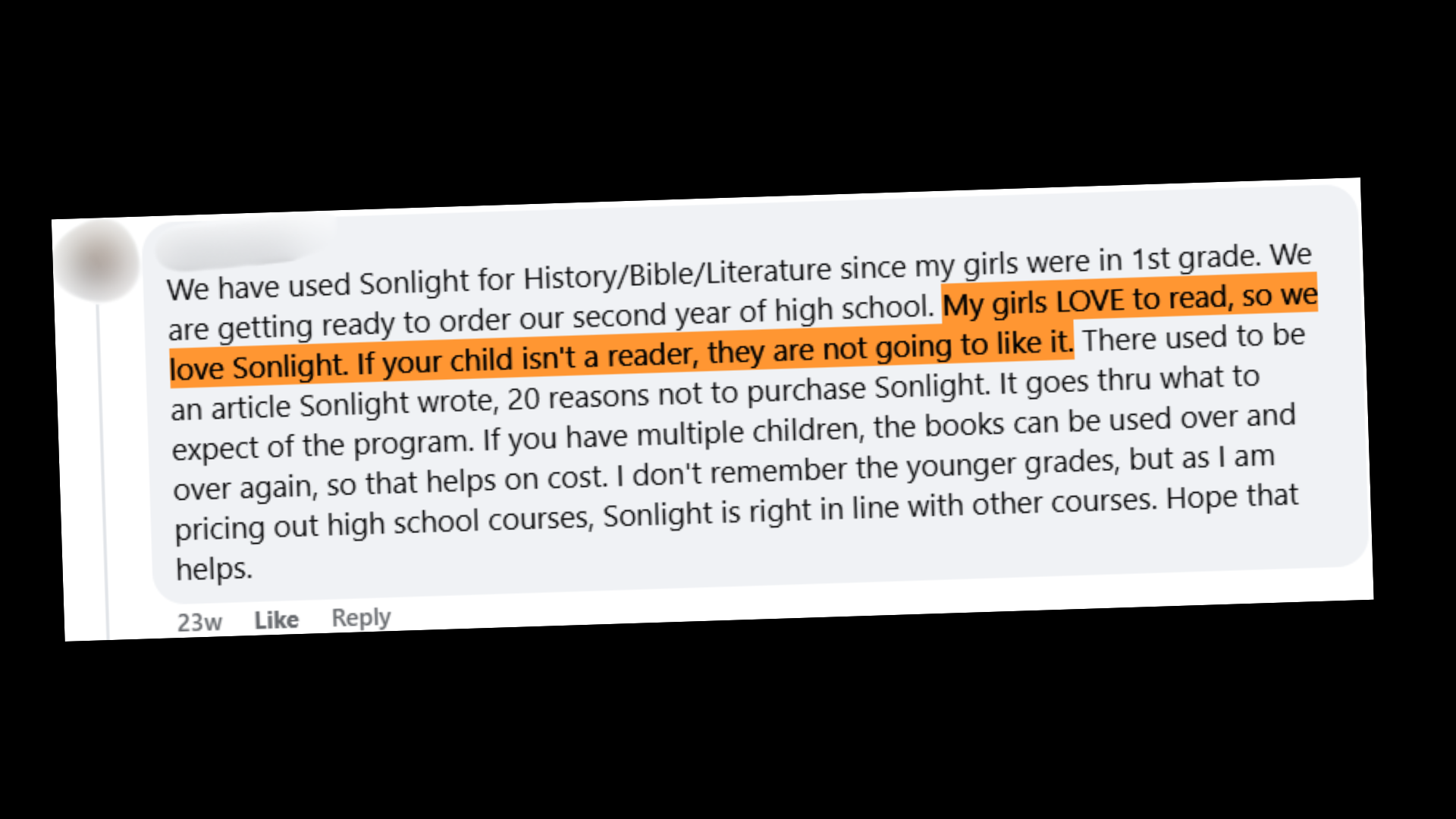
One mom put it perfectly:
“My girls LOVE to read, so we love Sonlight. If your child isn’t a reader, they are not going to like it.”
Sonlight feels cozy. It feels like learning on the couch. It rewards kids who love stories, conversations, and rabbit trails. It can be wonderful — if that matches your child.
Abeka, by contrast, is very traditional.
Think private Christian school… but it’s moved into your house and brought a syllabus.
You’ve got structured lessons, workbooks, regular review, quizzes, and tests.
There is a plan.
There is an order.
There is a very clear “we are done now.”
You can also add Abeka’s teacher video lessons, which means your child is taught directly by experienced Christian teachers while you quietly drink your coffee and pretend you’re not still in pajamas.
And really— I recommend the video lessons.
The teacher manuals are very parent-heavy.
If you try to do everything in them, you will still be doing worksheets at dinner time. Consider this your official permission to skip things.
If you don’t, Abeka will happily keep you busy all day, every day, forever.
This structure is a huge win for families who like routine and clear expectations. If your child thrives on checklists, concrete answers, and knowing exactly what’s expected, Abeka can feel very comforting.
Sonlight says, “Let’s follow this rabbit trail.”
Abeka says, “Please return to your desk.”
Neither is wrong. They’re just different.
At this point, if you’re feeling like, Why does choosing curriculum feel heavier than it should? — you’re not imagining it.
This is actually why I created Curriculum Confidence. I kept seeing Christian homeschool parents stuck between good options, over-researching, second-guessing, and sometimes buying three programs out of sheer panic. The course walks you through how to match curriculum to your kids, your season, and your priorities — without spiraling or burning out.

Okay — back to the comparison.
Cost & Reusability: What You’re Really Paying For
Let’s talk money, because eventually we all have to.
Sonlight usually runs around $1,000 per year per child.
Abeka is closer to $1,400 per year per child.
But the sneaky difference is what you keep.
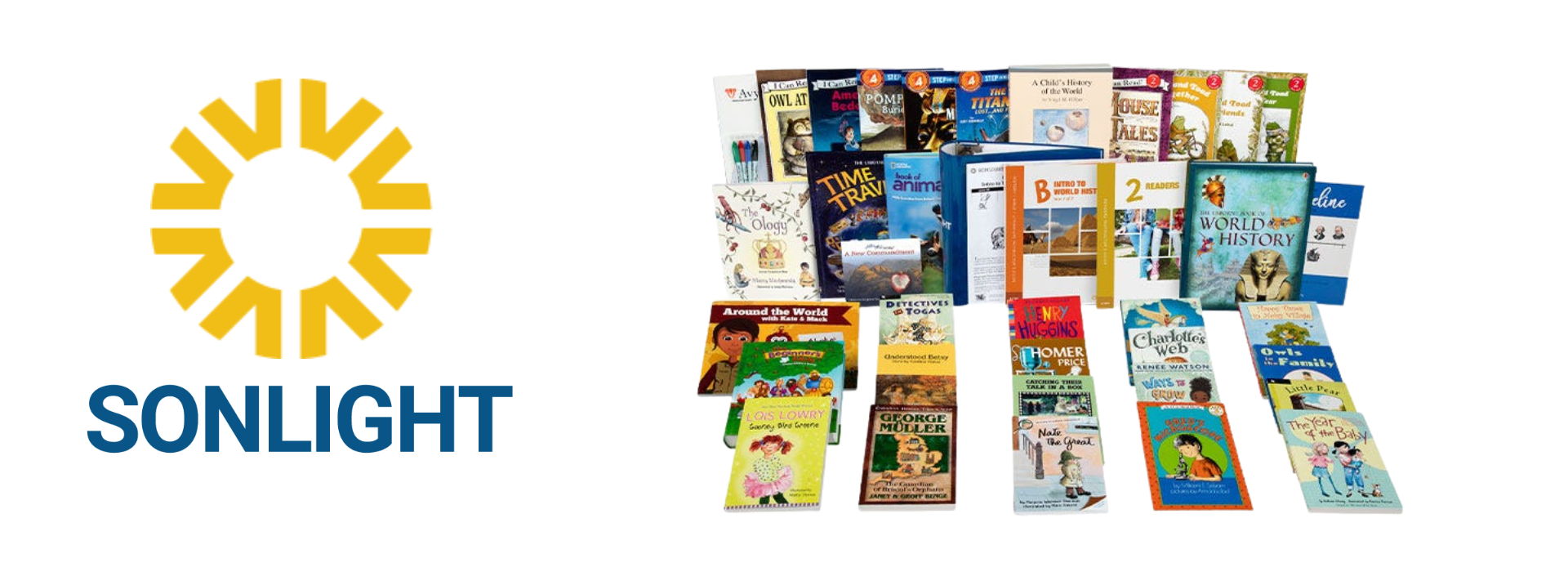
With Sonlight, a big chunk of what you’re paying for is books — real books. You keep them for your home library, reuse them with younger kids, or reread them just because.
One mom said it best:
“My kids have loved the books and continue to read them.”
Abeka’s workbook-heavy approach is a bit different.
You can reuse some of the textbooks, which helps. And you can reorder just the child kit instead of the full package for younger siblings. But most of the workbooks, quizzes, and tests are consumable.
And if you’re using the video lessons, those are paid per child, every year.
So yes — there is some reuse with Abeka. But it’s very much a “one child, one stack of books” situation.
In terms of long-term savings, Sonlight usually wins… unless your kids mysteriously stop reading after year one.
Extras & Accreditation: Bells, Whistles, and Structure
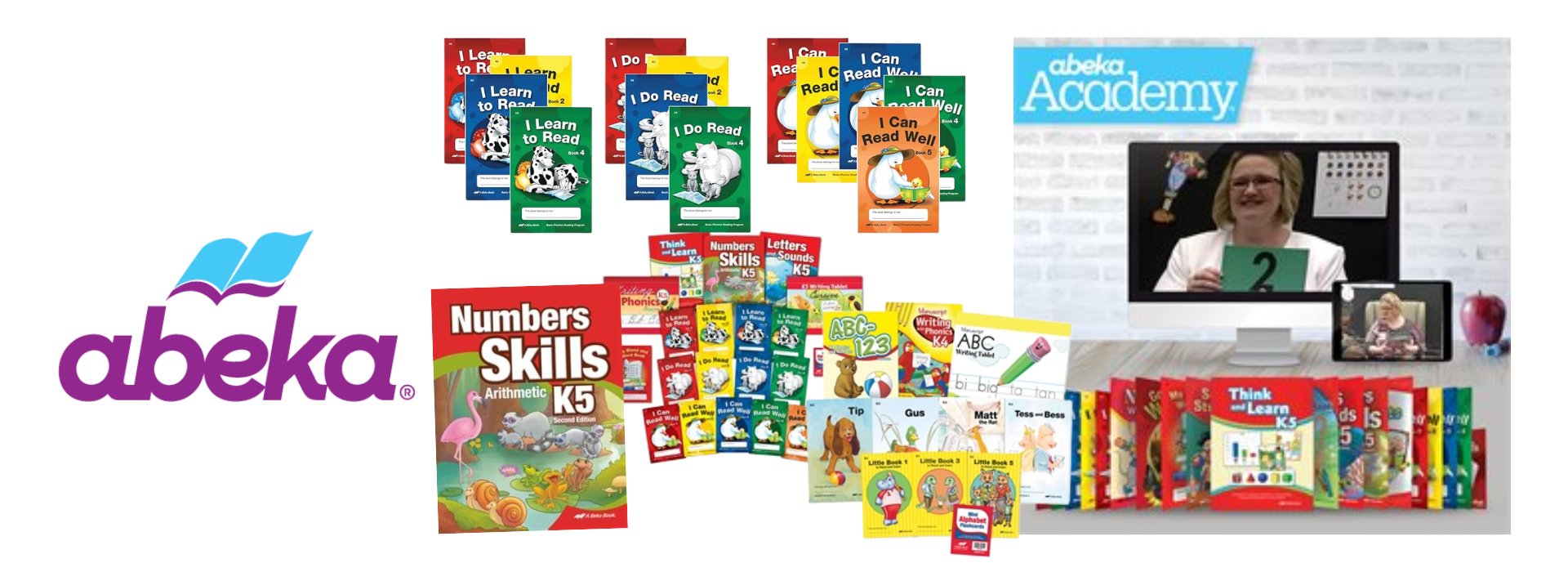
Abeka comes with all the bells and whistles.
Full video lessons.
Colorful textbooks.
And accreditation through Abeka Academy, which can be a big deal for families who want formal records, reporting, or an extra layer of accountability.
Some parents jokingly call it a substitute teacher who actually knows algebra — and really, that’s not far off.
Sonlight, by contrast, is completely offline.
No screens. No accreditation. Just you, your kids, and enough books to make your mailman question his career choices.
Again — this isn’t a flaw. It’s a design choice.
So… Which One Should You Choose?
Here’s the simplest way to think about it:
Sonlight = story-driven, literature-loving, discussion-heavy, offline learning.
Abeka = workbook-focused, structured, video-supported, Bible-everywhere schooling.
Both are solid. Both are Christian. Both have helped thousands of families homeschool successfully.
The real question isn’t which one is “better.”
It’s whether your family wants to feast on books… or workbooks.
One Last Thing Before You Go
Abeka gets compared to a lot of programs — but BJU Press is the one it gets compared to the most.
And honestly? I think it does a few key things better.
In my own homeschool, I actually use something very similar to Abeka — BJU Press — and I love it.
If you want to see why I chose it, and where Abeka still shines, check out my Abeka vs. BJU Press comparison article here.
You might be surprised by which one wins.