Charlotte Mason Homeschooling Explained for Rookies
Charlotte Mason homeschooling can sound wonderful until you actually try to figure out what you’re supposed to do every day.
You start reading about living books, narration, nature study and all the different ideas behind it—and suddenly you’re wondering whether this is going to simplify your homeschool or give you one more thing to worry about getting “right.”
And when you’re already trying to choose something that’s genuinely Christ-centred, academically solid and realistic with young kids, misunderstanding the method could mean spending months building a routine that never really suited your family in the first place.
So in this post, I’m going to show you what Charlotte Mason homeschooling actually looks like in real life, where it fits with a Christian homeschool, and the parts beginners often misunderstand.
By the end, you’ll know whether Charlotte Mason is something you genuinely want to try—or something you can confidently rule out and move on from.
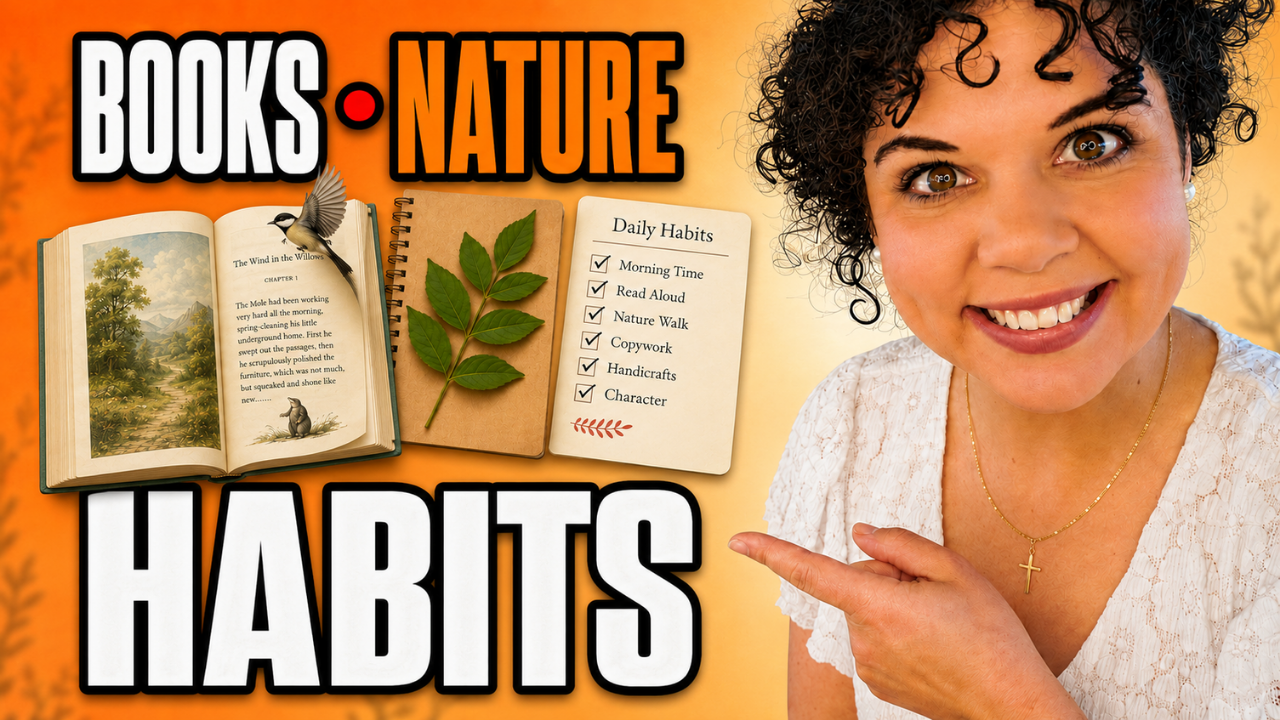
This post contains affiliate links. If you buy through them, I may earn a commission at no extra cost to you.
Why Charlotte Mason appeals to Christian homeschool families in the first place
Before we get into living books and narration and what you actually do all day, why are so many Christian homeschool families drawn to Charlotte Mason in the first place?
I think part of the answer is that it sounds remarkably similar to what a lot of us pictured when we first decided to homeschool.
You imagine spending more time with your children.
You imagine actually knowing what they’re learning instead of sending them off for most of the day and trying to squeeze family life into the hours that are left.
You picture being outside together more. Reading good books. Having time to talk about God, Scripture and the things your family actually values, rather than hoping everyone absorbs your worldview through proximity.
And then you discover Charlotte Mason and think, “Oh. This sounds rather familiar.”
Because so many of those things are already there.
There’s a huge emphasis on children encountering worthwhile ideas, spending time outdoors, developing good habits and receiving a broad education rather than simply completing an enormous stack of worksheets every day until everyone needs a biscuit and a lie down.
And over the years, I’ve taken quite a lot from Charlotte Mason’s philosophy and incorporated it into our homeschool because I think she has some wonderfully valuable things to say.
But there is an important distinction here.
A lot of the things that initially make Charlotte Mason sound appealing—more time with your children, good books, nature, teaching the things you value—aren’t actually unique to Charlotte Mason.
You can have all of those things in classical or eclectic homeschooling too.
Charlotte Mason goes much further than that.
She has specific ideas about how children should learn, what they should read, how long lessons should be, how they should show you what they’ve learned, how habits should be formed and even how they should interact with nature.
And that’s the part you actually need to decide whether you like.
Because you can absolutely say, “Yes, I want good books, time outside and a Christ-centred family life,” and then look at the actual Charlotte Mason method and think, “Nope. That is far too much narration for me.”
So don’t confuse loving the picture of a Charlotte Mason homeschool with loving the method of Charlotte Mason homeschooling.
Those are two very different things.
Basically, Charlotte Mason sounds suspiciously like the homeschool you imagined before you discovered homeschooling involves quite so much laundry.
What Charlotte Mason actually looks like in everyday family life
So if those priorities sound appealing, the next question is probably the practical one: what does a Charlotte Mason homeschool actually look like when you’ve got real children sitting around the table?
Because it’s very easy to read about Charlotte Mason homeschooling and picture lovely old books, children sketching birds and perhaps someone quietly practising the piano in the background.
Real children have other plans.
Short, varied lessons
At its simplest, the school day is made up of short, varied lessons—less “finish these four pages” and more “we’ll stop while you still remember what subject we’re doing.”
So rather than spending a massive block of time on one subject, you move through fairly quickly—Bible, maths, reading, narration, copywork or dictation, history, geography, poetry, music or art.
You might spend ten to twenty minutes on one thing, then put it away and move onto something completely different.
And that variety is deliberate.
You’re not trying to keep a child grinding away at one thing long after their attention has left the building.
Living books are a big part of this as well, which I’ll explain more below.
But rather than everything being delivered through textbooks and worksheets, children are exposed to good books and then very often asked to tell back what they’ve learned.
That’s called narration, and it can be incredibly simple.
Your child reads something—or you read it to them—and then they tell you, in their own words, what they remember and understood.
How narration helps Luke
That has actually been really useful with Luke in our homeschool because Luke has dysgraphia.
That means writing is difficult for him.
And if I insist that he has to write down everything he knows in every subject, eventually I’m not testing his history knowledge or his science knowledge anymore.
I’m testing how well he can cope with writing before we reach the stage where neither of us particularly cares what happened to the Roman Empire anymore.
Narration gives him another way to show me what he knows.
He can explain something to me verbally, and suddenly I can hear that there’s a lot more going on in his head than might have appeared on a piece of paper.
That doesn’t mean we never work on writing. Of course we do.
It just means writing doesn’t have to become a barrier between him and every other subject he’s learning.
And because those formal lessons are kept relatively short, you’re not necessarily sitting at the table doing bookwork until three o’clock either.
That leaves the afternoons open for some of the other things Charlotte Mason considered an important part of education—things like independent reading, handicrafts and, probably most famously, nature study.
Noticing God’s creation 🌿
Nature study is probably one of the Charlotte Mason influences I’ve appreciated most.
I deliberately try to get the kids to notice things.
Come and look at this worm. Look at what that spider is doing.
Watch the bee collecting from the flower. Can you see the bird in that tree?
These are tiny things, but they’ve made us slow down and actually pay attention to God’s creation rather than marching through it without noticing anything.
And I love that.
You don’t need a beautifully illustrated nature journal and six perfectly sharpened watercolour pencils every time somebody finds an interesting beetle.
Sometimes you just stop and look at the beetle.
That counts.
So in real life, Charlotte Mason is short lessons, good books, children telling you what they actually understood, and enough breathing room left in the day to go outside and inspect something with an unreasonable number of legs.
The distinctive ideas underneath that daily rhythm
But there’s more to Charlotte Mason than just keeping lessons short and finishing the bookwork before lunch.
You could copy that exact schedule and still not really be doing Charlotte Mason, because what makes the method different is how she believed children should actually learn.
For example, you could do fifteen minutes of maths, fifteen minutes of history and fifteen minutes of science…
…but if your child is just working through textbooks and filling in worksheets for each one, you’ve shortened the lessons without really changing the way they’re learning.
That is, you haven’t adopted the philosophy underneath them.
One of the big differences is what you’re actually putting in front of your child.
Charlotte Mason placed a lot of value on giving children rich ideas rather than making worksheets the centre of education.
What are living books? 📚
And that’s where living books come in.
A living book is generally written in an engaging, narrative way by somebody who actually knows and cares about the subject…
…rather than a textbook written with the apparent goal of making the entire Babylonian Empire feel like a tax return.
So instead of reading a page and then answering five questions designed to check whether they were awake, your child reads something interesting and then tells you what they understood from it.
Narration is more than a comprehension quiz
And that’s where narration becomes important.
Because to tell you what they’ve learned in their own words, they actually have to think about it.
They have to remember what happened, work out what was important, put it in some sort of order, and explain it back to you.
They can’t just hunt through the page for the sentence that contains the answer, copy it into the workbook and immediately return that information to wherever it came from.
And this is important because narration is not simply a Charlotte Mason-flavoured comprehension quiz.
You’re not constantly interrupting with, “What year did this happen? What was his name? What colour was the horse?”
You’re giving the child room to process and tell back what they understood.
Short lessons are about attention
Short lessons fit into that same philosophy.
“Short” doesn’t mean we’ve decided academics don’t matter and everyone can finish school at 9:07 in the morning.
The point is attention.
If a young child can give you ten or fifteen minutes of genuinely focused attention, there can be far more value in that than dragging the same lesson out for forty-five minutes while their mind left the room half an hour ago.
Good habits and a broad education
And then there’s habit.
This is another part that’s easy to miss, because Charlotte Mason can look very peaceful from the outside—but that peaceful homeschool doesn’t just happen by itself.
Children still need habits.
We need habits.
Things like attention, obedience, consistency and actually doing what needs to be done are deliberately developed over time.
Which, unfortunately, means buying a Charlotte Mason curriculum will not cause your children to begin speaking in hushed tones, putting things away voluntarily and wandering outside to sketch robins.
And then the definition of education itself is broad.
Nature matters. Art matters. Music, poetry, practical skills matter.
These things aren’t treated as pointless extras you can add if maths finishes early.
And underneath all of that is a particular view of the child: the child is a person.
They’re not an empty container that you need to stuff with enough information to produce an educated adult.
And they also don’t need you to constantly lecture, perform or entertain them into learning.
You put worthwhile things in front of them, teach them to attend and give them room to engage with those ideas.
So, the Charlotte Mason method puts rich ideas before piles of worksheets, uses living books, gets children to narrate what they’ve actually understood, and keeps lessons short enough to preserve attention.
It deliberately builds good habits and treats nature, art, music, poetry and practical skills as real parts of a child’s education.
Basically, your child is a whole person to educate—not a small filing cabinet you have twelve years to fill with facts.
The tradeoff that may decide whether Charlotte Mason suits your personality
Now, a lot of that sounds lovely on paper—and I genuinely love much of it—but this is where you need to consider not just your children, but yourself.
What happens if you like Charlotte Mason’s philosophy more than you like the pace of actually living it?
This is probably one of the biggest issues for me personally. I’m impatient.
Quite impatient, actually.
It’s one of my weaknesses that I pray about rather a lot. And Charlotte Mason can have a deliberately slower quality to it that I think is wonderful in principle and sometimes slightly irritating to the part of me that would like everyone to hurry up and just get schoolwork done.
Another parent could experience exactly the same pace and find it incredibly peaceful.
She might love not feeling as though every school day has to produce a mountain of completed pages.
But if you’re someone who likes visible forward movement, you need to know this about yourself.
Because with Charlotte Mason, progress isn’t always easy to measure. There isn’t always a lovely little benchmark reassuring you that yes, your children are learning and no, you haven’t accidentally ruined their education.
You may see it in the quality of your child’s narrations. You may notice that their attention has improved.
You may hear connections appearing in conversations. You may see their knowledge broadening through books and nature and art and history.
Those things are real.
They’re just not always as easily measurable as finishing page 117 and knowing that tomorrow you begin page 118.
And I think, ideally, perhaps some of us—including me—could stand to become a little more comfortable with that.
But we also need to be realistic.
If you know that you’re going to spend your entire year wondering whether your children are behind because another homeschool mum’s child has finished a particular maths book already, a less measurable approach may be difficult for you.
And comparison is already quite capable of causing trouble without us handing it additional stationery.
So this isn’t me saying one approach is academically superior…it’s me saying you need to consider what gives you enough confidence to actually continue homeschooling peacefully.
Because the best educational philosophy on paper isn’t much use if living it makes you permanently anxious.
I love a lot about Charlotte Mason, but the pace can feel slow if you’re naturally impatient, and because academic progress isn’t always as measurable, it may be harder for parents who want obvious benchmarks or an easy way to compare progress with other homeschool families.
Why “Charlotte Mason curriculum” can mean very different things depending on what you choose
And this becomes especially important when you start shopping for curriculum, because seeing “Charlotte Mason” on two different options doesn’t mean they’re going to create the same workload in your home.
So what are you actually signing yourself up for? This is where I think beginners can get caught out.
You see two curricula described as Charlotte Mason—or perhaps Charlotte Mason-inspired—and assume the practical experience of using them will be roughly similar.
Then one arrives pretty much ready for Monday morning, while the other seems to have quietly assigned Mum a part-time job in library acquisitions.
There’s a huge spectrum.
Some curricula give you a lot of the books you need. Some give you schedules that tell you what to read and when.
Some are designed around family-style learning, so several of your children can study certain subjects together.
Others give you book lists and plans, but you’ll be sourcing quite a lot yourself.
How independent can children really be?
And then there’s the question of independence.
If your dream curriculum is something you can hand to your child in the morning while you teach a younger sibling, deal with the toddler and discover why the washing machine is making that noise…
…you need to look very carefully at parent involvement!
Because the closer you stay to Charlotte Mason’s actual method, the harder it becomes to make the whole thing completely independent.
Somebody needs to select or source the books.
Somebody may need to read them aloud. Somebody needs to listen to narrations and encourage the good habits.
And nature study does rather require somebody to get everyone into nature at some point. The curriculum cannot take the children for a walk on your behalf.
(Unless you have acreage, in which case you can probably just open the back door and release them.)
But the point is, Mum is going to be involved. Quite a lot, actually. But that isn’t necessarily a bad thing.
For some families, that involvement is precisely what they want.
You may have chosen homeschooling partly because you want that relationship-rich education with your children. Wonderful.
But if you have a baby, three school-aged children and approximately fourteen minutes of available brainpower by lunchtime, we need to be realistic about what you can sustain.
This is why I’d look at workload alongside philosophy when you compare the actual curricula.
Some Charlotte Mason curricula give you more books, schedules or family-style learning while others expect you to source more yourself, and the more closely a curriculum follows the method, the less likely it is to be completely independent or truly open-and-go because Mum still needs to choose or read books, listen to narrations, establish habits and make things like nature study happen.
Where Master Books fits compared with the more Charlotte Mason-style options
So where do the actual curriculum options fall on that spectrum—and particularly Master Books, since that’s probably the name you’re most likely to have come across?
Let’s start with Master Books because this curriculum is extremely popular, particularly among Christian homeschool families looking for something relatively gentle and manageable.
(And this is also where I may get myself into trouble in the comments.)
Master Books tends to sit on the gentler side academically.
Now, some Master Books mums will completely disagree with the suggestion that this is a problem.
They’ll say, “My children are learning. They’re doing well. They enjoy school. It gives them a good education without burying them in unnecessary work.”
Fair enough.
Then you have more rigorous homeschool mums who look at the same curriculum and say, “No. This is not enough for what I want academically.”
Also fair enough.
If you desperately need to get your position on Master Books off your chest, you can put it in the comments. (It’ll make the comments section interesting…)
But I think both sides are useful because they reveal the actual decision.
The question isn’t whether Master Books has passed some universal homeschool-mum tribunal and officially qualifies as “enough.”
It’s enough for what? For which child?
And compared with what academic standard?
If you want a gentler workload, a Christian worldview and something that tends to be easier to implement, Master Books may be very appealing.
But I would describe it as more Charlotte Mason-inspired than a strict implementation of Charlotte Mason.
And I think part of the reason it can feel easier for Mum is precisely because it’s willing to move towards more traditional curriculum methods in places while incorporating Charlotte Mason elements.
Other curriculum options and Mum’s workload
Then, if you’re looking at more distinctly Charlotte Mason-style curricula, you’ve got options like Heart of Dakota, Simply Charlotte Mason, and Ambleside Online.
In my assessment, these sit more in the middle academically.
But the trade-off is that generally you’re going to be doing more.
Heart of Dakota, for example, can give you a rich, family-centred homeschool, but it can also become quite parent-intensive compared to Master Books.
Simply Charlotte Mason gives you a lot of guidance for implementing the philosophy, but again, Mum is quite involved.
Ambleside Online gives you everything for free, but you’re sourcing the books yourself and making it all happen at home. The curriculum is free.
Your time has apparently been donated.
And across these options, the exact workload varies depending on what you choose and how you implement it.
But broadly, the more faithfully you’re trying to reproduce a Charlotte Mason education, the less realistic it is to expect your child to disappear with a workbook or computer for four hours while you do something else.
That isn’t really what the method is designed around.
And this is why I don’t think you should choose purely by asking, “Which one is the most Charlotte Mason?”
Ask what you actually want your day to look like.
How many children are you teaching? How independently do they work?
How much reading can you realistically do? How much planning do you enjoy?
And how much Mum is actually available? Do you work from home and need a curriculum that doesn’t require you to simultaneously hold down a job and provide a personalised Victorian education for four children?
Because a curriculum can be beautiful, rich and academically excellent and still be completely wrong for your current season.
So, Master Books is probably the most popular and tends to be gentler academically.
Heart of Dakota, Tapestry of Grace, Simply Charlotte Mason, A Gentle Feast and Ambleside Online sit more in the middle academically, but generally require more from Mum.
Basically, the closer you get to Charlotte Mason, the less likely Mum is to be sitting somewhere peacefully drinking coffee while the curriculum educates the children.
What to do if Charlotte Mason sounds good but also completely overwhelming
At this point, you might be thinking, “I like a lot of this—but I absolutely do not have the capacity to learn an entire educational philosophy before Monday morning.”
So does choosing something simpler now mean giving up on Charlotte Mason altogether?
No.
And actually, if you’re brand-new to homeschooling, I think trying to understand every part of Charlotte Mason while simultaneously learning how to homeschool your actual children can be an awful lot.
Because you’re not just figuring out which curriculum to use. You’re also figuring out how your children learn.
You’re working out how long maths actually takes, which child needs you beside them, what happens when the preschooler decides school time is the ideal moment to require seventeen snacks…
…and whether the beautiful routine you made on Sunday bears any resemblance whatsoever to Wednesday.
Adding an entire educational philosophy on top of that can become overwhelming very quickly.
So there is nothing wrong with starting with something more traditional.
We use BJU Press and love it. But it’s not for everyone.
Generations is another more traditional Christian option we really like.
You can begin with something that gives you more structure and then spend time properly learning about Charlotte Mason without feeling that you have to implement every interesting idea you encounter by breakfast tomorrow.
And then add things gradually. Maybe you start using narration.
Maybe you shorten a lesson when you realise your child’s attention is gone and continuing is accomplishing nothing.
Maybe you add nature study. Maybe you start replacing certain books with richer ones.
You can actually observe your children and ask, “Is this helping?” That’s a much more useful question than, “Am I doing Charlotte Mason correctly?”
Start with Charlotte Mason’s Home Education 🎧
And if you do want to understand the philosophy itself, Charlotte Mason’s Home Education book is a very good place to start.
I’ve actually recorded a free audiobook version here you can listen to.
That book had a profound effect on the way I think about homeschooling.
Highly recommended. But you’re allowed to take time with it.
You don’t need to finish several volumes in her series, buy an entirely new curriculum and develop strong opinions about nature journals before you’re officially allowed to homeschool.
Start where you are.
Learn. Watch your children. Then make changes because they serve your family—not because you feel pressured to fit a homeschool label.
So, if you’re new to homeschooling and Charlotte Mason feels like an awful lot to learn, you can start with a more traditional curriculum that is easier to implement, spend some time properly researching the method, and gradually add the parts that work instead of feeling like you have to rebuild your whole homeschool on day one.
You don’t have to become a Charlotte Mason homeschooler to benefit from Charlotte Mason
And that brings us to the decision I eventually made myself, because there’s one option that’s easy to miss when you’re trying to decide whether you’re “a Charlotte Mason homeschooler” or not.
What if you don’t actually have to pick a side? Because I don’t identify as a Charlotte Mason homeschooler.
If you read my posts for any length of time, that will become fairly obvious.
We use a more traditional curriculum like BJU Press, and I’m perfectly happy doing that when it works well for our family.
But that doesn’t mean I need to throw out everything Charlotte Mason said because I’m not implementing her philosophy in its entirety.
I use narration. I like short lessons. I value nature study.
I want my children to notice the world God created rather than experiencing education as something that only happens when a workbook is open.
And I’ve kept those things because they’ve genuinely served our family.
But I don’t feel any obligation to adopt the whole method just because I like parts of it. Some things suit our family. Some don’t. So I keep the good bits and carry on with my life.
That’s fine too.
I think sometimes homeschool curriculum research accidentally turns into an identity crisis.
You start out trying to work out how to teach history and twenty minutes later you’re wondering whether you’re a Charlotte Mason mother, a classical mother, an eclectic mother or apparently required to declare allegiance before anybody will sell you a spelling book.
You don’t have to do that.
Learn what the method actually says. Understand why Charlotte Mason recommended these things.
Try the ideas that seem useful.
Then watch your children. If narration helps one of them communicate what they know, wonderful.
If short lessons improve attention, keep them.
If nature study causes your family to slow down and appreciate God’s creation, I think that’s a beautiful thing.
And if another part of the philosophy makes your homeschool unnecessarily difficult or simply doesn’t suit your children, you’re allowed to leave it.
The goal isn’t to produce a homeschool that fits perfectly underneath somebody else’s label.
For me, the much more important question is whether what we’re doing is glorifying God and serving the children God has given us.
Ask yourself, “Will this method help us provide a strong, Christ-centred education without making our home miserable in the process?”
And once you understand Charlotte Mason well enough to answer that question, you’ve got what you came for.
So no, I’m not a Charlotte Mason homeschooler. I’ve simply taken what genuinely makes our homeschool better and left the rest—which, conveniently, means there’s no Charlotte Mason membership card for anyone to revoke.
Which homeschool method fits your family?
But now that you know what Charlotte Mason actually involves, the bigger question is which homeschool method actually fits your family best.
Because Charlotte Mason is only one of six major approaches—and another method may give you the structure, independence or academic rigour your family needs without the parts that would make homeschooling harder.
In my post comparing six homeschool methods, I help you narrow them down to the two that are actually worth exploring for your family.