If you've ever finished a homeschool morning wondering whether you've actually done enough, you're not alone.
I've been involved in homeschooling for more than 30 years. I was homeschooled myself, and now I'm homeschooling my own three children.
And even with all that experience, our mornings still involve children needing completely different things, me trying to work from home, a toddler getting into absolutely everything, and apparently very urgent requests for an apple twenty minutes after breakfast.
So what does our Christian homeschool routine actually look like?
We homeschool four days a week, with approximately one hour of formal academics for my kindergartner and three hours for my third grader. We start with Bible time, use video lessons for much of our core curriculum, take plenty of breaks, and fit reading, science, history, games, and other learning around ordinary family life.
And no, we don't follow our homeschool schedule perfectly.
The goal isn't to create one of those lovely mornings where every child happily completes their work while Mum drinks an uninterrupted cup of tea.
It's to find a rhythm that gives our children a good education, makes room for prayer and Bible reading, and doesn't leave everyone completely exhausted.
Here's what we're doing, which curricula we're using, how I manage different ages, and what I've learned about making homeschooling work in real life.
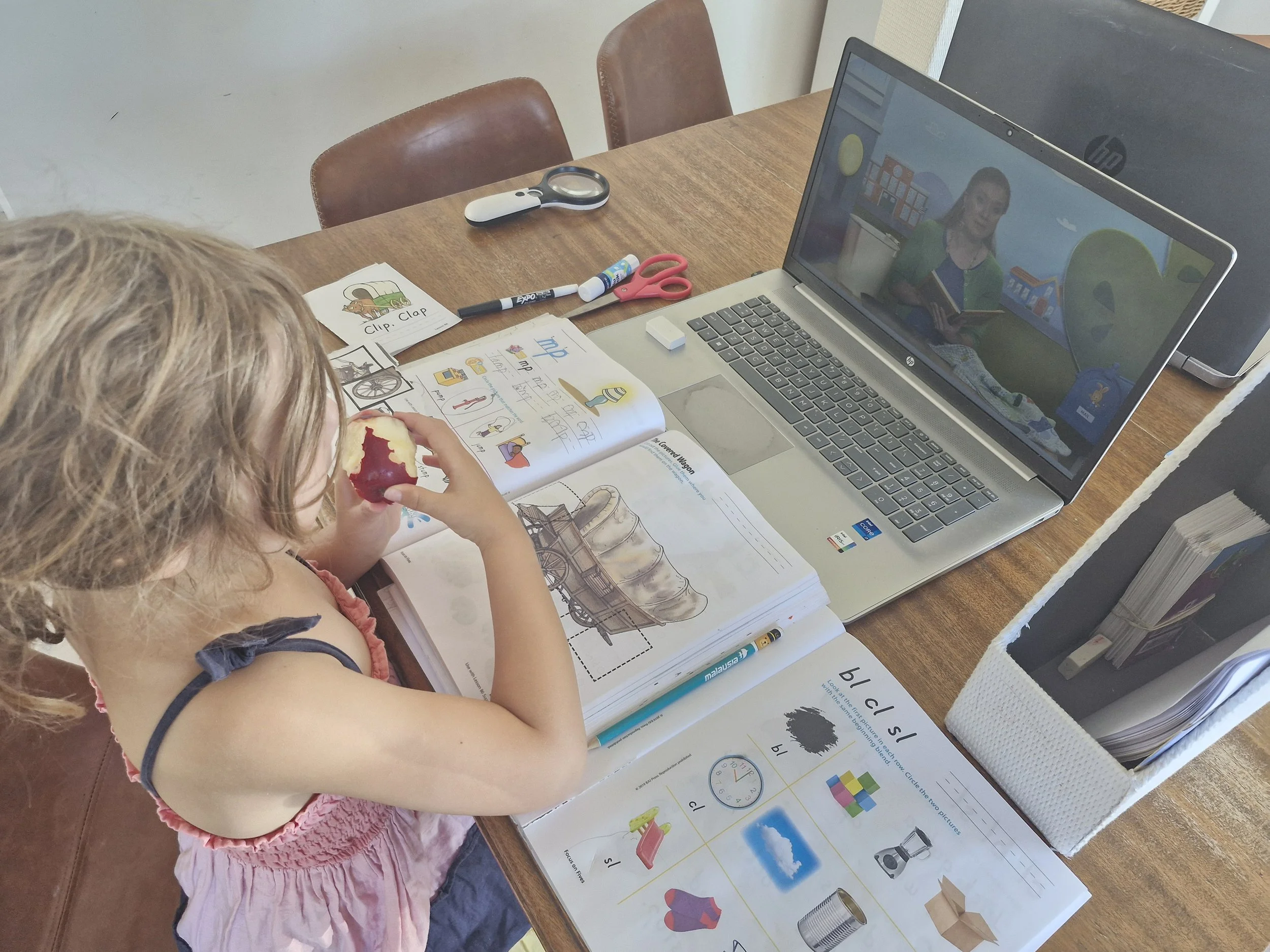
Some links in this post are affiliate links. If you buy through them, it helps support our homeschool at no extra cost to you. Thanks so much! ❤️
Our Homeschool Routine at a Glance
I have three children:
a nine-year-old third grader,
a six-year-old kindergartner, and
a toddler.
They're at very different stages, which means our homeschool has to accommodate children who can work independently, children who still need lots of hands-on teaching, and one small person who thinks her brother's Lego is a wonderful opportunity for creative destruction.
Here's roughly how we organise our day:
Morning routine: Breakfast, getting dressed, brushing teeth, and getting ready.
Family Bible time: Prayer, Scripture reading, discussion, and memory verses.
Core academics: Math, reading, writing, and BJU Press video lessons.
Morning break: Outdoor play, usually on the trampoline.
More learning: Science, history, Latin, or other enrichment activities.
Afternoon: Audiobooks, reading, quiet time, and Mum's work.
Later in the day: Family activities, games, chores, and ordinary life.
This isn't a timetable with every minute accounted for. Some activities happen on different days, and we're currently adjusting when we do our most focused lessons to fit around the toddler's nap.
And that's really the important part.
I prefer calling it a homeschool routine rather than a homeschool schedule, because a routine gives you some structure without making you feel you've failed if math takes longer than expected.
Why I Put Our Homeschool Routine on the Wall
One of the simplest changes we've made is creating an attractive homeschool routine in Canva, printing it, and sticking it to the wall with Blu Tack.
Nothing terribly sophisticated.
But it makes a surprising difference.
The children can see what they're meant to be doing and what comes next.
Instead of me constantly asking whether they've brushed their teeth, gotten dressed, or completed their morning jobs, I can simply say, "Have you done your list?"
Most of the time, they know exactly what I mean.
It helps me too, because I don't have to keep the entire day's plan in my head while thinking about my work, the washing, what we're having for dinner, and whether the toddler is currently somewhere she shouldn't be.
We also have a separate audiobook list so the children can take turns choosing what we'll listen to.
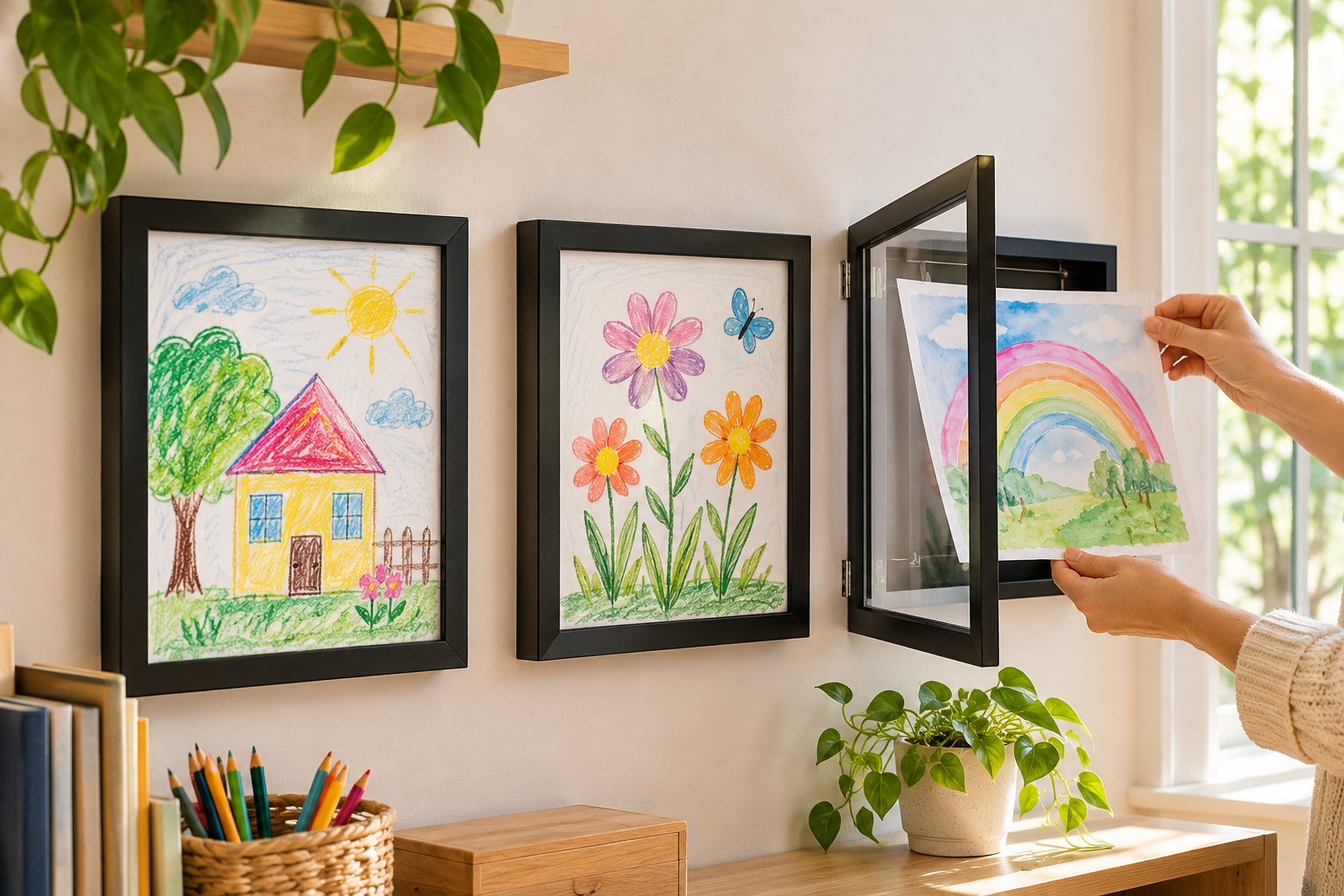
And one little feature I love in our homeschool area is our set of changeable picture frames.
The children can display their latest artwork, swap it when they've created something new, and proudly show Daddy or visitors what they've been making.
It means their work is on display without having 400 pieces of paper Blu Tacked to every available wall.
If you're starting from scratch, I've also written a guide to creating a simple homeschool schedule, with an example you can adapt to your own family.
But please don't let your routine rule you.
If somebody has a terrible day, you have an unexpected appointment, or a lesson takes longer than expected, change it.
We'll do things another day.
The world keeps turning.
How Long Do We Homeschool Each Day?
This is probably one of the questions I get asked most often.
And I think homeschool parents sometimes make life much harder for themselves because they imagine they need to reproduce a six-hour school day at home.
You really don't need six hours of desk work for a young child.
Here's what formal homeschooling looks like in our family at the moment.
ChildGradeFormal academicsOlder childGrade 3Around 3 hoursMiddle childKindergartenAround 1 hourYoungestToddlerNo formal curriculum
We also homeschool four days a week rather than five.
Now, these times don't include everything our children learn throughout the day.
When we're baking, they're measuring ingredients and following instructions. When they're listening to beautiful literature, they're learning vocabulary and language. When we're playing a money game, they're learning financial concepts.
And when one of the children asks a question that turns into an enormous discussion about history, science, or something in the Bible, that's learning too.
I don't think it's helpful to measure the quality of a homeschool education entirely by how many hours a child sits at a desk.
The other reason our hours are manageable is that I've become much more comfortable skipping curriculum work that my children have already mastered.
I'll explain that in a moment, because it's one of the biggest things that's changed our homeschool.
We Start Our Christian Homeschool Morning With Bible Time
Bible time is probably my favourite part of our homeschool morning.
We usually sit around the table, pray together, memorise a few Bible verses (we use this great little book for it), and then read a chapter from Scripture.
Sometimes we'll read two chapters if the toddler is being particularly cooperative.
We don't spend an enormous amount of time on memorisation.
Just a few minutes, often before or after our reading.
But one thing I've loved is that I'm memorising Scripture alongside the children.
When they were younger, we used this children's Bible more often.
I think a good children's Bible is particularly helpful for children under six who might struggle with the language and concepts in a regular Bible.
Now that my older children are six and nine, we're increasingly reading directly from Scripture. In fact, at the moment, I’m reading from the Archeology Bible, and explaining the side notes to my kids.
How I Keep the Children Interested During Bible Reading
I stop frequently to explain words, ask questions, and check that the children understand what we're reading.
For example, we were recently reading Joel and discussing questions like:
What's a locust?
What is sackcloth?
What does it mean to rend your heart?
Sometimes I ask the children to explain something in their own words.
If they can't, I'll explain it, and we talk about it together.
And sometimes their simple explanations actually make me stop and think about the passage differently myself.
That's one of the lovely things about homeschooling.
I'm not simply teaching them.
I'm learning alongside them.
My son regularly tells me that Bible time is his favorite part of the day, which I find particularly encouraging.
Because if you've been homeschooling for any length of time, you'll know there are days when you wonder whether anyone appreciates anything you're doing.
And then one of your children says something like that, and you think, 'Okay. This is worth it.’
I also love that our faith isn't confined to a single subject. We talk about Scripture and our Christian worldview as we study science, history, literature, and everyday life.
For our family, that's one of the greatest blessings of homeschooling.

Our Main Homeschool Curriculum: BJU Press
For most of our core subjects, we use BJU Press Homeschool (pictured above is thier preschool curriculum).
We've used it for years, and it's the backbone of our homeschool.
We use the online video lessons with physical workbooks, which is a combination I really like.
BJU Press is a traditional, academically strong Christian curriculum. It offers structured lessons, substantial content, and teachers who explain the material through prerecorded videos.
The Homeschool Hub also provides planning, scheduling, and progress-tracking tools, although exactly which features you use depends on your course and grade.
For me, the biggest benefit is that I'm not personally responsible for explaining every lesson.
I work from home, I have three children, and there are days when I simply don't have the energy to teach every subject from a teacher's manual.
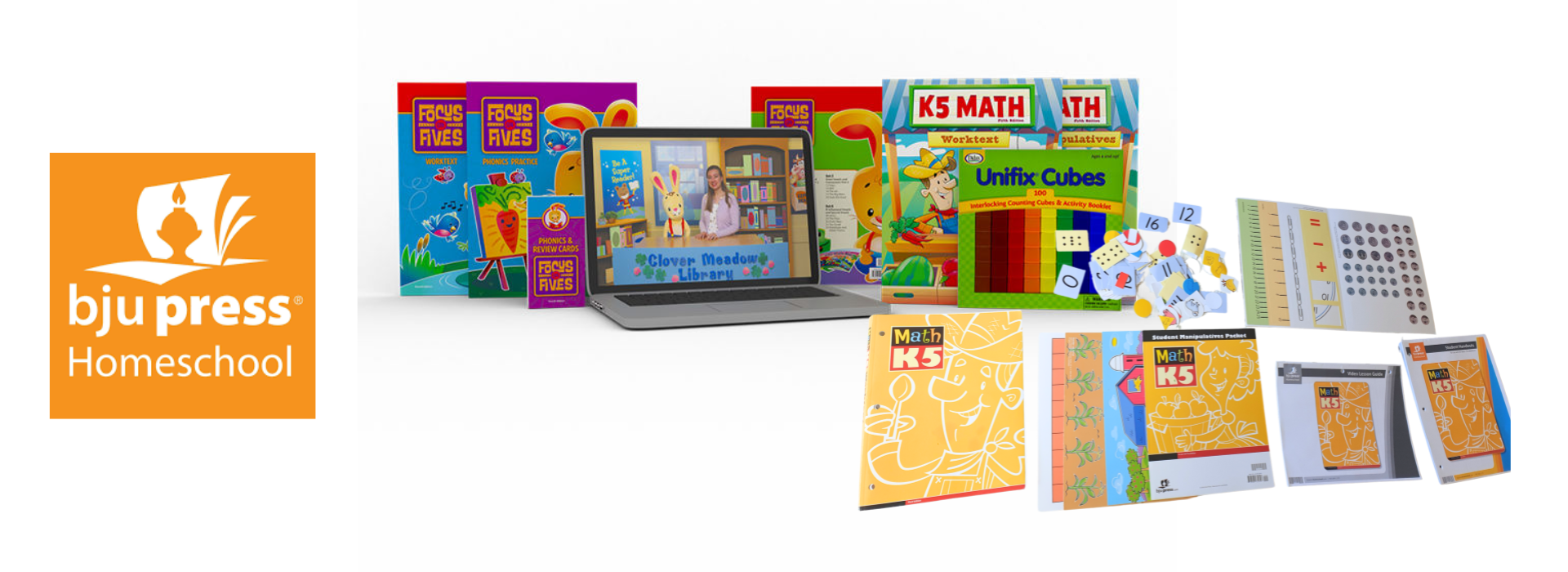
Having a good video teacher makes a tremendous difference. (Above is their kindergarten curriculum with video teacher and manipulatives).
My third grader can complete a great deal of his work independently, which allows me to help my younger daughter, attend to the toddler, or get some of my own work done.
My kindergartner still needs considerably more attention from me, particularly with reading and writing.
And that's normal. I wouldn't expect a six-year-old to have the same independence as a nine-year-old.
We Skip 30–50% of Our BJU Press Work
Here's something that's made our homeschool much easier.
We don't complete every single activity BJU Press provides.
In fact, I'd estimate that we cut approximately 30–50% of the work, depending on the subject and what the children already understand.
If my son has demonstrated that he understands a math concept, I don't necessarily make him complete another twenty similar problems.
Sometimes we skip review sections. Sometimes we complete only part of a workbook page. With science and history, we might simply read the textbook and discuss it.
But if somebody is struggling, that's when we slow down and do more practice.
I think one of the easiest ways to burn yourself and your children out with a traditional curriculum is to assume that every video, worksheet, review, project, and optional activity must be completed.
Publishers often provide more material than an individual child needs.
That can be a very good thing, because different children need different amounts of review. But it doesn't mean every child needs to do all of it.
Of course, I wouldn't recommend skipping foundational instruction, especially in subjects like math and phonics, simply to finish faster. The child needs to demonstrate understanding first.
BJU Press isn't the cheapest curriculum either. A full-grade video package generally falls into my 💲💲 mid-priced category, although the cost depends on the grade and what materials you purchase.
For our family, having video teachers and solid academics makes it worth the investment.
If you're a busy or working Christian homeschool parent who wants a structured curriculum without teaching every single lesson yourself, BJU Press is worth considering.
Another Christian Curriculum I Like: Generations Homeschool
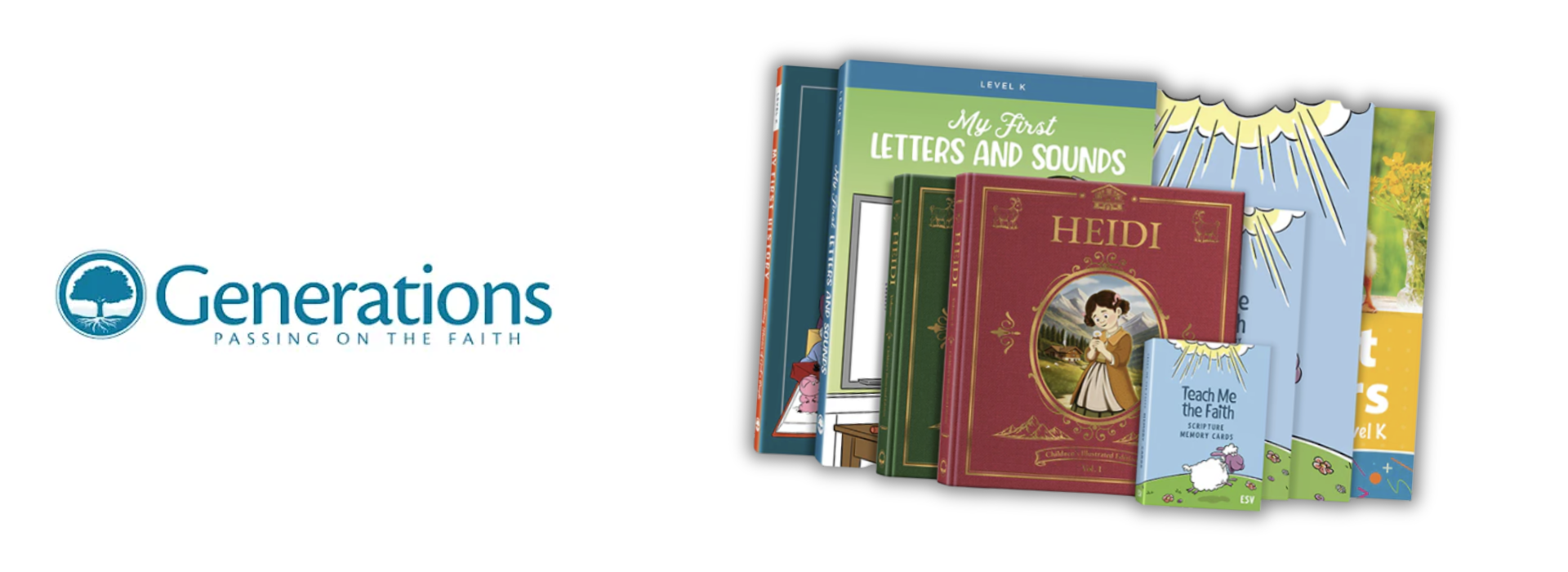
If you don't want video lessons and would rather use physical books, Generations Homeschool is another option I really like (its pictured above).
It's a Bible-rich, book-based curriculum with a traditional approach to education.
It's also considerably more affordable than many full-grade video programs, particularly in the elementary years. Its elementary packages generally fall into my 💲 affordable category.
The trade-off is that you won't have the same video-teacher arrangement we use with BJU Press. You'll need to think about the teaching and supervision required for your children's particular ages and subjects.
But if you want a Christian curriculum that keeps children in books rather than on screens, I'd put Generations on your shortlist.
What We Use for Kindergarten Math and Reading
Math and reading are two of our biggest academic priorities, particularly in kindergarten.
Both my kindergartner and third grader are using BJU Press math.
I like how colourful it is, how it introduces concepts, and how it uses manipulatives to help children understand what they're learning.
But probably my favourite feature is the video teacher.
Math is one of those subjects that can be surprisingly difficult to teach, particularly when you're explaining a new concept to a child who sees the problem in a completely different way from you.
With BJU Press Math, the teacher explains the lesson, and I can concentrate on helping where necessary.
If the children are flying through something, we'll reduce the repetitive review. If they're finding it difficult, we'll work through more of the lesson together.
Teaching a Kindergartner to Read Requires Patience
Math is challenging enough sometimes, but I think teaching a child to read in kindergarten probably beats it.
I'll be sitting beside my daughter Penny, with my finger directly underneath the word (we’re loving the Dr. Seuss series) I want her to read.
And she'll be looking somewhere off into the distance.
So I'll say, with an enormous amount of self-control: "Sweetheart, you can't read the word by looking up there. You've actually got to look at the word."
And then we'll try again.
Teaching reading really can be an exercise in patience.
At this stage, I'm much more concerned about helping her develop strong phonics, reading, writing, and math skills than trying to cram every possible subject into her morning.
There are lots of other lovely things we can do together, but I don't want my six-year-old spending five hours a day on formal schoolwork.
I'd much rather she develop strong foundational skills and still enjoy learning.
Phonics Museum: Another Christian Reading Option
Another reading program I like is Phonics Museum from Veritas Press.
It's a classical Christian phonics program designed for kindergarten and first grade, with systematic phonics instruction, readers, art, music, and handwriting.
There's also a digital app option with interactive lessons and games.
I particularly appreciate that it approaches learning to read within a Christian classical framework.
Personally, Reading Eggs hasn't been the best worldview fit for our family, which is one reason Phonics Museum appeals to me as an alternative.
But bear in mind that a digital phonics program doesn't eliminate the need for a parent to listen to a child read, notice where they're struggling, and help them practise.
Especially in the early years, that personal attention is important.
Handwriting, Latin, and Money Management
We also include a few subjects that aren't necessarily part of the main BJU Press lessons.
And I love having the freedom to add these according to what our children need and what interests them.
Handwriting Without Tears for My Dyslexic Son
My son is dyslexic and has some dysgraphia-type difficulties, which means reading and handwriting can be particularly challenging for him.
We've been using Handwriting Without Tears to help him practise.
He doesn't exactly leap out of bed in the morning begging me to get the handwriting book.
But it gives him something structured and manageable to work through without making handwriting completely overwhelming.
And sometimes that's all you need from a curriculum.
It doesn't have to be the most exciting thing your child has ever encountered. It has to teach the skill without making everyone miserable.
I also give him more breaks when he's doing handwriting and sometimes let him answer questions orally instead of writing everything.

Latin Games With Classical Academic Press
We've also been doing some Latin matching games after Bible time using materials from Classical Academic Press.
I think it's rather sad that Latin isn't taught as commonly as it once was.
There are so many connections between Latin and English vocabulary, and even a little familiarity with the language can help children start noticing patterns in words.
We're not doing an enormous amount.
It's simply a small extra activity that we enjoy adding to our homeschool.
And that's the beauty of homeschooling. Not every interesting subject needs to become a forty-minute lesson with an accompanying workbook and test.
Teaching Money Management Through Books and Games
Another thing we've been teaching deliberately is money management.
We've been reading Dave Ramsey's Junior's Adventures Storytime Collection, and I've really enjoyed it.
It's a collection of six illustrated stories that teach children about things like working, saving, giving, integrity, spending, and avoiding debt.
What I particularly like is that the children aren't sitting through an enormous lecture about finances.
They're enjoying stories while encountering financial decisions they can actually understand.
We've also been playing CASHFLOW for Kids, a board game that teaches financial concepts through play.
This one is genuinely fun.
It gets children thinking about assets, liabilities, expenses, and making decisions with money. And I found myself learning things while we played it too.
It's not the cheapest board game, and it does take time to play, so it's more of an occasional family activity than a quick daily lesson.
But I think it's definitely a worthwhile resource if you want your children to develop some financial understanding while they're young.
And if the children lose interest, you can always play it with your husband.
You might both learn something. We did.

Our Christian Homeschool Science Curriculum
For science, we use some BJU Press materials, but we've also really been enjoying Journey Homeschool Academy.
Journey offers Christian science courses for elementary, middle, and high school students.
The program uses engaging online video lessons alongside activities and accompanying resources. Depending on the course, there are also workbook materials and digital resources.
Both my son and daughter have enjoyed the lessons.
We've sometimes used courses intended for older students with my son, and my kindergartner has watched them alongside him.
Now, I'm certainly not expecting my six-year-old to understand or retain everything from a middle-school science course.
But she enjoys it, notices things, asks questions, and picks up information along the way.
That's enough for me.
I also like that we can use the lessons without having to design an entire science program ourselves.
If you're ordering from outside the United States, it's worth checking the available PDF and printing options for the course you're considering, because international shipping for physical materials can add up rather quickly.
Journey Homeschool Academy is a particularly good option for Christian families who want engaging video-based science without Mum having to deliver every explanation herself.
History, Geography, and Social Studies in Our Homeschool

History is another subject I really enjoy teaching.
We sometimes use BJU Press history materials, but I also like Notgrass History and Mystery of History.
Both can provide substantial Christian history study, and both offer more than simply reading a textbook.
But you don't have to complete all the extras.
Why I Often Prefer Reading the History Books
With history, we frequently just read.
We read the books, talk about what happened, and discuss anything the children find interesting.
Some programs offer crafts, timelines, notebooking, and additional workbook activities, which can be wonderful for families who enjoy that sort of homeschooling.
But I simply don't have time for all of it.
And I don't think every history lesson needs to end with a glue gun.
If we want to add a project occasionally, that's lovely. But I don't want to make history unnecessarily complicated.
If you have younger or particularly sensitive children, I'd generally lean towards Notgrass before Mystery of History.
Mystery of History can occasionally cover some fairly gruesome historical events. That's not necessarily a fault of the curriculum—history itself can be gruesome—but it does mean you'll want to consider your child's age and sensitivity.
Both are worth investigating, particularly if your family enjoys learning through stories and discussion.
Independent Review With Classical Quest
My son has also been using a newer online Christian program called Classical Quest.
This isn't a complete homeschool curriculum. It's more of a practice and enrichment program that can supplement what you're already doing.
It covers areas such as Latin, English, math, science, history, geography, fine arts, and Bible knowledge.
There are games and short practice sessions, and the program is designed to revisit knowledge through regular review.
I particularly like the independent-learning aspect.
My son can complete some review without needing me to stand beside him directing every question.
That's useful when you've got several children who need your attention, especially when one of them is a toddler.
Books and Audiobooks Are a Huge Part of Our Homeschool
One thing I really want my children to develop is a love of good books.
We have a lot of books in our home. Probably more than we could realistically get through.
Many have been given to us or bought second-hand.
Our local charity runs a large book fair about every six months, and we tend to come home with an enormous number of books because they're so much cheaper than buying everything new.
Half the homeschoolers in the area seem to be there as well, so it's actually a rather social outing.
And when we've finished with books we no longer need, we can donate them back.
How I Choose Books for My Children
I'm quite careful about what my children read, particularly when they're young.
Part of that comes from an experience I had as a child, when I came across a very inappropriate book at a library. I can still remember it decades later.
Because of that, I personally prefer to choose books for my younger children rather than letting them browse everything freely.
Our local library isn't always a great fit for us in that respect, so I tend to search for books beforehand and arrange to collect specific titles.
Your library may be completely different, and I think that's a decision every parent needs to make for their own family.
The important thing is that we're actively choosing worthwhile books rather than assuming every book aimed at children will necessarily be appropriate for our children.
Why I Love Free Audiobooks for Homeschooling
Audiobooks have been one of the most useful resources we've brought into our homeschool.
My son has loved them since he was about three, and my daughter currently enjoys listening to Beatrix Potter while she's doing crafts.
I love seeing her busy with something creative while she's also hearing beautiful language and stories.
We often listen to classic literature and Christian books.
I've put together a homeschool booklist for preschool through Grade 12 with lots of worthwhile reading suggestions (this link will give you the PDF booklist you can print and sign you up to my email list - woohoo!).
One way to find free audiobooks is to search for the title alongside the word audiobook on YouTube.
Example: [The last battle] [audiobook] (search this on youtube)
Older public-domain classics are often available legally, although it's worth checking that a recording has been shared with permission.
You can also look for public-domain recordings through services such as LibriVox.
Another practical thing I've found useful is a sturdy, portable Bluetooth speaker. We love the Wonderboom speaker as it’s affordable, waterproof and drop proof.
The children can listen while they're drawing, crafting, or playing, without needing to carry my phone around the house.
And audiobooks are particularly helpful when you have several children at different reading levels, because younger children can enjoy stories that they aren't yet able to read independently.
Homeschool Activities, Science Days, and Field Trips
We don't do all our learning at home.
As the children have gotten older, we've been taking advantage of more homeschool activities in our area.
We recently attended a special homeschool day at our local science centre, where the children got to see experiments and explore scientific ideas.
They were fascinated.
We've also sent our older two children to a science day at a local church, where they spent several hours doing activities and learning alongside other children.
They had a wonderful time. And I got a much-needed break.
I did still have the toddler with me, but when you normally have three children, only having one starts to feel surprisingly restful.
We've also been planning a trip to Sydney Aquarium as a celebration for my son finishing his math book.
And we're hoping to visit a large Christian bookstore in Sydney so the children can choose some quality books for our home library.
These bigger trips aren't something we do every week. Some involve quite a bit of driving, planning, and expense.
But I think they're worthwhile when they fit our family.
Homeschooling doesn't mean all education has to happen around the dining table.
How I Homeschool With a Toddler
Now, let's talk about the toddler.
Because homeschooling older children while caring for a toddler is a rather different experience from homeschooling children who can all sit quietly and follow instructions.
Toddlers interrupt.
They want attention, they get into things, and sometimes they seem to develop a very strong interest in whatever their older siblings are trying to do.
For a while, I deliberately kept our toddler awake while the older children were homeschooling.
It worked quite well for us.
But as she's gotten older, we've found that she's becoming more disruptive during subjects that require a lot of concentration.
So we're changing things.
Using Toddler Nap Time for Focused Subjects
We're starting to experiment with scheduling our most focused academic work during the toddler's nap.
That means things like math, reading, and writing.
I think it's a good example of why you should be willing to change your homeschool routine as your family grows.
Something that works beautifully when your toddler is one age can be completely impractical a few months later.
And you don't need to cling to it simply because you've written it on a schedule.
What I Give My Toddler to Do During School
I've found it helps to give my toddler some focused attention before trying to teach the older children.
Sometimes a little bit of connection first makes her more content to play nearby afterwards.
I've also learned that you don't necessarily need to spend a fortune on educational toddler toys.
I've bought expensive things in the past thinking they'd keep a little one occupied for ages.
Usually, they were interesting for about seven minutes.
Sometimes something as simple as a drawer of safe kitchen utensils, a few large containers, or age-appropriate toys works much better.
The important thing is choosing activities that are safe for your child's developmental stage, avoiding small choking hazards, and keeping them supervised.
I learned a rather memorable lesson about this after giving my toddler some coffee beans to play with, only to discover she was eating them.
That was not quite the educational activity I'd planned.
So these days, I prefer larger, toddler-safe materials that don't present the same swallowing risks.
And of course, sometimes the toddler simply needs me.
That's part of homeschooling with little children.
Why Silence Can Be More Worrying Than Noise
There's also this rather strange thing about homeschooling with toddlers.
Sometimes everything suddenly goes wonderfully quiet, and you think, Oh, this is nice.
And then you realise you haven't seen the toddler for a while.
Suddenly, the peacefulness is deeply suspicious.
In our house, that often means somebody has left a bedroom door open and she's found her brother's Lego.
And she's dismantling something he's spent hours building.
So yes, we're going to try nap time.
Should You Do Preschool With Your Toddler?
Personally, I'm not planning to start formal academic work with my youngest until she's around five, unless she shows a strong interest earlier.
And that's partly because I learned a lesson with my first child.
When my son was about three and a half, I was very enthusiastic about homeschooling and started doing some schoolwork with him.
I regret starting that early.
He burned out on it quite quickly.
So when my second child came along, I wanted to wait longer.
But she was very keen to begin when she was around four and a half because she'd been watching her older brother homeschool.
So we started doing little bits together.
And if she didn't want to do school one day, we simply didn't.
There was no pressure.
If you've got a three-year-old who isn't interested in worksheets, I really wouldn't rush out and buy an enormous preschool curriculum just because other families are doing formal lessons.
You can read books, count things around the house, sing alphabet songs, play games, practise letters when they're interested, and explore the world together.
There's plenty of learning happening in ordinary life.
And if you're already homeschooling older children, I wouldn't create more work for yourself unnecessarily.
The appropriate starting age will depend on your child and your local education requirements, but formal academics don't have to begin with a huge workload.
What If Your Child Doesn't Want to Do Homeschool Work?
I get asked this question frequently, and I think there's a balance to be found.
I don't believe every part of homeschooling needs to be entertaining.
Sometimes children need to persevere with something that's difficult or not particularly enjoyable.
That's an important life skill.
We talk about doing things properly because it's the right thing to do, even when we don't particularly feel like doing them.
But at the same time, I don't think we need to make school deliberately tedious.
Cut Unnecessary Busywork
If my child already understands a math concept, I don't necessarily make them complete another twenty questions just to fill the workbook page.
If they're finding something genuinely difficult, we'll slow down and practise.
But if the work is simply repetitive, I may shorten it.
And sometimes they don't need to write every answer.
Let Children Answer Orally Sometimes
This is particularly helpful for my dyslexic son, who finds handwriting challenging.
If the goal is to check whether he understands a science or history concept, I don't always need him to write a paragraph to demonstrate that.
Sometimes he can explain the answer to me in his own words.
This is called oral narration, and I think it's a fantastic skill for children to develop.
They're learning to organise their thoughts, explain ideas clearly, and speak coherently.
It's almost like little bits of public-speaking practice throughout the day.
Of course, we still practise handwriting. I just try to avoid making the physical act of writing an unnecessary barrier to demonstrating knowledge in another subject.
Know When to Encourage Perseverance and When to Take a Break
There are times when I tell my children, "No, you can do this. Let's finish this part."
A little challenge is good.
But I also don't recommend continually pushing through tears when a child is clearly beyond productive frustration.
Sometimes they need a break, a different explanation, or less work.
You'll become better at noticing the difference as you homeschool.
And if you're in your first year or two and you're not sure where that line is yet, that's something you'll learn with experience.
Why We Take So Many Homeschool Breaks
Breaks are a regular part of our homeschool day.
About halfway through the morning, I'll often send the children outside to jump on the trampoline for around half an hour.
They come back much fresher.
My third grader tends to need more breaks when he's writing because handwriting is difficult for him.
He doesn't need them quite as much with math, which generally comes more easily.
My daughter is very much a child who likes to move, so giving her opportunities to get up and do something physical is particularly important.
And generally, I find younger children need more frequent breaks.
Keeping a six-year-old staring at a worksheet for another thirty minutes doesn't necessarily mean you've achieved another thirty minutes of useful learning.
Sometimes sending them outside is much more productive.
Afternoon Quiet Time Helps Me Work From Home
In the afternoon, when I'm trying to get through my own work or household jobs, we have quiet time.
I usually tell the children:
"Now kids, don't interrupt me unless you're dying. And you won't be dying, okay?"
So yes, quiet time comes with some fairly firm boundaries in our house.
But it gives everyone a chance to recharge, read, play quietly, or do something independently.
And it allows me to complete work that would be much more difficult if all three children were constantly asking me questions.
For a working homeschool parent, building some independence and predictable quiet periods into your day can make a tremendous difference.
What I've Learned About Making a Homeschool Routine Work
After years of homeschooling, I think the biggest change has been learning to be more flexible.
I used to be much more concerned about completing everything on the schedule.
Now, I'm much more interested in whether my children are actually learning, whether our routine is sustainable, and whether we're still enjoying our family life.
Some days we'll get through plenty of academic work.
Other days we'll spend longer discussing a Bible passage, somebody will need extra help with reading, or the toddler will decide that absolutely nothing is acceptable except being carried around.
That's life.
I don't think the answer is to throw out every routine and simply hope everything gets done. Structure is genuinely helpful, especially when you're homeschooling different ages.
But the structure should support your family rather than make everybody miserable.
If you're struggling to build a homeschool day that works around your children, your other responsibilities, and real family life, my Homeschool Parenting Program can help you think through the routines and practical teaching decisions that make homeschooling more manageable.
And please remember that you don't have to copy somebody else's homeschool to give your children a good education.
Our combination of BJU Press, books, audiobooks, games, science lessons, outdoor play, and Bible reading works well for our family right now.
But it will probably look a little different next year.
That's okay.
Homeschooling becomes much easier when you stop trying to make your family fit the curriculum and start making your curriculum and routine fit your family.
And if a day ends with a child understanding something they couldn't understand yesterday, a good conversation around the dinner table, or an encouraging comment about Bible time, I'd call that a pretty worthwhile day.
Even if the toddler has dismantled the Lego again.
Of course, my curriculum isn’t for everyone. So how do we find a curriculum that will suit you? Read my article on BEST Christian homeschool curricula here and find something that’s going to suit you!