You keep hearing homeschoolers talk about Latin, Great Books, logic and rhetoric… but you’re still not entirely sure what classical education actually means.
And once you start looking into it, the explanations can make it sound like you need to read three philosophy books before you can even decide whether it would work for your family.
But if you write it off because it feels old-fashioned or complicated, you could miss an approach that genuinely fits the kind of Christ-centred, academically strong education you want for your kids.
So in this post, I’m going to explain classical education in plain English—what it is, why so many families are returning to it, and what it would actually look like in your homeschool.
I’m a second-generation Christian homeschool mum of three kiddos, and I’ve spent a lot of time looking at classical curricula—and using some classical methods in our own homeschool.
And by the end, you’ll know enough to decide whether it’s worth exploring for your family, without spending weeks researching or wondering what everyone else seems to understand that you don’t.
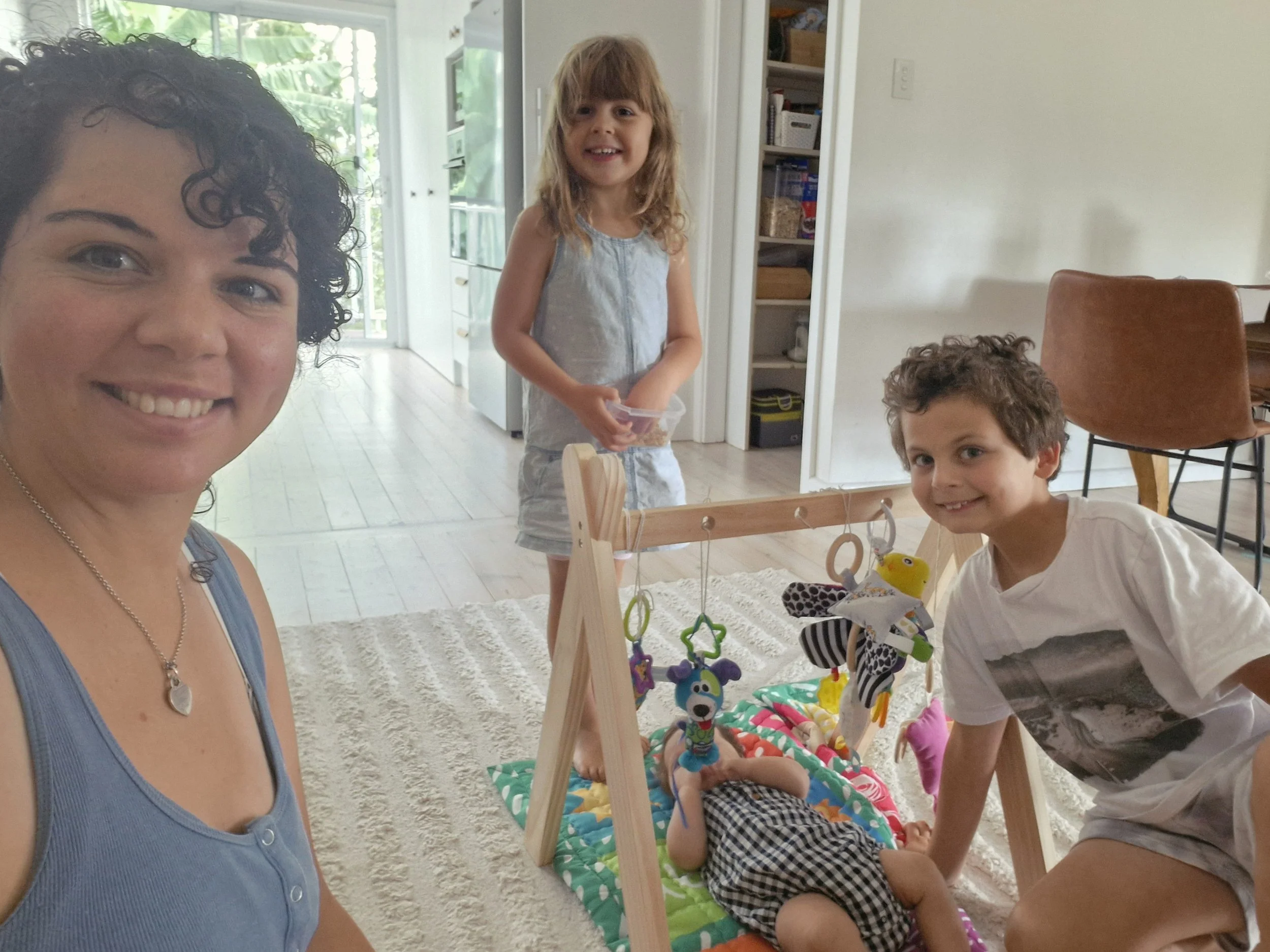
We love doing a bit of latin word prep after our Bible lesson in the mornings. These are my kids, Luke (9), Penny (6) and Josie (now 20 months).
This post contains affiliate links. If you buy through them, I may earn a commission at no extra cost to you.
Classical education is ultimately about the kind of person you’re forming
Before we get into grammar, logic, rhetoric or why classical homeschoolers seem to really love Latin, we need to start with the bigger question of what classical education is actually trying to accomplish.
Because from the outside, it can look a little bit like the homeschool method for people who think normal school simply doesn't contain enough Latin.
There are difficult books, memorisation, children discussing logic, Great Books and possibly a disturbingly large stack of flashcards somewhere on the dining-room table, so it's quite easy to assume classical education is basically rigorous academics with an old-fashioned aesthetic.
And academics absolutely do matter, but the bigger goal is formation.
Classical education isn't only asking, “How much information can we get into this child’s head before graduation?” It's also asking, “What kind of person are we forming?”
Because a child can memorise dates, earn excellent grades and know all the right vocabulary while still being easily persuaded by a terrible argument, or knowing what he believes without really being able to explain why.
And particularly as Christian parents, that matters.
We want our children to be academically capable, but we also care about wisdom and character. We care about whether they can recognise what is true, whether they understand why they believe it and whether they can communicate that truth with grace.
Obviously, no educational method can produce godly children for us. We cannot homeschool our children into salvation.
But education is formative, and what our children spend years reading, memorising, discussing and thinking about will shape them.
Now, there is one other thing I want you to keep in mind as we go through all of this, because classical education can sound absolutely beautiful in theory and still be far too much for your actual Tuesday morning.
I really like this approach, and we use parts of it ourselves, but I have not found an easy classical curriculum.
So as I explain the methods, don't only ask whether they sound educationally impressive.
Ask yourself whether you actually want to use them consistently with your children, because there is very little benefit in adopting somebody else's impressive homeschool philosophy if it quietly disappears by October.
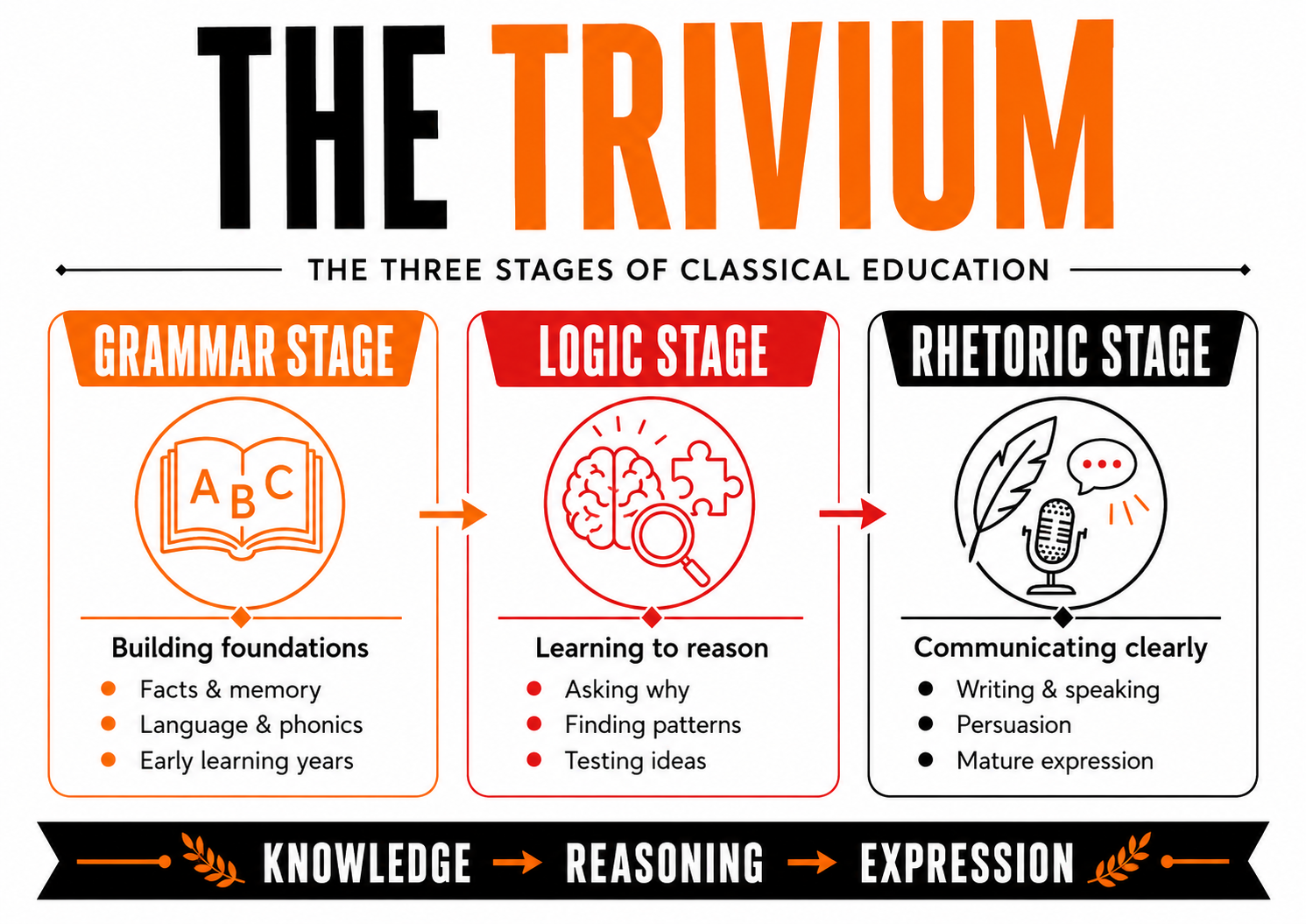
The trivium gives you a broad picture of how a classical program aims to train your kids.
The grammar stage gives children the raw material they will think with later 📚
Now, one of the first things that can feel slightly strange about classical education is how much emphasis it places on memorisation in the younger years.
Because if the goal is eventually to raise children who can think really well, why would you begin with so much repetition?
The classical argument is basically that you need something in your brain before you can think deeply about it.
If I ask a child to reason about the causes of a historical event when they know virtually nothing about the people, places or events involved, there isn't very much there for them to reason with. The same thing applies to language, maths, science and plenty of other subjects.
So in the younger years, classical education deliberately spends time building that storehouse of knowledge.
Children might memorise maths facts, historical information, Scripture, poems, grammar rules or Latin vocabulary, and this actually takes advantage of something young children tend to be rather good at…
…repetition.
A six-year-old will happily listen to the same song 40 times and repeat a joke that wasn't particularly funny the first time three times before breakfast, while I, at age 37, try to memorise a passage of Scripture and struggle to remember one verse.
Classical education basically says: use that ability while it comes naturally.
Give children useful and beautiful things to memorise through songs, chants and repetition, so that information is already there when they're ready to understand it more deeply and use it in more complicated ways.
Multiplication facts are a really simple example of this.
A child who immediately knows that seven times eight is 56 doesn't have to spend mental energy recalculating it every time it appears inside a harder maths problem.
The information is simply there and available to use.
And that is really the idea behind the grammar stage. The memory work isn’t the final destination. You’re filling their heads with useful knowledge while they’re young enough to actually enjoy memorising it, so they have something to think with later.
But as children get older, simply knowing the information isn't enough anymore.
Somewhere around middle school, they also tend to develop a fairly impressive enthusiasm for asking why absolutely everything is true, and classical education looks at that and basically says, excellent, we can work with this.
The logic stage teaches children how to think about what they know 🔎
If you have spent any time with a middle-schooler, you'll know questioning things is not generally a skill we have to introduce with great difficulty.
Why do I have to do that?
Why is that true? Are you sure? Who decided that?
So instead of trying to suppress that constant questioning, the logic stage starts directing it somewhere useful.
The emphasis shifts from simply acquiring information to examining it.
How are these ideas connected? What caused this? Does this conclusion actually follow from the evidence? What assumptions is this person making, and is this even a good argument in the first place?
Imagine, for example, that an advertisement tells your child, “Nine out of ten people prefer this product, therefore it is the best product.”
Well, according to whom?
How many people did they ask? What were they comparing it with? Does “preferred” actually mean it was better? And even if most people preferred it, does popularity prove quality anyway?
Those are very basic questions, but they begin to develop an important habit of mind.
We don't want our children to hear something confidently stated by an advertiser, influencer, politician—or some bloke on the internet with a podcast microphone—and assume confidence automatically makes it true.
But logic isn't simply about teaching your child to identify why everybody else is wrong, because that can become tiresome rather quickly.
It is also about asking whether they can explain their own beliefs.
If I ask why you think something is true, can you give me something beyond, “Well, Mum said so”?
And that matters enormously as Christian parents.
When our children are young, they naturally receive a great deal from us, but as they grow, we want them increasingly able to examine ideas carefully, recognise falsehood and understand the reasoning behind their own convictions.
We're not trying to create twelve-year-old debate machines patrolling the dining table waiting for somebody to commit a logical fallacy.
Nobody needs that.
We're trying to teach them how to reason well, and once they can recognise a bad argument, eventually they also need to learn how to make a good one themselves without becoming completely unbearable to talk to.
Rhetoric teaches them to communicate what they know well 💬
You can be completely correct and still communicate your point so badly that the other person becomes determined never to agree with you again.
This is where rhetoric comes in.
By the high-school years, the classical emphasis shifts again. The student has spent years gathering knowledge and has started learning how to reason about that knowledge, so now the question becomes whether they can communicate what they know well.
Can they write clearly and speak persuasively? Can they understand the person they're communicating with? Can they make a worthwhile argument without simply bludgeoning everybody else with it?
There is an old classical idea of the “good man speaking well,” and I really like that because it brings us straight back to formation.
The goal isn't simply to produce a child who is eloquent.
A persuasive person without character can do enormous damage, while somebody with genuinely good ideas who cannot communicate them clearly may struggle to persuade anybody of anything.
And for Christian families, I think there is an obvious connection here.
Truth matters, but so does how we communicate truth. And being technically correct does not give us permission to be graceless.
So if you remember nothing else about those three stages, the basic progression is actually quite simple.
First, children gain knowledge. Then they learn how to reason about that knowledge, and eventually they learn how to communicate it well.
That is the basic grammar, logic and rhetoric progression.
But classical education is bigger than those three stages
Now, this is where the word “classical” becomes slightly unhelpful when you're actually trying to buy curriculum, because two programs can both call themselves classical and still give you surprisingly different homeschool days.
Grammar, logic and rhetoric are part of the picture, but different classical programs can place very different amounts of emphasis on Latin, memorisation, Great Books, primary sources and discussion.
Great Books and primary sources
Great Books are a particularly common feature.
Instead of only reading a modern textbook that tells students what an important thinker said, older students are often encouraged to read important works themselves and engage with the ideas more directly.
Obviously, I am not suggesting you hand Augustine to your seven-year-old and tell him you'll see him after lunch.
But as students mature, the idea is that we don't always want somebody else doing all of the intellectual work for them.
Instead of only asking what a textbook says someone believed, they can start asking, what is this person actually arguing?
Do I agree? Where do I disagree? How does this connect with other things I've already learned?
And that helps explain why classical curricula often contain so much rich literature, history and discussion.
It also explains why you shouldn't assume that the word “classical” on the box tells you exactly what you're buying, because it really doesn't.
One curriculum may be extremely Latin-heavy, while another focuses much more on Great Books. One may contain substantial amounts of memory work, while another relies far more heavily on discussion.
So if you're choosing curriculum, don't stop at the label. Look underneath it and ask what that particular publisher is actually expecting your child—and you—to do.
Because eventually the beautiful philosophy has to meet your actual dining-room table.
A classical homeschool can be beautiful, but it is not usually the easy option
And this is the part I really want new homeschool parents to hear.
I like classical education, and there is a lot about it that I find genuinely compelling, but All the classical programs I've encountered tend to be fairly rigorous.
You may be looking at substantial reading, memory work, writing, Latin or another language, discussion and fairly high academic expectations.
For the right child and the right family, that can be wonderful.
Some children absolutely thrive on it, and if you're deeply convinced by the philosophy, you're also much more likely to put the effort into making those methods work.
But there is still effort involved, and parent capacity really does matter.
Sometimes we choose curriculum based on the homeschool family we imagine we're going to become rather than the family currently eating breakfast in our kitchen.
Imaginary Homeschool Mum has a remarkable amount of time.
Her toddler apparently doesn't draw on anything, everyone completes Latin before 9 a.m., and…
… I have yet to meet her.
In real life, you may have a preschooler, a baby, two older children working at completely different levels, washing that keeps reproducing when you're not looking and somebody asking what's for lunch approximately six minutes after breakfast.
All of that needs to influence your curriculum choice.
Now, Mum does not necessarily have to personally teach every subject in a classical homeschool, because there are programs with live classes, recorded teaching and self-paced lessons that can remove a substantial amount of instruction from your plate.
But generally, a rigorous classical curriculum is going to require more time and effort from both you and your child than a simple, open-and-go traditional curriculum.
And if you're brand new to homeschooling, that isn't a small consideration.
You're already learning how your children learn, figuring out how long lessons actually take and trying to teach multiple children at different levels…
…all while discovering that the maths lesson scheduled for 30 minutes occasionally develops ambitions of its own and takes over the morning.
So before adding a demanding classical curriculum on top of all of that, it is worth knowing what you're signing up for.
Are you convinced enough to keep using the methods?
The other question is whether you actually believe in the methods enough to keep using them.
Take Latin.
If you don't really believe Latin is useful, but you're teaching it because all the impressive classical homeschoolers seem to be doing it, how long are you realistically going to keep going when your child doesn't want to learn the vocabulary?
The same thing applies to memorisation.
If you fundamentally dislike memory work and aren't persuaded that it has educational value, you're probably not going to sustain a curriculum containing a great deal of it.
Week one begins with enthusiasm.
By week six, perhaps we'll skip Latin today, and by week twelve Latin has quietly disappeared and nobody mentions it anymore.
That doesn't necessarily mean Latin failed.
It may simply mean you adopted a method you were never convinced about in the first place.
So before choosing a classical curriculum, I would ask two separate questions.
Do I like the results this philosophy is aiming for?
And am I actually willing to use the methods it relies on to get there?
Because those aren't always the same answer.
You do not have to become a fully classical homeschool family
And this is basically where we've landed in our own homeschool.
We use Latin and memorisation because I'm persuaded they're useful, so I'm happy to make room for them.
But I don't want the academic intensity of a completely classical homeschool because, for our family, it would simply be too much.
We're very eclectic, and I'm quite happy to borrow something from classical education, Charlotte Mason or a traditional curriculum if it genuinely serves my children without feeling obliged to adopt the entire philosophy that came with it.
You can use the parts that work for your family without adopting the whole philosophy. Nobody is going to confiscate your Great Books because you gave up on Latin.
You can use what serves your family.
And I think that can be a huge relief if you've been researching classical education and thinking, “This sounds wonderful, but I cannot possibly do all of it.”
You don't necessarily have to.
Maybe you want more memory work in the younger years, or perhaps Latin really appeals to you. You might love the emphasis on logic or want your older children reading more primary sources.
You can take those ideas seriously without recreating a classical academy around your dining-room table.
Classical does not automatically mean Christian
But there is one distinction Christian families need to be particularly careful about, which is that classical does not automatically mean Christian.
Those are two separate labels.
A curriculum can be classical and Christian, classical and Catholic, or it can approach the Western tradition from a broadly Christian perspective.
It can also be classical without sharing your theological convictions at all.
So if having a genuinely Christ-centred homeschool matters to you, don't see the word “classical” and assume the worldview question has already been answered.
Remember, classical education has its roots in ancient Greece and Rome—and those Greeks and Romans certainly weren’t Christians!
Christians later adopted and developed many of these educational ideas.
So look at the actual curriculum.
Look at the publisher, the theology and how Scripture is used.
What are they teaching about God, man, sin, salvation and truth?
Because I can really appreciate an educational method and still decide that a particular curriculum isn't the right theological fit for our home.
If classical education sounds like a fit, these four options give you very different homeschool days
So suppose you like what you’ve read and want to explore classical education without spending the next three weeks opening 47 curriculum tabs.
Where would I actually start?
There are four places I'd put on your shortlist, but I wouldn't begin by asking which one is objectively “the best.”
I would ask one much more practical question:
What do I want Tuesday morning to look like?
And more specifically, how much teaching do you actually want Mum to do?

Veritas Press
If you want rigorous classical academics and Great Books but would rather outsource a substantial amount of the teaching, I would start by looking at Veritas Press (pictured above).
The live classes are a big attraction because your child can receive instruction without Mum having to personally teach every subject, which can make a demanding classical education much more realistic if you're also homeschooling several other children.
The obvious trade-off is price, because having other people teach your children tends to cost more than doing it yourself.
Funny how removing work from Mum usually has that effect.
Depending on where you live in the US, you may also be able to use ESA funding to pay for your curriculum.
And having the government pretty much pay for your homeschool curriculum instead of your credit card taking the hit?
Yes, please.
You can book a free consultation to ask about Veritas options and ESA eligibility in your state.
So Veritas is the option I would investigate if you want strong classical academics, you value outside teaching and you're prepared for the additional cost.
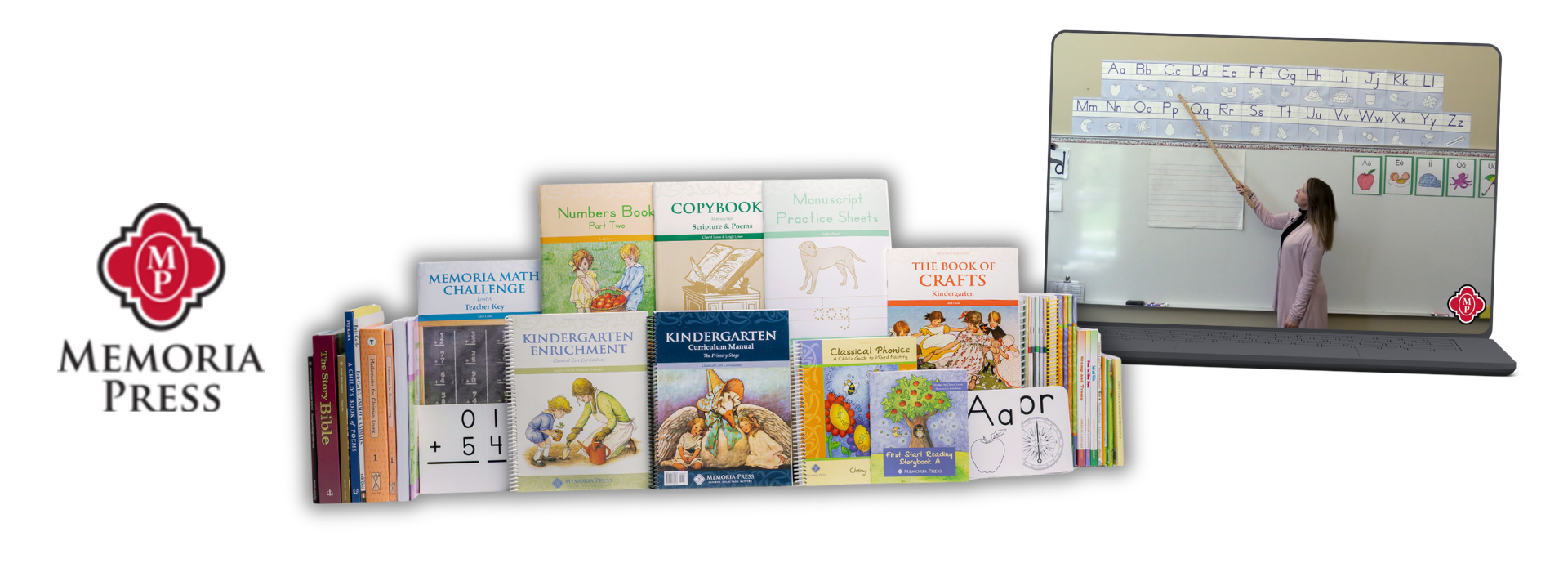
Memoria Press
If you prefer physical materials and want something very established and traditionally classical, Memoria Press is another strong option (pictured above).
One thing I like about it is that many of the physical materials can be reused across children, which can make the cost easier to justify if you've got a larger family.
It's also appealing if you're deliberately trying to keep your homeschool offline.
The trade-off is that Mum is usually much more involved.
If you're using the standard materials at home, you're going to be doing a substantial amount of the teaching and overseeing yourself.
They do offer live lessons, which obviously changes that equation, although once you add live instruction, the price changes to roughly what Veritas is charging.
So I would look at Memoria Press if you value physical, reusable materials and either enjoy being closely involved in the teaching or you're willing to pay more to outsource some of it.

Classical Academic Press
Or perhaps you just want some classical subjects in your home…then Classical Academic Press is the option I would investigate.
It gives you that more enjoyable book-based classical feel but with a lot more flexibility.
I really like Classical Academic Press, and you'll also see their materials used inside other classical programs.
They also offer some physical workbooks alongside affordable, self-paced online video options, which means you have more freedom to decide where Mum actually needs to teach and where your child may be able to work more independently.
For some families, that gives you a really useful middle ground.
You can still have proper books and tangible materials without necessarily requiring Mum to personally deliver every single lesson.
So if you're drawn to classical education but already suspect a completely parent-led program may become too much, CAP is one I would take a close look at.
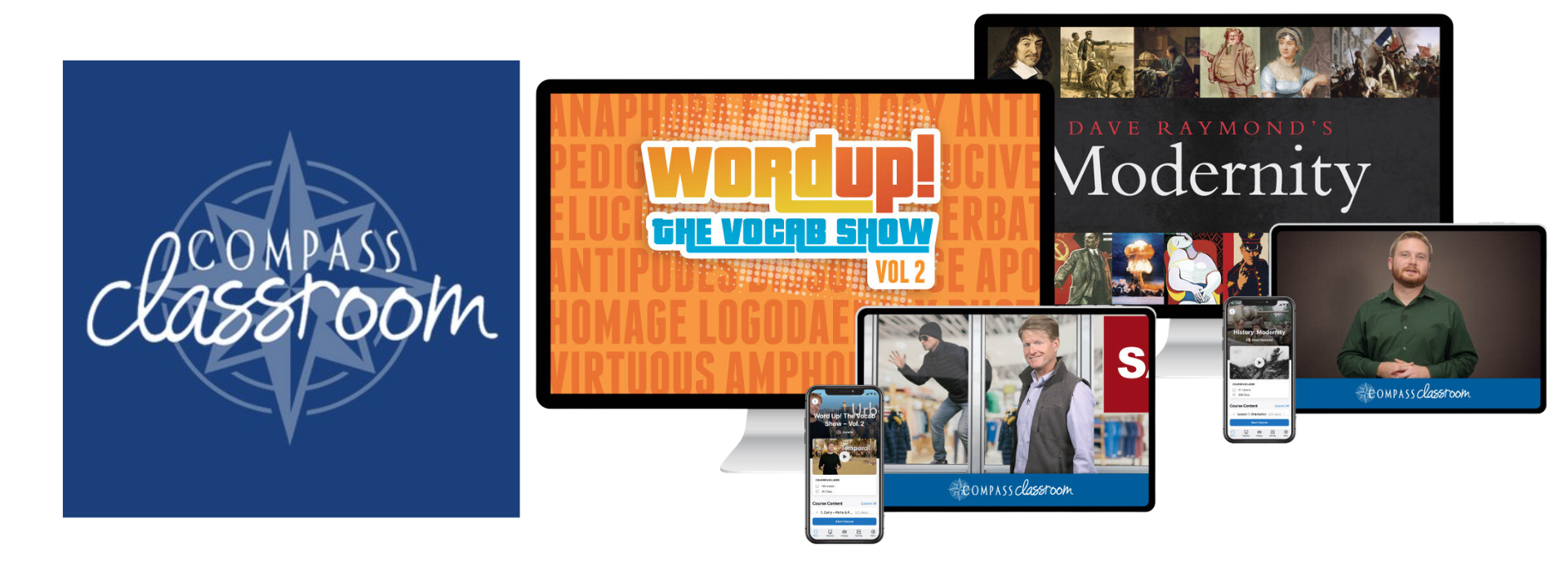
Compass Classroom
And then we have Compass Classroom.
Of these four, this is probably the easiest on Mum and one of the more affordable options for what you're getting.
The big difference is that it is online and primarily aimed at middle- and high-school students.
For older children, that can make it extremely useful because a student can work through a substantial amount of the material independently without Mum needing to hover beside them for every lesson.
And if you're also teaching younger children, that independence can be enormously valuable.
The trade-off is that this isn't going to solve your problem if you're looking for a complete elementary classical curriculum, because it really is aimed at older students.
So if you've got a middle- or high-school student who can work independently, and your biggest priorities are affordability and reducing Mum's teaching load, Compass Classroom becomes very interesting.
Which classical curriculum fits your family?
And this is why I don't think the useful question is, “Which of these four is the best classical curriculum?”
The useful question is still, “What do I want Tuesday morning to look like?”
If you want live teachers and strong classical academics, look closely at Veritas.
If you want reusable physical materials and you're happy to teach, Memoria Press may make more sense.
If you like physical materials but also want self-paced flexibility, I'd investigate Classical Academic Press.
And if you've got older children and your biggest priorities are independence and affordability, Compass Classroom may be the better fit.
Then put your other filters over the top.
Is the theology a fit? Can you afford it?
Is the academic workload realistic for this particular child? And can your family sustain it beyond the first exciting month when all the books are new and nobody has lost the Latin flashcards yet?
Because that is ultimately how I would approach classical education as a rookie.
I wouldn't begin by asking whether you are a “classical homeschooler.”
I would ask whether you believe in what this approach is trying to accomplish, whether you actually want to use the methods it relies on and whether the workload fits your family.
You may decide you love the whole thing.
You may decide you want the Latin, memory work and Great Books but not everything else.
Or you may decide classical education isn't a good fit for your family at all.
All three are useful answers.
The goal isn't to acquire the most impressive homeschool philosophy. It's to choose an education you can actually sustain, that serves your children academically and fits the Christian convictions you want shaping your home.
You can also book the free consultation for more information about using Veritas Press through ESA in some states.
Does your child’s learning style need to decide your curriculum?
Now that you know classical education can be a great fit for some families—but the wrong curriculum can quickly become overwhelming—there’s another mistake that can send you toward the wrong curriculum entirely: choosing it based on whether your child is a “visual,” “auditory,” or “kinesthetic” learner.
Because those labels may not matter nearly as much as you’ve been told.
In my post on learning styles, I explain what actually matters when figuring out how your child learns—so you don’t spend hundreds of dollars replacing a curriculum that was never really the problem.