5 Best Classical & Charlotte Mason Curriculums Homeschool Moms LOVE
Choosing between a classical homeschool curriculum and a Charlotte Mason curriculum can feel unnecessarily difficult. Classical education offers structure, logic, history cycles and rigorous academics.
Charlotte Mason education offers living books, narration, beautiful ideas and short lessons that do not make children complete another worksheet simply because somebody printed it.
Naturally, many homeschool parents want both.
We want rich literature and academic structure.
We want beautiful family discussions and children who eventually understand logic, literature and perhaps even Latin.
We would also prefer not to spend every Sunday evening sourcing seventeen library books and building a colour-coded schedule that nobody follows. 😅
Thankfully, several Christian homeschool programs combine elements of classical and Charlotte Mason education.
I have used most of the programs in this list, and I have ranked them according to how manageable they are for the parent.
Because a curriculum can look absolutely beautiful in a catalogue and still leave Mum hiding in the pantry by Thursday.

⚡ Quick Picks: Which Curriculum Should You Choose?
Do not have time to read the entire article?
Here are my quick recommendations:
Best true classical and Charlotte Mason blend: Tapestry of Grace
Best for crafts and family learning: My Father’s World
Best affordable option for a large family:SchoolhouseTeachers.com
Best gentle and open-and-go option: Master Books
Best for busy parents wanting academic depth: Compass Classroom
My overall choice: Compass Classroom
No curriculum on this list represents a perfect fifty-fifty blend of Charlotte Mason and classical education.
Some lean heavily classical.
Others have more of a Charlotte Mason feel.
The goal is not to find a curriculum that fits perfectly inside two educational labels.
The goal is to find something that works inside your actual home—with your children, your schedule, and your present level of enthusiasm for salt-dough maps.
📝 Classical and Charlotte Mason Curriculum Comparison
At a Glance
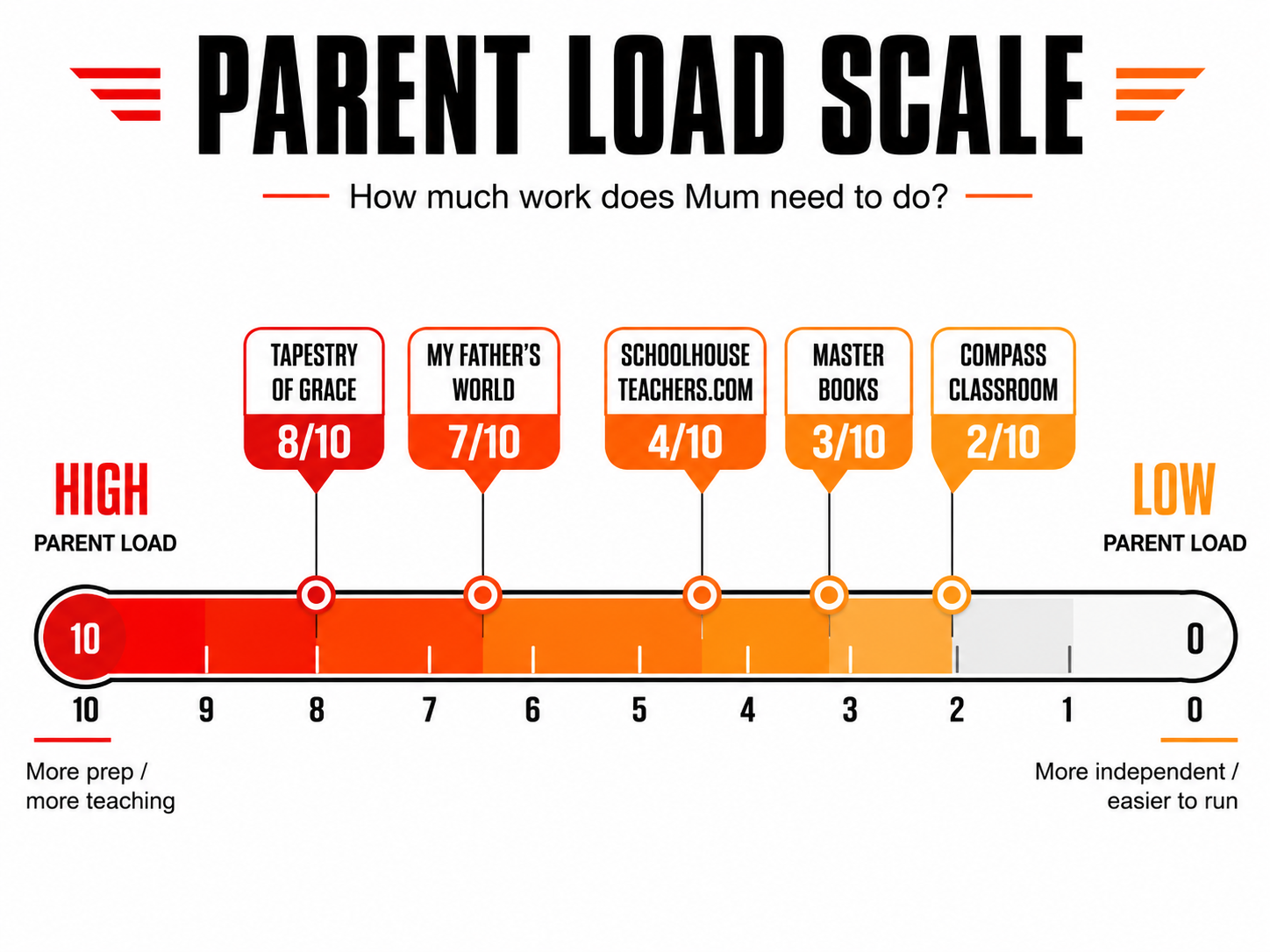
Consider how much time you have before you pick your curriculum.
Tapestry of Grace — Parent Load: 8/10
A strong classical and Charlotte Mason blend for confident parents who enjoy planning.
My Father’s World — Parent Load: 7/10
A mixture of Charlotte Mason, classical education and unit studies for families who enjoy crafts and learning together.
SchoolhouseTeachers.com — Parent Load: 4/10
A flexible, eclectic option for large families wanting customised learning.
Master Books — Parent Load: 3/10
A gentle Charlotte Mason-style curriculum for busy families wanting open-and-go books.
Compass Classroom — Parent Load: 2/10
An independent, video-based classical curriculum for busy parents wanting rigorous Christian courses.
Let’s look more closely at what each curriculum offers—and how much work it creates for Mum. 😅

5. Tapestry of Grace 📖
Tapestry of Grace is probably the strongest genuine blend of classical and Charlotte Mason education on this list.
It follows a classical structure with four-year history cycles and different levels of learning for younger children, dialectic students and rhetoric students.
At the same time, it incorporates Charlotte Mason-style methods through:
Living books
Narration
Literature
Family discussion
Rich historical study
It is also strongly Christian, with Bible, theology and worldview woven throughout the program.
Educationally, Tapestry of Grace is incredibly rich.
But what is it actually like for the parent?
🧺 What Is the Parent Workload Like?
Tapestry of Grace is wonderful—provided your spiritual gift is sourcing library books and constructing colour-coded spreadsheets.
There are lots of books to find and plenty of decisions to make.
Parents need to organise materials, select assignments, guide discussions and work out how to use the curriculum with children at different levels.
This is not an open-and-go curriculum.
It is more like:
Open. Plan. Print. Reserve fourteen library books. Discover six are unavailable. Search Facebook Marketplace. Reconsider your life choices.
I would give Tapestry of Grace a parent workload score of 8 out of 10.
The benefit is that children can receive a wonderfully rich education.
Families can study history, literature, geography, worldview and Bible together, while adapting the assignments for different ages.
But you need enough time and energy to make it work.
✅ Who Is Tapestry of Grace Best For?
Tapestry of Grace may suit:
Mums who genuinely enjoy planning
Larger families who want to learn together
Classical homeschoolers who still want living books
Parents who enjoy deep family discussions
Confident or experienced homeschoolers
I probably would not recommend starting here as a nervous first-year homeschooler.
You may already be wondering whether children need shoes to complete maths.
You do not also need to locate twelve historical novels before Monday.
💰 How Much Does Tapestry of Grace Cost?
The curriculum itself may cost a few hundred dollars, but the required books are generally purchased separately.
Once all the books are included, families can easily spend around $800 to more than $1,000.
However, many of the books can be reused with younger children, which helps reduce the cost over time.
Borrowing from the library or purchasing second-hand books can also make the curriculum more affordable.
💭 My Opinion of Tapestry of Grace
If you have plenty of time, enjoy planning and want to learn alongside your children, Tapestry of Grace is a high-quality option.
It offers deep, thoughtful and academically rich learning.
However, busy parents may quickly start feeling buried beneath the preparation.
You wanted to study ancient Egypt.
Instead, you are being buried alive under a pile of library reservations.
That is personally why I would not choose Tapestry of Grace for my own family. BUT…it might be a great choice for yours 😁.

4. My Father’s World 🎨
My Father’s World combines elements of:
Charlotte Mason education
Classical education
Unit studies
Hands-on family learning
It is more guided than Tapestry of Grace, but it still incorporates living books, family discussions, Bible, history, science, music and art.
The curriculum is strongly Christian, and Scripture is woven throughout the lessons.
My Father’s World also allows families to teach several children together, particularly for subjects such as history, science and Bible.
That can be a significant advantage for larger families.
✂️ What Is the Parent Workload Like?
My Father’s World gives parents a clear schedule and much more guidance than Tapestry of Grace.
However, it is still fairly parent-led.
There is preparation involved, and it is not designed to be highly independent.
I would give My Father’s World a parent workload score of 7 out of 10.
It can become especially demanding when parents attempt to complete every craft, activity and hands-on project.
And My Father’s World does enjoy a craft.
There may be maps to construct, food to cook, objects to paint and historical scenes to recreate.
Crafty mums may read that list and feel inspired.
I read the words “make a salt-dough map” and immediately need a cup of tea. ☕
✅ Who Is My Father’s World Best For?
My Father’s World may suit:
Families wanting a clear plan
Parents who enjoy teaching children together
Children who love crafts and hands-on projects
Families who enjoy unit studies
Christian families wanting strong Bible integration
Parents who want a warm, family-style homeschool
💰 How Much Does My Father’s World Cost?
Depending on the year and package selected, a full My Father’s World program may cost around $400 to $700.
Some packages may cost more once maths, language arts and additional student materials are added.
Many of the books can be reused with younger siblings, which can reduce future costs.
💭 My Opinion of My Father’s World
I actually really like My Father’s World.
We used the complete kindergarten package, have returned to the curriculum at different times and still own and use several of its books.
I love the Christian worldview, family learning and warm teaching style.
However, I am not naturally a crafty person.
My idea of a successful homeschool craft is handing the children sticky tape and returning later to make sure nobody has attached themselves permanently to the furniture.
Of course, families can skip many of the crafts.
The trouble is that My Father’s World often shines most brightly when you actually complete the hands-on activities.
Without them, the program can become much more reading-heavy.
So although I like My Father’s World, it would not be my personal first choice.

3. SchoolhouseTeachers.com 💻
SchoolhouseTeachers.com is a very flexible and eclectic Christian homeschool program.
It does not follow one single educational philosophy.
Instead, families receive access to hundreds of courses and can build a curriculum that fits their preferred homeschool style.
Parents can create a classical-style education using subjects such as:
Latin
Logic
Literature
History
Rhetoric
They can also create a more Charlotte Mason-inspired program using living books, art, nature, notebooking and hands-on learning.
Lessons are offered through a mixture of videos, printable materials, worksheets and online resources.
There is an enormous amount of content available.
Choosing courses can feel a little like scrolling through Netflix.
Except instead of giving up and watching the same program again, you eventually need to decide whether your child is studying Latin, marine biology or medieval architecture.
🖨️ What Is the Parent Workload Like?
SchoolhouseTeachers is flexible, but flexibility comes with a trade-off.
Parents need to choose and organize the courses themselves.
Depending on the subjects selected, there may also be a significant amount of printing.
At first, the large course library can feel overwhelming.
You may log in looking for one history course and emerge two hours later considering photography, apologetics, architecture, and beginner violin.
However, once children are confident readers, they can complete many of the courses independently.
I would give SchoolhouseTeachers a parent workload score of around 4 out of 10.
The initial planning requires some thought, but the everyday workload can be very manageable.
✅ Who Is SchoolhouseTeachers Best For?
SchoolhouseTeachers works especially well for:
Large families
Parents wanting a customisable homeschool
Families mixing several educational styles
Independent readers
Parents wanting lots of electives
Families looking for an affordable all-family option
One membership covers the entire household.
That makes it particularly helpful for families with several children.
It may even cover the pet rabbit—although his written assignments could become a problem. 🐇
Check out SchoolhouseTeachers here.
💰 How Much Does SchoolhouseTeachers Cost?
SchoolhouseTeachers generally costs around $300 to $400 per year for a whole-family membership.
This makes it one of the most affordable options on this list, particularly for larger families.
Instead of purchasing a separate curriculum for every child, one subscription provides access to hundreds of courses across grades K–12.
💭 My Opinion of SchoolhouseTeachers
I really like SchoolhouseTeachers because of its affordability, flexibility and enormous course selection.
It allows families to build a curriculum without purchasing five completely separate packages.
However, there can be a lot of printing, and parents need to make plenty of decisions.
That does not bother me personally.
But some homeschool mums may open the course library, see hundreds of choices and quietly shut the laptop again.
Struggling to Choose a Homeschool Curriculum? 🤔
If you have been researching Christian homeschool curriculum for weeks and still do not know what to choose, this is exactly why I created the Curriculum Confidence course.
The course takes you step-by-step through choosing the right curriculum for:
Your children
Your preferred teaching style
Your family’s needs
Your budget
The amount of time you genuinely have
It can help you stop researching endlessly, stop second-guessing yourself and finally move forward with confidence.
Because at some point, you do need to close the 47 browser tabs and order something.
You can find the Curriculum Confidence course through the link below.
2. Master Books 🌿
Master Books has much more of a Charlotte Mason feel than a classical one.
The lessons are gentle, story-based and often follow what Master Books calls a living education approach.
Many courses include:
Stories and conversation
Short lessons
Picture study
Biblical connections
Gentle written work
Attractive, colourful books
There are also some classical elements, particularly through logic, literature, structured progression and certain high-school courses.
It is not a pure classical or Charlotte Mason model, but it creates a blend in practice.
Master Books is also strongly Christian and integrates Scripture throughout its curriculum.
⚠️ Is Master Books Academically Rigorous?
Master Books is generally on the gentler side academically.
We have used some of its maths books, and I found them far too easy for the stated grade level.
That does not mean they will be too easy for every child.
However, parents should definitely use the placement tests.
I am saying this clearly and lovingly:
Use. The. Placement. Tests.
Otherwise, your child may complete the entire maths lesson before you finish making your coffee and begin wondering why Mum looks worried. ☕
Some children may need to work one grade level above their usual placement.
🧺 What Is the Parent Workload Like?
This is where Master Books really shines.
The curriculum is:
Open-and-go
Low-preparation
Clearly scheduled
Easy to use consistently
Lessons are generally short and manageable.
Parents can open the book, complete the lesson, close it and move on with the day.
There is no need to build a miniature Roman aqueduct before breakfast.
I would give Master Books a parent workload score of around 3 out of 10.
This is definitely a toddler-on-the-hip-friendly curriculum.
✅ Who Is Master Books Best For?
Master Books may suit:
Busy homeschool mums
Families wanting low-stress lessons
Children who enjoy stories
Students overwhelmed by large workloads
Parents wanting strong Christian content
Families looking for open-and-go books
💰 How Much Does Master Books Cost?
A complete year of Master Books curriculum may cost somewhere between $200 and $500, depending on the number of subjects purchased.
Many textbooks can be reused.
However, parents may need to purchase new consumable workbooks for younger children.
Individual Master Books courses are often reasonably affordable, making it possible to use selected subjects without purchasing a complete grade package.
💭 My Opinion of Master Books
I really like many things about Master Books.
The books are attractive, the lessons are manageable and the Christian worldview is clear.
However, I do not use many Master Books courses because they are not always academically rigorous enough for what I want.
When we tried the kindergarten maths, Penny found it far too easy.
The placement tests can solve some of this because children can be moved to a higher level when appropriate.
But if your family wants gentle, story-rich and easy-to-use Christian curriculum, Master Books may be exactly what you need.
1. Compass Classroom 🏆
Compass Classroom is my top choice from this list.
If I had to select one of these programs as a busy homeschool mum, Compass Classroom is the curriculum I would choose.
It leans more heavily towards classical education and offers courses in subjects such as:
History
Latin
Literature
Logic
Writing
Economics
Philosophy
Science
Christian worldview
However, it also includes several Charlotte Mason-style elements through story, literature, discussion, rich ideas and meaningful books.
It does not perfectly combine the two methods, but it incorporates many of their best qualities.
Compass Classroom is also strongly Christian and gospel-centred.
The teachers frequently connect learning back to Scripture, prayer and a biblical understanding of the world.
That is something I always want at the centre of our homeschool.
Because Jesus is the Way, the Truth and the Life.
🎥 What Is the Parent Workload Like?
This is where Compass Classroom stands out.
The curriculum is video-based, which can be an enormous relief for parents.
The teacher appears onscreen.
The lesson is already organised.
And nobody asks Mum to explain rhetoric before she has finished breakfast. 🙌
Students can work quite independently, particularly from middle school onwards.
There is very little direct teaching required from the parent.
PDF materials can be printed at home, and physical materials are available for many courses.
Despite being easy for parents to implement, Compass Classroom remains academically rich and fairly rigorous.
That balance can be difficult to find.
Many easy-to-use curriculums are also academically light.
Compass Classroom offers deeper learning without requiring Mum to become the household Latin professor, history lecturer and discussion-panel moderator.
I would give Compass Classroom a parent workload score of around 2 out of 10.
✅ Who Is Compass Classroom Best For?
Compass Classroom is particularly well suited to:
Busy homeschool families
Working homeschool parents
Families homeschooling with toddlers
Parents wanting classical education without enormous preparation
Middle-school and high-school students
Children who learn well through video
Families wanting strong biblical teaching
💰 How Much Does Compass Classroom Cost?
Compass Classroom allows families to purchase individual courses or choose a subscription.
A single-student membership may cost around $490 per year, while a family membership may cost around $890 per year.
Monthly payment options may also be available.
Parents can also purchase individual courses instead of subscribing to the complete library.
💭 My Opinion of Compass Classroom
For me, Compass Classroom hits the sweet spot.
It is:
Rich without being overwhelming.
Rigorous without requiring constant parent teaching.
Classical without forcing Mum to spend Sunday evening constructing next week’s civilisation.
It is also strongly Christian without treating the Bible as a small optional subject added at the end.
We have used around ten Compass Classroom courses.
Some of our favourites have included The Vocabulary Show and Modern Parables.
The Vocabulary Show even sparked an interest in Latin in our home.
That is why Compass Classroom gets my overall vote.
It is manageable for parents while still providing students with a thoughtful, academically solid education.
🤔 Can Classical and Charlotte Mason Education Work Together?
Classical and Charlotte Mason education can work beautifully together.
Both methods value excellent books, rich ideas and meaningful learning.
Neither method is built around children filling in endless worksheets merely because the page exists.
However, the two methods also have important differences.
Classical education tends to place more emphasis on:
Rigorous academic progression
Formal logic and rhetoric
Ancient languages
Historical cycles
Great books
Charlotte Mason education generally places more emphasis on:
Living books
Narration
Nature study
Short lessons
Habit formation
Art and music appreciation
Some families will love combining the two approaches.
Others may eventually discover that they are happier leaning strongly towards one.
Either approach can provide an excellent education when it is used consistently and adapted to the needs of the child.
🥇 Which Classical and Charlotte Mason Curriculum Is Best?
The best curriculum depends on your family.
Choose Tapestry of Grace if you want the strongest classical and Charlotte Mason blend and genuinely enjoy planning.
Choose My Father’s World if you love family learning, unit studies, and hands-on activities.
Choose SchoolhouseTeachers if you want an affordable, customizable option for several children.
Choose Master Books if you want gentle Christian lessons that are easy to implement.
Choose Compass Classroom if you want robust classical learning without a heavy parent workload.
For my own family, Compass Classroom would be my first choice from this list.
It gives students rich, Christian, and academically meaningful learning while remaining manageable for busy parents.
And sometimes the best curriculum is not the one with the most impressive book list.
It is the one you can actually use on an ordinary Tuesday—with a toddler nearby, washing, waiting, and somebody asking for another snack.