Generations Homeschool Curriculum Review: The Most Bible-Rich Curriculum I’ve Seen?
Generations Homeschool Curriculum is a strongly Christian, book-based homeschool curriculum with a major emphasis on biblical worldview and family discipleship.
I’ve personally used the Grade 3 history books and Grade 3 reading books, and the first thing I noticed was how much Scripture and Christian teaching were woven throughout the lessons. This is not a curriculum where Bible is treated as a small add-on. The Christian worldview shapes the content itself.
Generations offers materials from Kindergarten through high school, with its strongest areas appearing to be Bible, history, reading, literature, and worldview. It does not use video lessons, but it does offer books, workbooks, answer keys, schedules, and some affordable audio options.
In this review, I’ll walk through what Generations is like, what I loved, what parents should know before buying, and which families I think it will suit best.
At no extra cost to you, you get to support my channel and our homeschool by buying through these affiliate links. Big Thanks!
Generations Curriculum: Quick Facts 📌
✝️ Best for: Christian families wanting a very Bible-rich curriculum
📚 Grades: Kindergarten through high school
📝 Subjects: Bible, history, reading, literature, worldview, science, and more
🎧 Format: Books, workbooks, schedules, answer keys, and some audio options
🎥 Video lessons: No
👩🏫 Parent help: Moderate in younger years
🙏 Faith perspective: Strongly Christian, conservative, Reformed flavor
✂️ Craft level: Low
What is Generations Homeschool Curriculum?
The central idea behind Generations is that education is never neutral. Every curriculum teaches children a way of seeing the world. Some do this through secular humanism, some through progressivism, some through moralism, and some through a biblical Christian worldview.
Generations is very open about its position.
It wants children to see God’s authority, God’s providence, God’s Word, and God’s purposes across every subject.
Their philosophy seems to rest on a few major ideas:
Family discipleship matters
Worldview is part of every subject
Christian books and biographies shape children
Learning should lead children toward worship and obedience
That makes Generations feel very different from a curriculum where Bible is simply one separate subject in the day. With Generations, the Christian worldview is not kept in a box. It is part of the whole program.
What Subjects Does Generations Cover?
Generations offers curriculum from Kindergarten through high school, though not every subject is complete for every grade yet.
Their strongest areas appear to be Bible, history, literature, reading, and worldview. They also have science and other subject areas, but some upper-level strands are still being developed.
The curriculum leans heavily toward Christian writings, biographies, missionary stories, biblical themes, and worldview-rich content.
So if you want lots of standard secular classics inside the core program (for example, Alice in Wonderland and The Wind in the Willows), you will want to add those separately.
But if you love the idea of your child reading about faithful Christians, church history, missionaries, biblical truth, and God’s work in the world, Generations fits that aim very well.
See Generations reading books here so you can get an idea of the literature they favor.
The Christian Worldview Is Very Strong ✝️
This is the main thing Generations is known for, and it really is the main thing I noticed when I used it.
The curriculum constantly points children back to God, Scripture, obedience, sacrifice, faithfulness, courage, and following Christ. In the Grade 3 materials I used, the lessons did not feel like generic schoolwork with a Christian label added at the end. The Christian worldview was built into the actual content.
That is a major strength if you want your homeschool curriculum to reinforce your faith instead of making you constantly correct, explain, skip, or reframe things.
It also means this curriculum will not be for everyone. Families who want a lighter Christian tone may find Generations too strong. But for families who want something very Bible-rich and discipleship-focused, that strength is exactly the point.
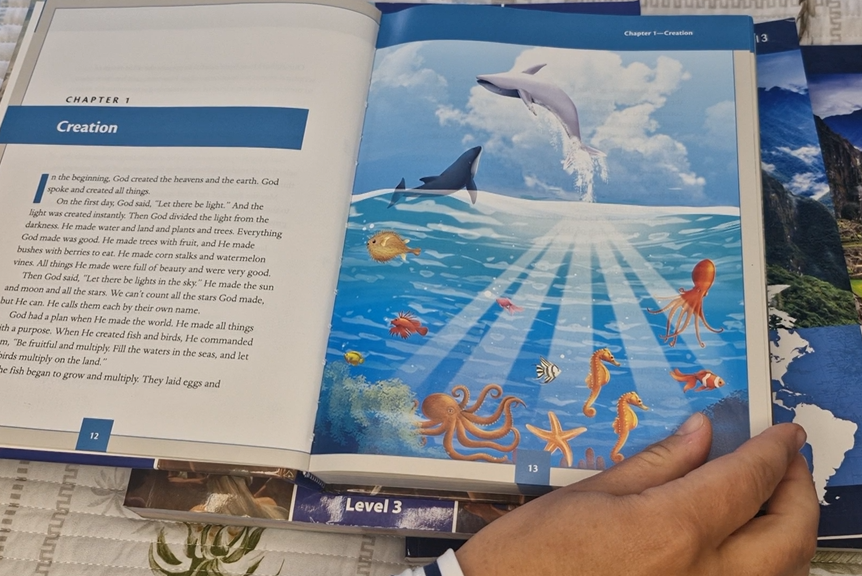
The reading curriculum has children reading a sort of paraphrased Children’s Bible!
What I Loved About the Grade 3 Books
The biggest thing I loved was how much the curriculum encouraged my children to think about God and the cost of following Him.
It was not only teaching history or reading skills.
It was also asking deeper questions about faith, obedience, sacrifice, character, and what it means to live before God. I found that incredibly valuable as a Christian parent.
I also liked that the books are written directly to children.
The tone feels more personal and student-friendly than a teacher manual. That matters because it helps children feel like the lesson is speaking to them, not just being delivered through the parent.
Another thing my children enjoyed was the artwork.
The books are visually appealing, with vivid printing, strong colour, and beautiful illustrations. For younger children, that makes a real difference.
A curriculum can have excellent theology, but if the pages feel dull or visually flat, children often disengage quickly.
Generations does well here.
Is Generations Easy to Teach?
Generations is fairly open-and-go, but it is not a hands-off video curriculum.
There are no video lessons, so the parent is still involved, especially in the younger grades.
You may need to read sections aloud, help with workbook questions, discuss the lesson, and make sure your child understands the spiritual application.
That does not make it a bad curriculum. It just means parents need to know what they are buying.
In the early years, I would describe Generations as moderately parent-involved in younger years.
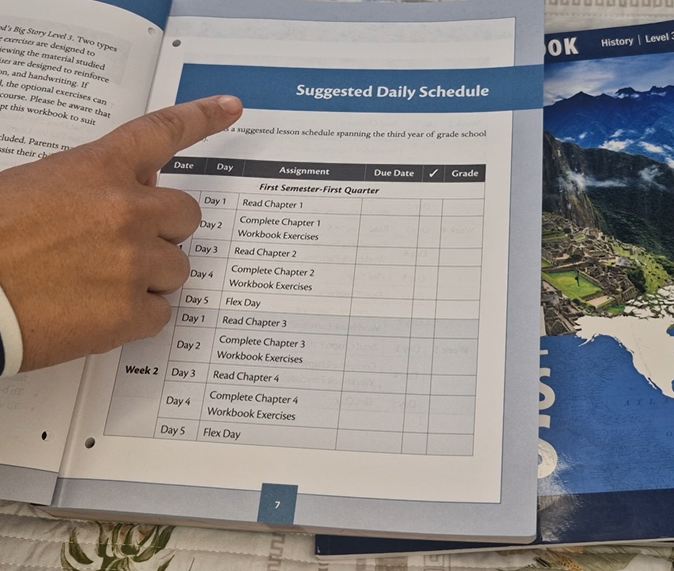
As children get older and read more confidently, they can likely work more independently because the books are written directly to the student and Generations includes schedules and answer keys.
So, practically speaking, Generations is not chaotic or overly complicated, but it does expect the parent to be part of the discipleship process.

I enjoyed reading these history books with my son.
A Note for Dyslexic or Struggling Readers 💛
This was the main challenge for us.
My son has dyslexia, so workbook-heavy or reading-heavy curriculum can be harder for him. He found the Generations workbooks a little difficult at times, not because the content was poor, but because written workbook-style learning is more challenging for him.
Generations does not have video lessons, so if your child has dyslexia, struggles with reading, or needs more audio-visual teaching, you may need to sit beside them more.
You could also use the Generations curriculum audio options…
Generations Audiobooks Are a Very Helpful Option 🎧
One of the best things Generations offers is audio.
They do not have video lessons, but they do offer audiobooks and audio resources, including history audio. These can be a very practical help for families who want the richness of Generations but need some support with delivery.
Check out the quite affordable Generations audiobooks here.
Audiobooks can work well:
in the car
during quiet time
while children draw or play quietly
for auditory learners
for children who struggle with reading
for parents who cannot read everything aloud every day
The audio option does not replace parent discipleship or discussion, but it can make the curriculum more manageable.
Does Generations Include Crafts or Hands-On Projects? ✂️
Generations is not a craft-heavy curriculum.
That may be a pro or a con depending on your family. If you love hands-on projects, unit studies, posters, models, crafts, and activities, you may need to add those separately (or use a curriculum like My Father’s World which is very crafty).
But if you prefer a curriculum that is book-based, discussion-based, worldview-focused, and low-mess, Generations will probably appeal to you.
Personally, I like that it is not craft-heavy. I would rather have rich discussion and strong Christian content than a pile of craft supplies I have to organise every week.
Generations is more focused on reading, thinking, talking, and applying truth than hands-on projects.

Fiction, Biographies, and Literature
Generations leans more toward Christian biographies, missionary stories, Scripture-based literature, and worldview-rich readings than a long list of classic fiction.
That is important to know.
Some families will love this because they want their children to read about real Christians, faithful examples, church history, and people who sacrificed to follow Christ.
Other families may feel the program needs more fiction or classic literature added alongside it.
I don’t see that as a major problem.
You can always add fiction separately.
But it is helpful to know the flavour of the program before you buy. Generations is not trying to be a mainstream literature program with light Christian additions.
It has a very specific discipleship aim.
Is Generations Good for Multiple Children?
Generations can work for more than one child, but it is not mainly designed as a big family-style unit study where all your children sit around the table doing the exact same lesson together.
It works best when children are working at their own level or when you have children close enough in age to share some content.
The good news is that textbooks can often be reused, which helps with long-term cost.
The workbooks are consumable, so you will need new copies for each child.
For larger families, this means Generations may be more affordable over time than it looks at first, especially if you reuse the main books and only replace the workbooks.
Is Generations Affordable? 💸
Generations sits more in the mid-range category for Christian curriculum.
It is not the cheapest option, but it is also not priced like some large online or video-based programs.
The value is really in the theological depth and the amount of worldview work already built into the lessons.
You are not paying for flashy videos or an online platform. You are paying for books, structure, discipleship, worldview, and Christian content that does not need constant fixing.
A few cost notes:
Textbooks can often be reused
Workbooks are consumable
Sales seem worth watching
Audio can be a cheaper way to try the program
Digital options may help international families
Check current Generations sales and pricing here
Generations also has scholarship options for some families in financial hardship, so it may be worth checking their current policy if cost is a barrier.
Shipping for Australian Families 📦
For Australian families, shipping is something to think about.
Ordering heavy books internationally can be expensive, so it may be worth checking local suppliers, such as Reformers Bookshop, to see whether they stock the specific items you want.
Digital products and audio resources can also be a good way to start without worrying about international postage.
What Other Parents Say About Generations
After reading hundreds of comments over the years on Generations, the parent feedback I’ve seen is overwhelmingly positive, especially from families who want strong Christian content.
Common positives include:
Christ-centred lessons
affordable options
shorter, manageable lessons
solid Christian worldview
Scripture incorporated throughout
good history and reading materials
Several parents also seem to appreciate that Generations is serious about tying faith into everyday learning, not just adding Bible separately.
But the feedback is not all one-sided, which is helpful.
Some parents (and they were very much in the minority) mentioned cautions, including certain early history stories feeling a bit forced, some math materials lacking a full teacher guide, mistakes in newer materials, and some tests feeling too light.
Like any curriculum, some parts may be stronger than others.

Checkout these pretty colors. It’s called ‘Rainbow Mountain’ in south America.
Who Will Love Generations? ✅
Generations will likely suit families who want a curriculum that is openly and consistently Christian.
It is especially worth considering if you want:
strong Scripture integration
Christian worldview across subjects
history taught through God’s providence
missionary stories and Christian biographies
low craft requirements
beautiful books
audio options
discipleship-focused lessons
a curriculum that takes theology seriously
If you want your homeschool to feel like discipleship, not just academics, Generations may be a very good fit.
Who Might Not Love Generations? ⚠️
Generations probably will not suit every family.
You may not love it if you want:
video lessons
online games or interactive lessons
a lighter Christian tone
lots of hands-on crafts
a big family-style unit study
a curriculum full of classic fiction
minimal parent involvement in the early years
It may also be harder for children who struggle with reading, unless you are willing to sit with them or use audio support.
My Verdict on Generations Homeschool Curriculum ⭐
My verdict? Generations is one of the most Bible-rich homeschool curricula I’ve ever used.
I used their Grade 3 history and reading books, and what stood out most was how naturally and consistently the curriculum pointed my children back to God. It was not just “Christian” because a verse appeared here and there. The Christian worldview shaped the actual lessons.
As a parent, I loved it.
My kids enjoyed the vivid pictures, beautiful printing, and friendly student-facing style.
The biggest caution for our family was that my son’s dyslexia made the workbook side harder, so children who struggle with reading may need more support.
Would I use Generations as a full curriculum?
Yes, in a heartbeat. ✅
It is not the best fit for every family, but for Christian parents wanting a serious, Scripture-rich, discipleship-focused curriculum, Generations is a very strong option.
If you want to look at thier curriculum, browse Generations Homeschool Curriculum here
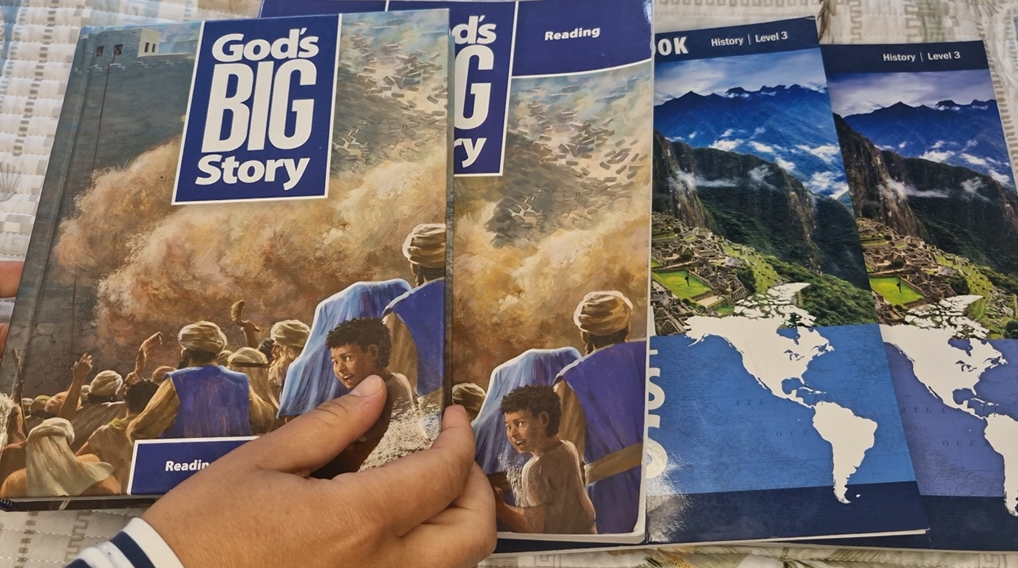
Generations homeschool curriculum comes with textbooks and student workbooks where they fill out answers. Here are the Reading and History books we have.
Generations Homeschool Curriculum FAQ
I’m going to quote from a forum thread to answer these questions.
Is Generations Homeschool Curriculum Calvinist?
Generations does have a Reformed flavour, but based on parent feedback, it does not seem to be constantly teaching detailed Calvinist doctrine like TULIP in every lesson.
One parent summed it up well: “It doesn’t teach a particular soteriological view or the TULIP, but it does clearly teach God’s sovereignty and providence throughout history.”
That matches my impression too.
I would not call Generations neutral or broadly vague. It is strongly Christian, conservative, and Reformed-leaning, especially in how it talks about God’s sovereignty, providence, history, and discipleship.
Can non-Calvinist families use Generations?
Yes, many non-Calvinist families (Arminian, etc) seem to use Generations comfortably.
In the comments, one parent said, “I’m not Calvinist,” but was still interested in the high school material.
Another said, “We use their curriculum for past few years and we haven’t noticed any heavy Calvinistic doctrines.”
Another parent with a conservative Baptist background said her children had used the 6th, 7th, and 8th grade levels and she “hadn’t noticed anything I do not agree with.”
So I wouldn’t scare non-Calvinist families away from it automatically.
The bigger issue is whether you are comfortable with a curriculum that strongly emphasizes God’s rule over history, biblical authority, and Christian discipleship.
Where might the Reformed flavour show up most?
Based on the comments, the Reformed flavor seems most likely to appear in history- and worldview-heavy subjects, not necessarily on every workbook page.
One parent who had used quite a bit of Generations said the Calvinistic viewpoint “only seems to come across in their history” and said they either discuss or skip those bits depending on the child’s age.
So my practical advice would be: don’t panic, but don’t buy blind either.
Preview the sample chapters for the exact grade and subject you’re considering, especially history, Bible, worldview, and high school courses.
My take: Generations is Reformed-leaning, but many non-Calvinist Christian families may still be comfortable using it — especially if they appreciate strong teaching on God’s sovereignty and providence.
What If Generations Feels Too Parent-Heavy?
If you love Generations but need more teaching help in the younger years, I’d look at BJU Press Homeschool next.
BJU is video-led, workbook-rich, beautifully structured, and still gorgeously Christian — which can really help if you need more independence in your homeschool day.
You can read my full review here: Is BJU Press Homeschool Worth It? My Honest Review.