12 Best Homeschool Social Studies Curriculum Options for 2026
Choosing a homeschool social studies curriculum sounds simple until you start looking.
Suddenly, one company calls it social studies.
Another calls it history.
Another has bundled history, geography, government, economics, literature and Bible together into a package large enough to require its own bookshelf.
So what are you actually supposed to buy?
After personally using several Christian history programs—and reading through many discussions between Christian homeschool parents—one option came up more than any other: Notgrass History.
It is also my personal first recommendation.
But Notgrass will not suit every family.
Some children learn best through video lessons.
Some families want literature and hands-on activities.
Some need a free option.
Others want something their high schooler can complete independently while Mom attempts to teach phonics, stop the toddler from decorating the wall and remember where she left her coffee.
So, in this guide, I’ll compare the best Christian social studies and history curricula for:
✅different ages,
✅budgets and
✅homeschool styles.
Let’s get started!
This article contains affiliate links. At no extra cost to you, you get to support my blog and our homeschool by buying through these affiliate links. Big Thanks!
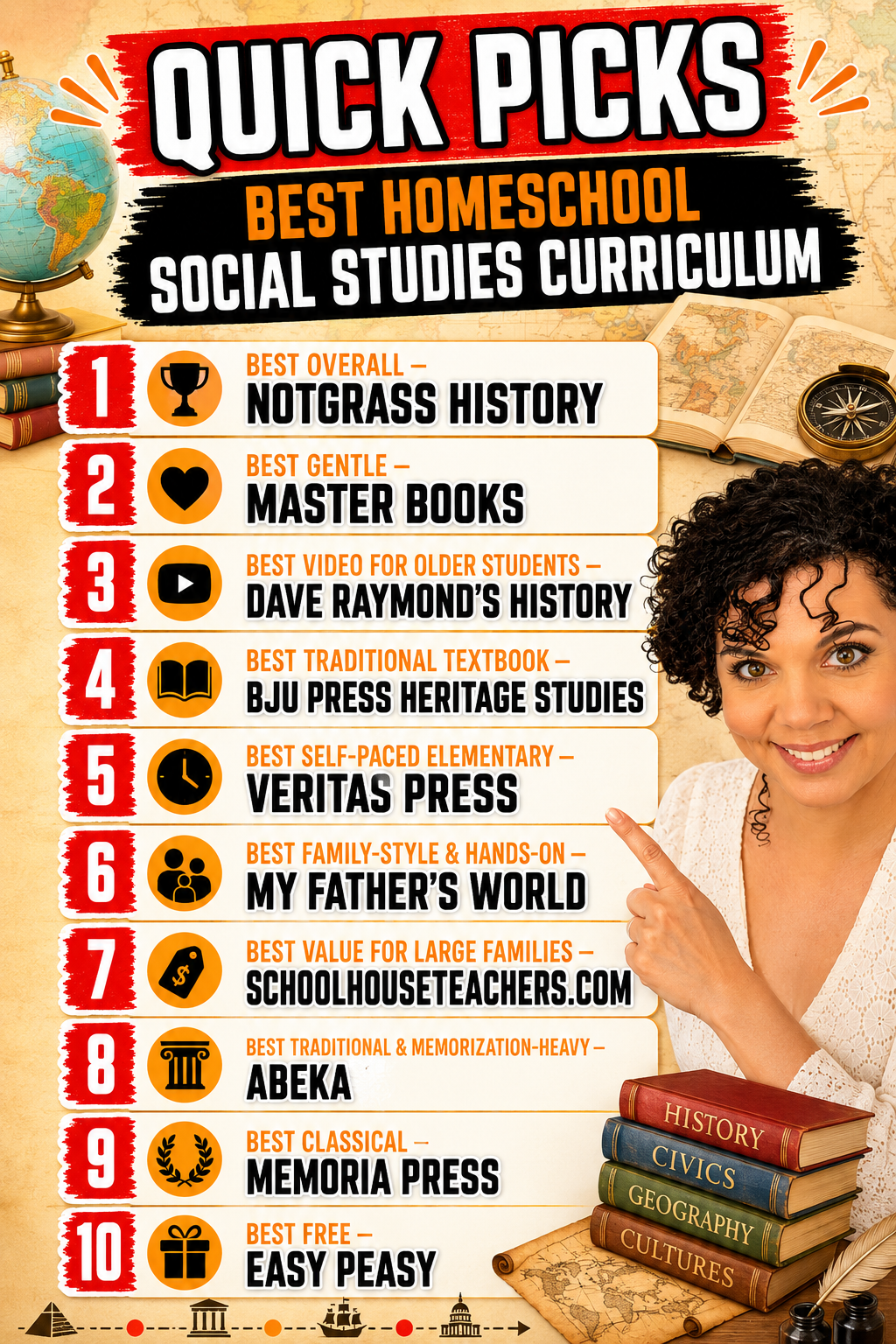
Quick Picks: The Best Homeschool Social Studies Curriculum
Here are my recommendations for families who need the answer before someone calls them to wipe something:
🏆 Best overall: Notgrass History
🌎 Best gentle social studies curriculum: Master Books
🎥 Best video history for older students: Dave Raymond’s History
📖 Best traditional textbook curriculum: BJU Press Heritage Studies
✂️ Best family-style and hands-on curriculum: My Father’s World
👨👩👧👦 Best value for a large family: SchoolhouseTeachers.com
📝 Best traditional and memorization-heavy option: Abeka
🏛️ Best classical social studies curriculum: Memoria Press
💰 Best free option: Easy Peasy All-in-One Homeschool
We will examine all of these properly below because choosing a curriculum from a three-word summary is how boxes arrive at your door that you later regret.
What Is Social Studies in Homeschooling?
Social studies is broader than history.
A complete social studies homeschool curriculum may include:
History
Geography
Government and civics
Economics
Communities and cultures
Current events
Sociology
Political science
However, homeschool publishers do not always use the term social studies.
They may call the subject history, heritage studies, world cultures, geography or civics.
Throughout this article, I will sometimes use social studies and history interchangeably, because history usually makes up the largest part of a homeschool social studies program.
That does not mean you need to study every social studies topic every year.
No…your seven-year-old will survive if you do not complete a detailed unit on monetary policy 😂
Why I Am Only Recommending Christian Social Studies Curriculum
You will not find a list of the best secular social studies homeschool curriculum options in this article.
That is deliberate.
I am a Christian, and I think I would give fairly terrible secular curriculum recommendations.
Social studies is not a neutral subject.
What we believe about God, humanity, truth, morality, government and the purpose of history affects how we teach it.
I believe Jesus Christ is Savior and Lord.
I believe all of history belongs to Him, points toward Him and sits under His sovereign rule.
I also believe our studies—and our lives—should ultimately glorify Him.
That is the perspective from which I evaluate curriculum.
Parents who want a secular curriculum would be better served by someone who shares that worldview and can evaluate those programs properly.
How to Choose the Right Homeschool Social Studies Curriculum
Before choosing a program, think about more than which book has the prettiest cover.
Consider your child’s age
Kindergarten social studies should not look like high school government.
Young children usually learn best through:
✅ stories,
✅ pictures,
✅ maps,
✅ conversations and
✅ simple activities.
Older students can begin:
✅ analyzing sources,
✅ comparing ideas,
✅ completing projects and
✅ writing essays.
Consider how your child learns
Does your child enjoy:
Listening to stories?
Watching video lessons?
Reading independently?
Completing worksheets?
Making timelines?
Building models?
Cutting, gluing and leaving tiny scraps of paper in every room?
There is no single curriculum format that works for every child.
Consider the writing load
This is particularly important if your child has dyslexia, dysgraphia or another learning difficulty.
A child may understand the history perfectly but struggle to demonstrate that knowledge through pages of written answers.
That is not the same thing as failing to learn.
You can often adapt a curriculum by allowing:
👍oral answers,
👍narration,
👍typing,
👍speech-to-text or
👍fewer written questions.
I always reckon the goal of social studies and history should be to learn the content, not get extra handwriting practice in.
So don’t exhaust the child with workbooks…cultivate a love of history in them instead!
Consider your capacity
A wonderful curriculum can still be the wrong curriculum for your current season.
I work from home and homeschool with a toddler nearby. '
I therefore have a different definition of “easy to use” from someone who considers constructing a historically accurate medieval village a relaxing Tuesday activity.
Be realistic about how much teaching, preparation, printing and hands-on work you can sustain.
Okay, nuff said…let’s get into the social studies picks!

1. Notgrass History: Best Overall Homeschool Social Studies Curriculum
Best for: Families wanting engaging, Christian, story-based history
Ages: Elementary through high school
Format: Printed books, optional literature, workbooks, timelines and activities
Parent involvement: Moderate in elementary; increasingly independent in older grades
Notgrass History (pictured above) is my first recommendation for the best homeschool social studies curriculum.
We have personally used their From Adam to Us history and social studies curriculum and absolutely loved it.
Instead of presenting history as a long procession of names and dates that your child must memorize before forgetting them after the test, Notgrass teaches through interesting historical stories.
The lessons feel fun and easy to read.
They invite children into history rather than standing at the door shouting facts at them.
Notgrass currently offers separate elementary, middle school and high school programs (meaning you can combine kids of closer ages and don’t have to buy a separate history curriculum each year for every child!).
Its elementary courses are written for Grades 1–4, while its older courses cover American history, world history, government, economics and geography.
The programs are Christian, open-and-go and designed so the instructions and assignments are included in the lesson books.
I’ve really enjoyed reading Notgrass History to my kids and re-learning all the old historical things I forgot 30 years ago in my own homeschool history education!
What comes with Notgrass?
Depending on the course, you may find:
Full-color lesson books
Student workbooks
Review questions
Literature selections
Maps
Timelines
Primary-source documents
Songs and poems
Hands-on activities
Creative writing
Games and review materials
For example, Our Star-Spangled Story is a one-year American history course for Grades 1–4. Its optional materials include literature, a timeline, songs, poems, dances, coloring pages and writing activities.
Notgrass also offers elementary geography through Our 50 States and Our Great Big World. Our 50 States combines stories, songs, maps, literature and optional activities in a one-year Christian course for Grades 1–4.
We did From Adam to Us and LOVED it.
How we use Notgrass
We do not always complete everything.
At the moment, we are often simply reading it.
And despite not completing every workbook page, timeline entry, and optional activity, my son is currently a walking social studies book.
He keeps telling me historical facts, making connections, and remembering things I had completely forgotten.
That is a fairly good sign that the curriculum is working.
You can use the workbooks, game books, charts, and activities.
But you can also close the activity book, sit on the couch, and read.
No one from Notgrass will arrive to confiscate your curriculum because you declined to use glue.
Is Notgrass hands-on?
It can be beautifully hands-on, but the activities are optional.
This makes it more flexible than curricula where the activity is the lesson.
Families who enjoy projects can lean into them.
Families who are busy can choose the ones that look especially worthwhile and leave the rest.
Potential drawbacks
Not every child enjoys a narrative curriculum.
Some students prefer concise textbooks, videos, or highly structured worksheets (I really think these kids are in the minority, though).
The complete packages can also include quite a lot of material.
Don’t assume you must complete every component merely because it arrived in the box.
My verdict: If a parent asked me to recommend one Christian social studies curriculum without giving me any other information, I would start with Notgrass.
👉 Check current Notgrass curriculum pricing and view samples here (they’re pretty affordable too!).
2. Master Books: Best Gentle Christian Social Studies Curriculum
Best for: Families wanting gentle, open-and-go lessons
Ages: Kindergarten through high school
Format: Full-color books with lessons and student activities
Parent involvement: Low to moderate
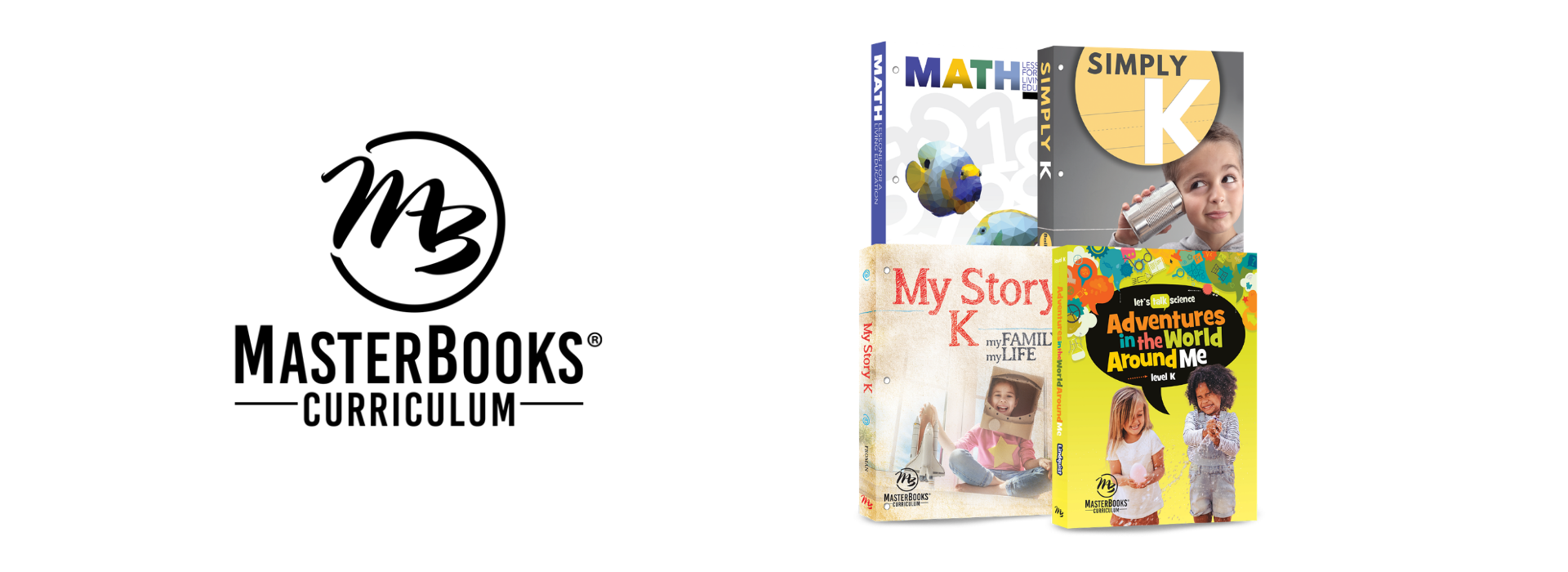
Master Books offers several history and social studies series.
For younger children, the My Story (pictured above as one of the books) series covers Kindergarten through Grade 2.
It introduces children to geography, history, culture, economics, government and communities from a Christian perspective.
Master Books describes it as an open-and-go social studies series designed for K–2.
Its Kindergarten course begins with family, neighborhood and church before introducing simple geography, citizenship, culture and economics.
For older elementary students, Master Books offers the America’s Story series (one picture below).
The three volumes cover American history and are generally designed for Grades 3–6.
They use an engaging narrative, historical pictures, maps and optional timelines, while the accompanying teacher guides contain schedules, worksheets and answer keys.

My opinion on the different Master Books levels
I do not think the K–2 social studies books are the strongest part of Master Books.
They are gentle, attractive and easy to use, and many families love them.
They may be exactly right for a young child who needs a light introduction.
However, I personally prefer Master Books’ America’s Story and World’s Story history series for older children.
These feel more like engaging history courses while remaining reasonably easy for parents to manage.
Why families choose Master Books
Master Books tends to work well for families who want:
Shorter lessons
Attractive pages
A gentle workload
A clear Christian worldview
Open-and-go plans
Less parent preparation
A curriculum that does not arrive making demands before you have removed the plastic
It is generally lighter than BJU Press, Abeka, Veritas Press or Memoria Press.
Whether that is a benefit or a problem depends on what you need.
A gentle curriculum is not automatically an inadequate curriculum.
But families seeking a highly rigorous or writing-intensive program may find it too light.
Best Master Books social studies options by age
Kindergarten–Grade 2: My Story
Grades 3–6: America’s Story
Upper elementary and middle school: The World’s Story
High school: Individual history, government, and economics courses
👉 Check current Master Books social studies and history pricing here.
3. Dave Raymond’s History: Best Video Social Studies for High School
Best for: Older students who learn through engaging video lectures
Ages: Approximately 12 and older
Format: Streaming video, readings, assignments, projects and exams
Parent involvement: Low to moderate
Dave Raymond’s history courses are offered through Compass Classroom.
I have not personally completed Dave Raymond’s courses, so I cannot give you a firsthand review.
However, I repeatedly see Christian homeschool parents rave about them.
We have used other Compass Classroom courses and loved them.
Everything I have seen from Compass Classroom has been thoughtful, interesting and aimed primarily at middle and high school students.
Dave Raymond’s American History is officially recommended for ages 12 and older and provides one full history credit.
It uses video lectures to connect American and world history with theology, literature, art, beliefs and a Christian worldview.
Compass Classroom recommends beginning with:
American History — age 12+
Modernity — age 13+
Antiquity — age 14+
Christendom — age 14+
The courses include far more than watching someone talk at a camera.
American History includes substantial video content, readings, projects, weekly exams and a year-long portfolio.
Compass Classroom positions the series as full high school history or social studies credits.
Why Dave Raymond stands out
Dave Raymond is known for teaching history as a story.
That matters because a good history teacher does not merely transfer information.
He helps students understand the people, ideas, beliefs and consequences behind events.
This is the sort of course where an older student may voluntarily tell you what he learned afterward, rather than responding, “History,” when asked what the lesson was about.
Things to consider
These courses are designed for older students.
I would not buy Dave Raymond for a young elementary child and expect him to sit through it simply because he once watched a two-hour animated movie without moving.
The content, assignments, and maturity level are different.
Some courses also include significant projects and written work.
Families should examine the samples and course requirements before choosing.
My verdict: Dave Raymond would be one of my first recommendations for a Christian high school student who enjoys video lessons and thoughtful storytelling.
👉 Check current Dave Raymond and Compass Classroom course pricing here.

4. BJU Press Heritage Studies: Best Traditional Christian Social Studies Curriculum
Best for: Families wanting colorful textbooks, structure, and optional video teaching
Ages: Grades 1–6 for Heritage Studies, with later BJU history courses available
Format: Textbooks, activity books, tests, and optional video lessons
Parent involvement: Moderate without videos; low with videos
We have personally used BJU Press Heritage Studies, and we enjoyed reading it together.
BJU Press teaches history, geography, culture and other social studies topics from a Christian worldview.
Its Heritage Studies courses are available through the elementary grades, with printed materials, digital options and online video instruction.
For example, BJU’s first-grade online Heritage Studies course includes streaming lessons through HomeschoolHub.
That course is scheduled for 90 days, with lessons averaging 15 minutes each.
What I liked about BJU Heritage Studies
The books are colorful, clear and interesting.
Although you can purchase video lessons, I enjoyed teaching Heritage Studies myself.
One of the wonderful parts of homeschooling is that you get to learn alongside your children.
You revisit topics you studied when you were young—or apparently sat near while someone else studied them—and suddenly understand them much better as an adult.
My son enjoyed the lessons and learned a great deal.
Adapting BJU Press for dysgraphia
The workbooks were a lot for my child with dysgraphia.
The problem was not understanding. It was the amount of writing required to demonstrate what he understood.
So I modified it.
I asked him the workbook questions orally, and he answered them verbally.
Sometimes we discussed a map or activity together instead of requiring him to write everything.
Once I separated learning social studies from producing pages of handwriting, he enjoyed the subject far more.
BJU’s activity books are designed to reinforce the lessons through map work, review exercises and study skills, but homeschool parents are free to adjust how children complete that work.
BJU Press video lessons
The optional online courses are a strong choice for families who need more independence.
The child watches an experienced teacher, then completes the assigned textbook or activity work.
This is particularly helpful if you are teaching several children, working from home or simply do not want to personally teach every subject.
BJU can become expensive when video lessons and complete book packages are added.
However, you can purchase the textbooks without the videos and teach the material yourself.
My verdict: BJU Press is a solid, enjoyable, and academically substantial choice.
Do not be afraid to modify the workbook load, especially for a child with writing difficulties.
👉 Check current BJU Press Heritage Studies pricing here.
5. Veritas Press Self-Paced History: Best Rigorous Online Elementary History
Best for: Children who enjoy games, songs, video and academic challenge
Ages: Primarily elementary, depending on the course
Format: Interactive online lessons with memory songs and activities
Parent involvement: Low
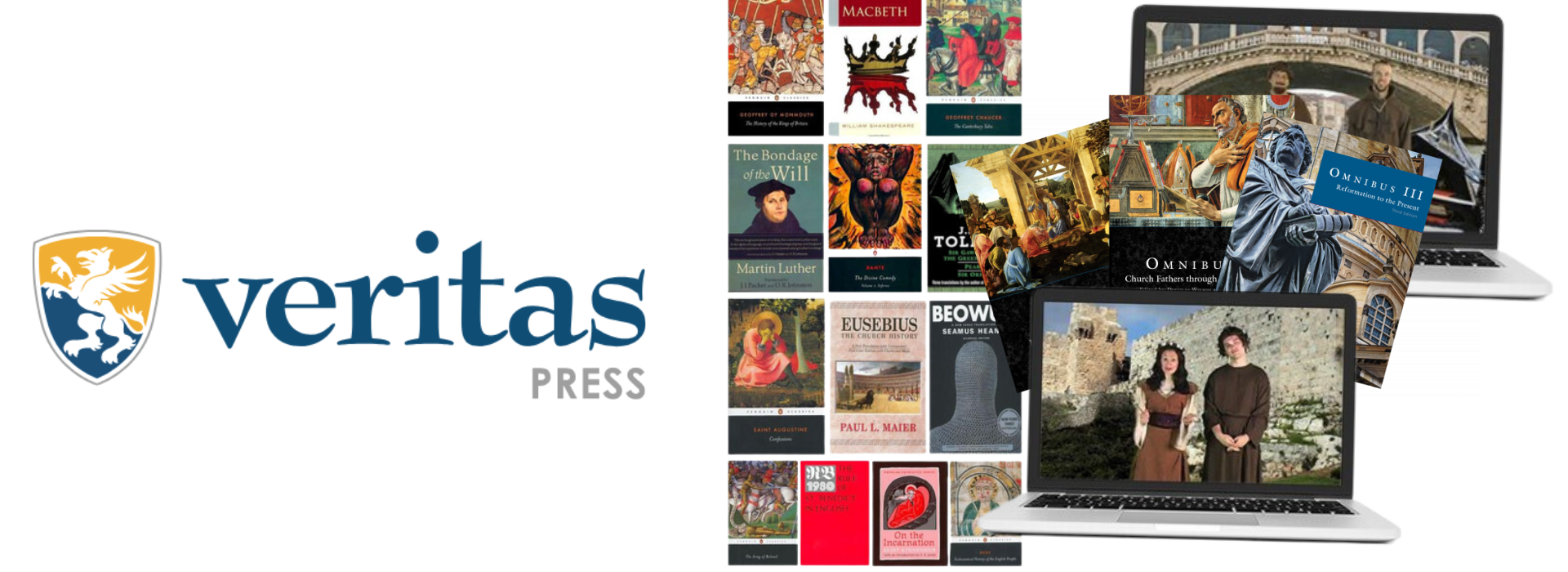
We used Veritas Press’s Old Testament and Ancient Egypt Self-Paced History course.
It was fun, interactive and quite rigorous.
The course covers 32 major events, beginning with Creation and moving through Old Testament and ancient Egyptian history.
It intentionally places biblical events into the wider chronological history of the ancient world.
That was one of my favorite parts.
Children do not learn Bible history as though it occurred in a separate floating universe.
They see biblical events alongside kingdoms, rulers, wars, and developments occurring elsewhere.
What the lessons are like
The lessons include:
Animated and live-action teaching
Games
Quizzes
Chronology
Historical characters
Review exercises
Memory songs
The history songs are extremely effective.
Children may forget a worksheet by lunchtime, but sing a sequence of events to them, and they may still be singing it while you are trying to concentrate three days later.
How rigorous is Veritas Press?
Veritas Press is more demanding than it initially appears.
The course is entertaining, so children may not notice immediately that they are being asked to retain a large amount of information.
It also asked my children to spell some very long historical names.
At certain points, history appeared to have quietly become an advanced spelling course.
The lessons could take a while, especially if the child carefully completes every activity.
This is not necessarily a bad thing, but families wanting a very short social studies lesson should know before purchasing it.
Who will like it?
Veritas is an excellent fit for:
Visual learners
Children who enjoy online games
Families wanting biblical and secular chronology connected
Parents wanting an independent course
Children who enjoy challenge
Classical homeschoolers
It may not suit a child who becomes frustrated by detailed quizzes, spelling or longer computer lessons.
My verdict: Fun enough that children do not always notice how much they are learning, but rigorous enough that parents certainly will.
👉 Check current Veritas Press Self-Paced History pricing here.

6. My Father’s World: Best Family-Style and Hands-On History Curriculum
Best for: Families who enjoy books, projects and teaching several children together
Ages: Preschool through high school
Format: Literature, unit studies, Bible integration and hands-on activities
Parent involvement: High
We have completed some My Father’s World history lessons, and my children really enjoyed them.
My Father’s World teaches through a collection of smaller books read together as a family.
Its approach combines Charlotte Mason influences, classical ideas, unit studies and a Christian worldview.
History, Bible, geography, literature, art, music and other subjects are integrated rather than treated as entirely separate boxes.
Its family cycle allows children in approximately Grades 4–8, along with younger siblings, to study many of the same subjects together.
What My Father’s World feels like
My Father’s World is warm, connected and family-centered.
You may read a historical story, find the place on a map, complete an activity, discuss the biblical connection, and add something to a notebook or timeline.
For book-loving children, this can be delightful.
It is also a popular answer when parents want literature-based social studies for a kindergartener and older elementary child together.
Why have we not used more of it?
I am not a naturally hands-on curriculum mom.
I work from home, I have several children, and my available enthusiasm for assembling projects has firm limits.
My Father’s World is a good curriculum.
It is simply more parent-involved and activity-rich than I can consistently manage in this season.
That does not mean it will not suit another family beautifully.
Some parents see a collection of craft supplies and become inspired.
I see it and begin calculating how long it will take to vacuum afterward!
Who should choose My Father’s World?
Consider it if you want:
Family-style teaching
A literature-rich program
Strong Bible integration
Hands-on learning
Unit studies
Multiple subjects connected together
A plan telling you which books and activities to use
Avoid it if you need children to work almost entirely independently or feel tired merely reading the materials list.
👉 Check current My Father’s World curriculum pricing here.

7. SchoolhouseTeachers.com: Best Social Studies Value for Large Families
Best for: Large families wanting many courses under one membership
Ages: Preschool through Grade 12
Format: Digital courses, printables, lesson plans, and streaming resources
Parent involvement: Varies by course
SchoolhouseTeachers.com is less like buying one social studies curriculum and more like receiving access to a very large curriculum cupboard.
One membership covers the whole family and includes hundreds of courses from preschool through high school, including core subjects, electives, lesson plans, and streaming resources.
This makes it particularly good value if you have several children or want to select different history courses for different ages.
Why SchoolhouseTeachers is useful
You can find courses covering:
American history
World history
Geography
Government
Economics
Historical people
Wars and major events
Different countries and cultures
Short unit studies
Full-year high school courses
It also provides subjects beyond social studies, so the membership may replace several separate curriculum purchases.
It’s a really good deal if your whole curriculum budget for the year is only a few hundred dollars and you have more than 3 children!
The downside
There can be a lot of printing.
The curriculum is primarily digital, so you may need to download lesson plans, readings and activity sheets.
A home printer that becomes emotionally unstable after page 40 may not appreciate this membership.
The enormous number of choices can also be overwhelming to new homeschoolers.
Do not join and assign twelve history electives merely because they are included.
Treat it like a buffet.
Access to everything does not mean your child must put everything on the plate.
Is it affordable?
Its value increases with each child who uses it because the membership covers the family rather than charging separately for each student.
SchoolhouseTeachers frequently runs substantial promotions.
At the time I checked, it was advertising a two-year membership offer (a yearly occurance), while its standard options included quarterly, annual and lifetime memberships.
👉 Check the current SchoolhouseTeachers.com membership offer here.
8. Abeka History: Best Traditional and Memorization-Heavy Option
Best for: Families wanting a highly structured, traditional curriculum
Ages: Kindergarten through high school
Format: Textbooks, teacher materials, tests and optional video lessons
Parent involvement: Moderate without videos; low with videos
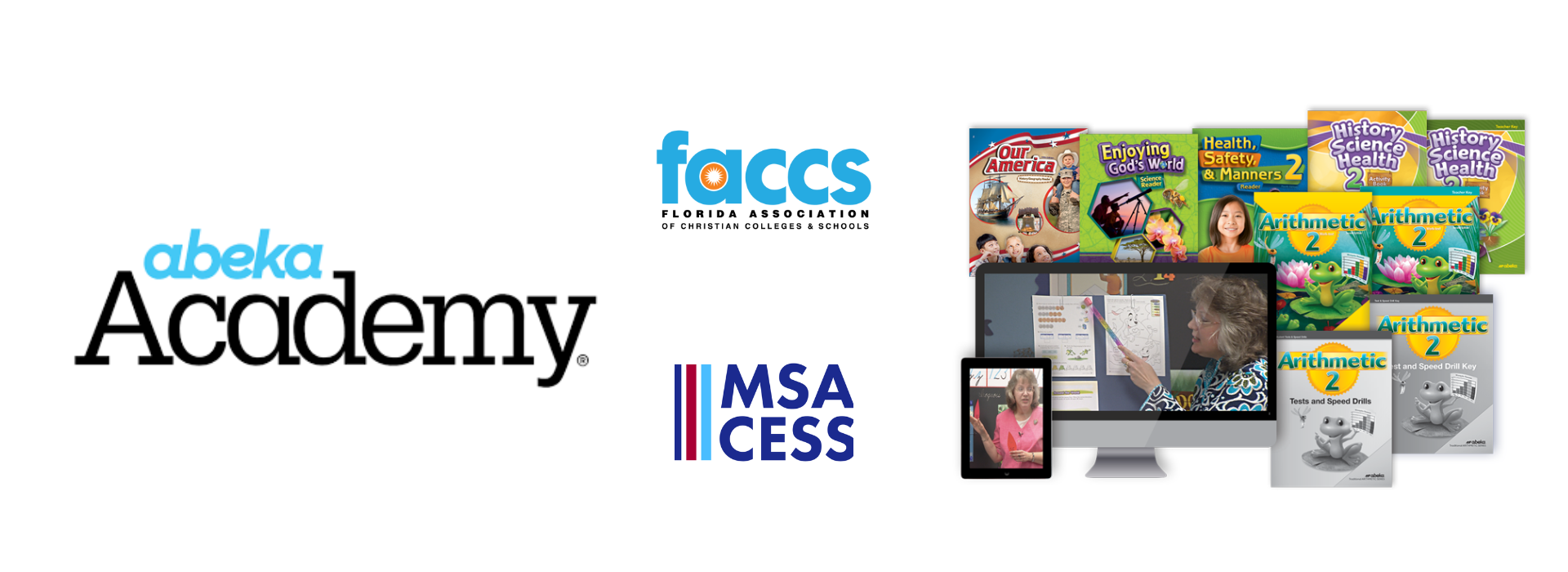
Abeka is similar to BJU Press in that it offers structured Christian textbooks, complete teacher materials and video instruction.
However, Abeka generally includes more material, places greater emphasis on memorization and often has longer lessons and videos.
It is academically solid and very traditional.
What Abeka does well
Abeka provides:
Clear daily plans
Frequent review
Historical facts and dates
Geography
Maps
Tests and quizzes
Strong teacher support
Optional video instruction
Its early elementary plans may combine history, science, health, social studies, art and music, while later grades use dedicated history and geography materials.
My strongest advice for using Abeka
Trim it.
Do not assume you must complete every question, activity, review and test exactly as written.
Abeka was originally designed with a traditional classroom structure in mind.
A homeschool family may not need the same amount of repetition or every piece of assigned work.
Use the curriculum. Do not let the curriculum use you.
If your child already knows the material, move on.
If the written work is becoming excessive, answer some questions orally.
If the video lesson is reviewing something mastered, skip or speed it up.
Potential drawbacks
Abeka can be:
Expensive
Memorization-heavy
Time-consuming
Repetitive
Overwhelming if used exactly as scheduled
But it remains a dependable choice for families who want structure, traditional academics and a clearly Christian perspective.
👉 Check current Abeka history curriculum and video pricing here.

9. Memoria Press: Best Classical Christian Social Studies Curriculum
Best for: Families wanting classical rigor, older texts and Western history
Ages: Junior Kindergarten through high school
Format: Books, study guides, recitation, tests and optional videos
Parent involvement: Moderate to high
Memoria Press teaches history through a classical Christian approach.
Its curriculum places strong emphasis on Western civilization, Greek and Roman history, literature, Christian studies, geography, memory work and carefully selected older texts.
The company describes Latin as a foundation of its classical program, with history and literature developing knowledge of Western civilization.
I have not personally used Memoria Press’s social studies materials, so I cannot tell you how they worked in my own home.
However, I have examined and used other Memoria Press materials, and its overall approach is clear: academically serious, carefully organized and substantially more rigorous than many gentle homeschool programs.
What Memoria Press history may include
Depending on the grade, students may study:
Ancient civilizations
Greek and Roman history
Famous historical figures
Church history
Classical geography
Christian studies
Art history
Literature connected to the period
Recitation questions
Quizzes and tests
For example, its sixth-grade package includes medieval history, world geography, Christian studies and classical literature alongside Latin and composition.
Who should consider it?
Memoria Press may be a good fit if:
You love classical education
Your child enjoys reading
You value memorization and recitation
You want a rigorous program
You enjoy older books
You want clearly scheduled lessons
The sight of Latin flashcards fills you with purpose rather than dread
It may not suit families wanting a light, child-led or highly independent social studies course.
Its full program can require considerable parent involvement, particularly in younger grades.

10. Easy Peasy: Best Free Homeschool Social Studies Curriculum
Best for: Families who need a completely free option
Ages: Kindergarten through high school
Format: Online lessons with readings, links, videos and printables
Parent involvement: Low to moderate
Easy Peasy All-in-One Homeschool is my recommendation for a free homeschool social studies curriculum.
Easy Peasy is a free Christian online curriculum covering subjects from Kindergarten through high school.
Its history themes include Ancient History, Early American History, Geography and Cultures and Modern History.
Children can follow daily assignments online, and families may print worksheets or purchase bound versions of the printables.
What I like about Easy Peasy
It is free.
That deserves to be said plainly because free curriculum can make homeschooling possible for a family who otherwise could not afford it.
It also organizes lessons for parents and provides a clear path through the material.
What parents should know
Although Easy Peasy’s core and foundation are Christian, it links to many resources around the internet, including secular materials.
That means the worldview and quality may not feel as consistent as a curriculum written and published entirely by one Christian company.
External websites can also change.
Sometimes following the resources feels a little more like an internet scavenger hunt than opening a single polished textbook.
I recommend Easy Peasy when the budget is extremely tight.
When families can afford a curriculum such as Notgrass, Master Books or BJU Press, I would generally choose one of those instead for a more cohesive and polished social studies course.
But when the choice is between Easy Peasy and not studying history at all, Easy Peasy is a wonderful resource to have available.
Best Kindergarten Social Studies Curriculum for Homeschool
Parents often wonder whether they need a formal kindergarten social studies curriculum for homeschool.
You do not need to turn Kindergarten into a miniature high school history class.
At this age, social studies can include:
Learning about family
Understanding neighborhoods and communities
Looking at simple maps
Learning the difference between a town, state and country
Reading stories about children in other places
Discussing important people from history
Learning Bible history
Talking about rules, leaders and good citizenship
Noticing national holidays and symbols
Read picture books.
Look at maps.
Talk about where relatives live.
Visit a museum.
Point out your country on a globe.
That is real social studies.
My top kindergarten recommendations
1. Master Books My Story K
This is the clearest standalone Christian Kindergarten social studies course on this list.
It introduces family, church, neighborhood, maps, citizenship, cultures and simple economics from a Christian perspective.
2. My Father’s World
My Father’s World integrates early history, Bible, literature, science, art and other subjects into its complete curriculum rather than requiring families to teach social studies as a completely separate subject.
3. Family read-alouds
A formal curriculum is optional.
A stack of good books, a globe and conversations with an interested parent can provide a wonderful foundation.
Notgrass is also excellent, but its dedicated elementary courses officially begin at Grade 1 rather than Kindergarten.
Best Elementary Social Studies Homeschool Curriculum
For elementary students, my strongest recommendations are:
Notgrass History — best overall
BJU Press Heritage Studies — best traditional option
Master Books — best gentle option
Veritas Press Self-Paced History — best online option
My Father’s World — best family-style option
At this age, I want children to enjoy stories, develop a sense of chronology, become familiar with maps and begin understanding how people, cultures and governments have changed.
I would rather have a child remember fascinating stories from history than complete 180 worksheets and retain only the knowledge that worksheets are unpleasant.
Best Middle School Social Studies Curriculum
For middle school, consider:
Notgrass From Adam to Us for world history
Notgrass America the Beautiful for American history
BJU Press for structured textbook or video lessons
SchoolhouseTeachers.com for flexible course options
Abeka for a traditional approach
Veritas Press for classical students
Notgrass’s middle school options are written for Grades 5–8 and include American history, world history and civics-related courses.
Middle school is a good time to add more independent reading, primary sources, maps, written narration and occasional projects without immediately requiring a thesis on the fall of Rome.
Best High School Social Studies Curriculum
My top high school recommendations are:
Best video course: Dave Raymond
His courses are designed for older students and provide full history credits with videos, readings, projects and assessments.
Best book-based curriculum: Notgrass
Notgrass offers high school courses in American history, world history, government, economics and geography. Some courses can also provide Bible or English credits when the complete assignments and literature components are used.
Best traditional option: BJU Press or Abeka
Both provide structured Christian courses with textbooks, assessments and optional video instruction.
Best classical option: Memoria Press
Memoria Press works well for academically strong students who enjoy literature, history, theology and classical studies.
Best flexible membership: SchoolhouseTeachers.com
This can be especially useful when siblings need several different high school courses.
Best Online Social Studies Curriculum for Homeschool
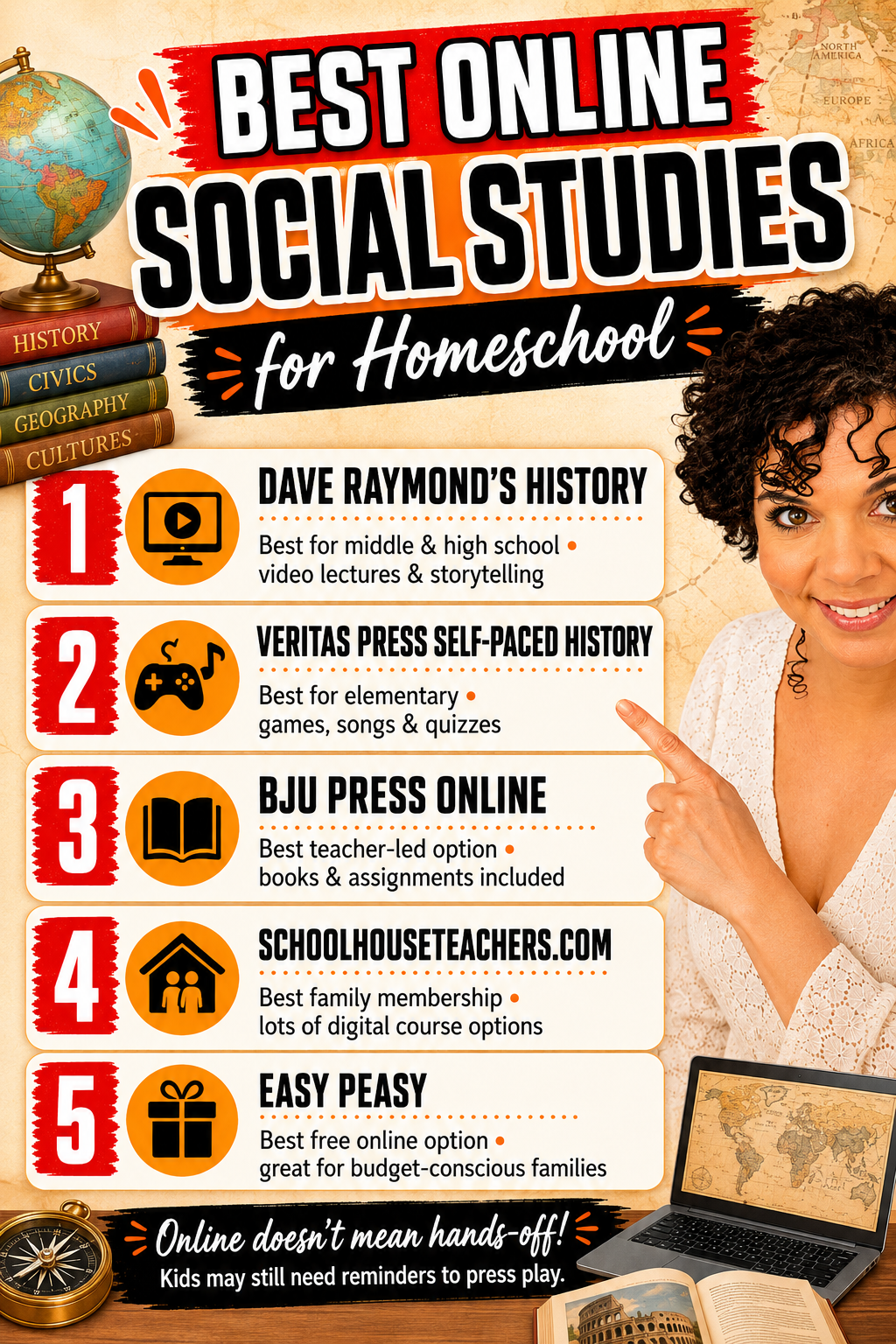
Parents searching for an online social studies curriculum homeschool option should consider these programs:
Dave Raymond’s History
Best for middle and high school students who enjoy video lectures and storytelling.
Veritas Press Self-Paced History
Best for elementary students who enjoy interactive lessons, games, songs and quizzes.
BJU Press Online
Best for families wanting a complete teacher-led course with corresponding textbooks and assignments.
SchoolhouseTeachers.com
Best for families who want a large selection of digital courses under one family membership.
Easy Peasy
Best for families who need a free online course and are comfortable following external links.
Online does not always mean completely hands-off. Students may still need books, projects, written assignments or help managing their schedule.
Unfortunately, purchasing a video course does not guarantee the child will press play without being reminded.
Best Literature-Based Social Studies Curriculum
For children who love books, consider:
Notgrass History
My Father’s World
Sonlight
Generations Homeschool
Simply Charlotte Mason
I have not included full reviews of every one of these in this guide because I prefer to give detailed recommendations about programs I have personally used, closely examined or researched thoroughly.
However, Beautiful Feet, Sonlight, Generations and Simply Charlotte Mason repeatedly appear in Christian homeschool discussions when parents ask for literature-based history.
Among the options I have used, I would choose Notgrass for the best balance of stories, structure, flexibility and optional literature.
A Note for Australian Homeschool Families
Most of the curricula in this article are written primarily for American families.
That is not automatically a problem.
Australian students can benefit from studying American and world history, just as American students benefit from studying civilizations beyond the United States.
However, Australian families will usually want to add some Australian history and civics.
A good option is Our Sunburnt Country, available through My Homeschool. It traces Australian history from Aboriginal settlement through more recent history and can be used alongside a broader history curriculum.
You do not necessarily need to add a second enormous history program.
Read an Australian history book, add a timeline or notebook and cover the required local topics. Your child can learn Australian history without your homeschool day developing its own time zone.
👉 Check current pricing for Our Sunburnt Country here.
Frequently Asked Questions
Is history the same as social studies?
History is part of social studies.
Social studies may also include geography, economics, government, civics, cultures and communities.
Homeschool publishers often call a broad social studies course “history,” even when it includes several of these areas.
What is the best Christian social studies homeschool curriculum?
My first recommendation is Notgrass History.
It is Christian, engaging and flexible.
Families can use the full collection of literature, workbooks, maps, timelines and activities—or simply read and discuss the lessons.
What is the best elementary social studies curriculum?
Notgrass is my first choice overall.
BJU Press is excellent for families wanting a structured textbook or video course.
Master Books is gentler, while Veritas Press provides a more rigorous online option.
Does my kindergartener need social studies?
Your kindergartener should begin learning about family, communities, maps, cultures and Bible history, but you do not necessarily need a formal daily curriculum.
Keep it light and enjoyable.
What is the best social studies curriculum for a child with dysgraphia?
Look for a curriculum that allows oral discussion, narration, videos or reading without requiring large amounts of handwriting.
We successfully used BJU Press Heritage Studies by asking the workbook questions orally.
Notgrass can also work well because you can read and discuss the lessons without completing every written activity.
Do we need to use the student workbook?
Not always.
A workbook can reinforce learning, but it is not the only evidence that learning occurred.
You can use oral answers, narration, conversations, maps, projects, timelines or occasional tests.
Choose a method that measures your child’s knowledge rather than merely measuring how long he can hold a pencil.
What is the best independent social studies curriculum?
For younger students, Veritas Press Self-Paced History or BJU Press Online can provide substantial independence.
For older students, Dave Raymond, Notgrass high school courses and BJU video courses are strong options.
What is the best free homeschool social studies curriculum?
Easy Peasy All-in-One Homeschool is my free recommendation.
It provides organized Christian history courses, although it also uses resources from other websites and may require printing.
Can I combine science and social studies in one homeschool curriculum?
Yes.
Programs such as My Father’s World integrate science and social studies with Bible, literature and other subjects.
Easy Peasy coordinates history and science themes, while SchoolhouseTeachers.com provides both subjects under one membership.
This can be useful for families who prefer unit studies or want several children studying connected topics.
Which social studies curriculum is best for a large family?
Notgrass and My Father’s World can both be used family-style.
SchoolhouseTeachers.com is also excellent value because one membership covers the whole family rather than charging for every course and child separately.
Still Not Sure Which History Curriculum to Choose?
Social studies is a broad subject, and many of the best options are really history curricula that also include geography, civics, culture, government, or economics.
So, before you buy anything, read my full guide to the best homeschool history curriculum.
In that article, I compare even more Christian history programs and help you choose according to your child’s age, learning style, independence level, and your own capacity as the parent.
Because the best curriculum is not necessarily the one with the largest box, the longest book list, or enough projects to keep your glue gun employed full-time. It is the one your family will actually enjoy and use.
👉 Read: The Best Homeschool History Curriculum Options for Christian Families or watch the video below!