The Good and the Beautiful Controversy, Revisited
If you’ve researched The Good and the Beautiful, you’ve probably heard two completely different claims: “It’s Mormon—stay away from it,” and “There’s nothing Mormon in the curriculum, so just teach Bible separately.”
After my original video, hundreds of comments pushed back on what I said—some argued that it’s the parent’s job to teach theology, others said the curriculum is genuinely Christ-centered, and quite a few questioned whether I could judge it fairly without actually using it.
And if you’re simply trying to choose a solid Christian curriculum for your children, all of that disagreement makes it much harder to know what actually matters and what you can safely ignore.
So in this post, I’m going back through the strongest questions and criticisms from that comment section and looking carefully at what The Good and the Beautiful actually teaches—and what it doesn’t.
By the end, you’ll know which concerns I think are legitimate, which ones are overstated, and whether this is a curriculum you can use with confidence in a Christ-centered homeschool.
Is The Good and the Beautiful actually a Mormon curriculum? 📚
Let’s start with probably the biggest misconception from my original video, because I think people on both sides can talk past each other here. Does The Good and the Beautiful actually teach Mormon doctrine?
Because this came up again and again in the comments.
People said, essentially, “I’ve used this curriculum for three years. There is no Mormonism in it. We’ve never opened a language arts lesson and discovered LDS theology.”
And I believe you.
If by “Mormon curriculum” we mean a curriculum that explicitly teaches children LDS doctrine, then no, that isn’t what I mean.
Your child isn’t going to open their maths book and suddenly find the Book of Mormon sandwiched between long division and fractions. That would certainly make this post considerably shorter.
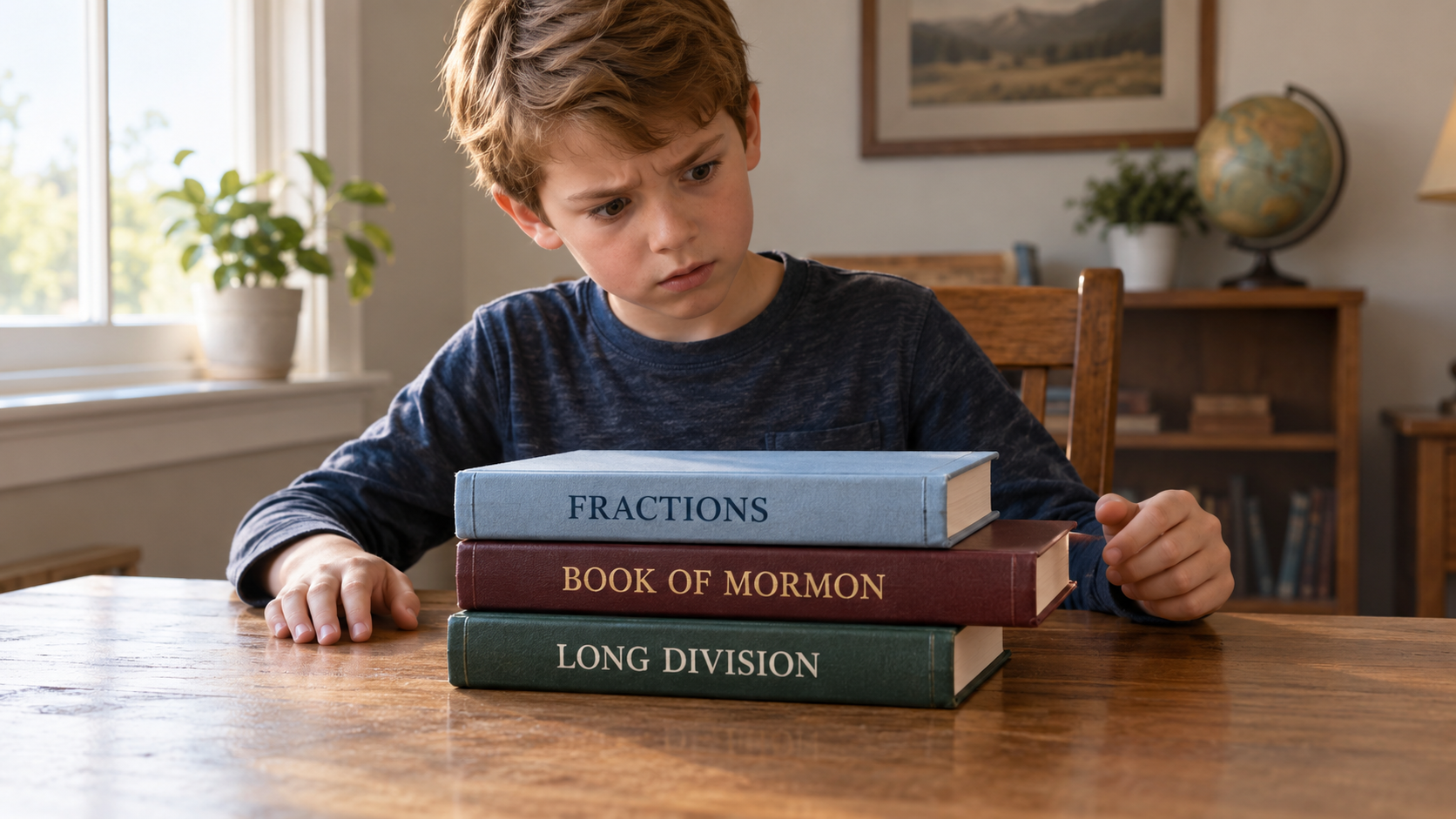
And this is actually one place where I think I could have been clearer in the original blog and video.
Plenty of Bible-believing Christian families have used The Good and the Beautiful for years and have said they have never encountered overt Mormon doctrine in it.
I’m not disputing their experience. But this is where the question changes.
Because if the curriculum doesn’t teach Mormon doctrine, then what exactly am I objecting to?
What has been left out?
My concern is actually almost the opposite.
It’s not primarily what has been put in. It’s what has deliberately been left out.
The Good and the Beautiful wants to be usable by families coming from very different theological backgrounds, and to do that, it has to avoid doctrines those families fundamentally disagree about.
And if this were simply being sold as a broadly wholesome curriculum, that would be one thing.
But when something is presented as Christian, I think we’re allowed to ask a second question:
What does “Christian” actually mean here?
Because there is a difference between saying, “This curriculum doesn't teach Mormonism,” and saying, “This curriculum clearly teaches the Christian gospel.”
Those aren't the same claim.
No—The Good and the Beautiful does not openly teach Mormon doctrine, and that was never my biggest objection; my concern is that it deliberately avoids the doctrines that distinguish the biblical gospel from other religions while still presenting itself as Christian.
Then why does Jenny Phillips being LDS matter?
And that immediately raises the objection I heard over and over again: if the curriculum isn’t teaching Mormon doctrine, why does Jenny Phillips being LDS matter at all?
Well, her religious background becomes relevant because this particular curriculum is presented as Christian while being deliberately designed for people with substantially different definitions of the biblical God, Jesus, Scripture and salvation.
And that creates a legitimate question about what definition of “Christian” is being used.
This isn't about whether Jenny Phillips is a nice person. I have no reason to make a judgment about her character.
It isn't even about whether an LDS person can produce academically useful material. Of course they can.
The question is whether The Good and the Beautiful has made its definition of ‘Christian’ so broad that it leaves out some of the core beliefs that actually define Christianity.
And I think that's a much fairer way of putting my original concern.
Her religion is relevant because The Good and the Beautiful markets itself as Christian, while using a definition of Christianity broad enough to include Mormon and Jehovah’s Witness backgrounds.
But my objection isn’t simply that an LDS woman created it.
My concern is that you can’t remove the doctrines that define Christianity, keep the Christian label, and call it non-denominational.
At some point, we’ve taken so much out of the sandwich that we’re just selling the bread.
Isn’t it the parent’s job—not the curriculum’s—to teach children the Bible?
But even if you agree that doctrine matters, you might still say, “Hang on—it’s my responsibility as the parent to teach my kids about God, not the curriculum’s.”
And actually, do we disagree on that?
This was probably one of the most common objections under my original video.
Parents said, “We use The Good and the Beautiful, but we do our own Bible study. I don't need my language arts curriculum teaching theology. That's my job.”
Yes. It is.
I completely agree that God gives parents responsibility for discipling their children. I don't want to outsource teaching my children Scripture to a curriculum company either.
But I think this presents us with a choice we don't actually have to make.
Choosing materials that reinforce what I teach
I can personally teach my children the Bible and choose educational materials that reinforce what I'm teaching them.
In fact, choosing those materials is part of my responsibility as their parent.
If my children are going to spend several hours a day, five days a week, learning through curriculum I've put in front of them, I care about what that curriculum teaches explicitly, what it assumes, and sometimes what it leaves out.
And that doesn't mean the curriculum becomes Mum and Dad and pastor and Sunday school teacher all rolled into one enormous teacher guide.
I'm still responsible.
But precisely because I'm responsible, I'm going to care about what I put in front of them.
And by the way, I know people had very strong opinions about this last time. I’d genuinely love to hear what you think of my rebuttals this time around, so tell me in the comments.
Yes—so part of that responsibility is choosing what will teach and influence our children for several hours every day, so I can teach my children the Bible myself and still choose a curriculum that reinforces it.
I don’t think those two ideas need separate custody arrangements.
Can’t you just use The Good and the Beautiful and add Bible separately? 📖
And this is where a lot of homeschoolers offered what sounds like a very practical solution: if you like the curriculum academically, why not just use it and add a separate Bible study?
And you absolutely can.
In fact, I do think parents should be teaching their children the Bible themselves. I’m not handing my children a language arts book and saying, “Right, excellent. You handle their eternal souls. I’ll be in the kitchen.”
That’s not my argument.
My concern is what we’re communicating to our children when we sit them down with something, and tell them,
“This is your Christian curriculum,” and then that curriculum teaches very little about who Christ actually is, why we need Him, and what He has done to save us as laid out in the Bible (not the book of Mormon or the Jehovah’s Witnesses’ New World Translation).
Because what does a child begin to understand Christianity to be?
They may encounter God. They may encounter prayer. They may encounter kindness and good morals and the occasional Bible verse even.
But they can walk away from their “Christian” curriculum without actually understanding the biblical gospel.
And to me, that’s the problem.
Because we’ve called something Christian while removing the very thing that makes Christianity Christianity.
Now, obviously, I can do damage control over breakfast by reading the Bible to my kids myself.
I can teach the gospel in family worship. I can talk about Jesus throughout the day.
And I should.
But that still doesn't answer my objection to the curriculum itself.
If anything, it leaves me in the slightly ridiculous position of having to add the Christianity back into the Christian curriculum. Which feels like something that should probably come pre-installed.
Christianity is more than a separate Bible subject
And I think this matters beyond simply having a separate Bible subject.
Because Christianity isn't just one little box on the timetable between maths and lunch.
When my children study literature, I want them to understand human nature through a biblical lens.
When they study history, I want them to understand sin and human nature.
When they study creation, I want them to know the Creator.
And when something calls itself Christian, I don't want my children gradually absorbing the idea that Christianity basically means: believe in God, pray, be good and be kind.
That is a warped picture of Christianity.
So yes, add Bible. Please teach your children the Bible. I certainly do.
But my question is still: why should I be satisfied with a curriculum calling itself Christian if my child can go through it without being clearly pointed to the biblical Christ and the gospel?
Of course we can add Bible separately.
But Jesus shouldn’t be sitting in the ‘optional supplements’ folder of a Christian curriculum.
Does every maths problem really need to mention Jesus?
Now, whenever I say I want the gospel woven through education, there’s an obvious pushback: does that mean every maths lesson has to turn into a Bible study?
No.
And I think this is where my argument can very quickly become a slightly ridiculous version of itself.
I am not suggesting that question seven should read, “If Jesus has twelve disciples and Peter subtracts three…”
Jesus doesn’t always need to make a cameo.
A multiplication problem doesn't become more mathematically accurate because someone has placed a Bible verse beside it.
And I wouldn't evaluate every subject in exactly the same way.
Maths usually involves fewer explicit worldview questions than history, literature or science.
So when I say I want a Christ-centred education, I don't mean every individual worksheet must contain an explicit gospel presentation.
There's a difference between Christian education having a Christian foundation and trying to shoehorn Christian terminology into every possible sentence.
In fact, forced integration can become rather silly.
But the existence of subjects where theology is going to be less explicit doesn't mean theology becomes irrelevant to education as a whole.
That's the distinction I'm making.
No—nobody is asking for Jesus to be awkwardly inserted beside every multiplication problem, and worldview is far more obvious in literature, history and science than arithmetic… but in Christian education, it shouldn’t be nowhere.
It mentions God, Jesus, prayer and the Bible—so why isn’t that enough?
And this brings us to what may be the strongest objection from families who have actually used the curriculum: it does mention God, Jesus, prayer and the Bible. So why am I still saying that isn’t enough?
This is important, because I don't want to pretend those references aren't there.
Families who use the curriculum have quite reasonably pointed out that it talks about God. It uses Scripture. It talks about prayer and “Christian” values.
So if I simply said, ‘There’s nothing Christian anywhere in it,’ that would be too simplistic. There are clearly Christian values there. My concern is what’s missing from them.
The question is what those (I’m going to call them) theological words actually communicate.
The same words can mean different things
Because two people can both use the word “Jesus” without believing the same things about Jesus.
Two churches can both use the word ‘salvation’ while meaning very different things by it.
Mormons, JWs and orthodox Christians can all use words like grace, Scripture and God while holding fundamentally different beliefs underneath them.
And this came up so many times in my original video’s comment section that I could make an entirely separate video about it. Please don’t encourage me. But one comment illustrates it particularly well.
An LDS viewer very graciously explained that she absolutely believes the gospel is about Jesus and that we cannot be saved without Him.
I appreciated that comment.
But sharing Christian vocabulary doesn't remove the very substantial theological differences between historic Christianity and LDS theology.
That's precisely why merely counting references to Jesus doesn't answer my question.
For me, a Christ-centred curriculum should do more than communicate that God exists, prayer is good and children should be kind.
I want my children pointed towards who Christ actually is, why human beings need saving, what happened at the cross and resurrection, and where salvation is found.
That's the centre.
Mentioning Jesus is not the same as teaching the gospel, and for me a Christ-centred curriculum must do more than contain Christian references—it should clearly point children to who Christ is, why they need saving and what He accomplished for them.
But isn’t avoiding theological disagreements exactly what “non-denominational” means?
Now, I’m not expecting a non-denominational curriculum to resolve two thousand years of Christian disagreement before we get to morning tea. So where do we actually draw the line?
Because Christians disagree about heaps of things.
Baptism. Church government. The end times.
We have demonstrated a rather remarkable ability to disagree about things for two thousand years. And I don't need my child's spelling curriculum to finally resolve all of them.
Secondary disagreements and foundational beliefs
A broadly Christian curriculum can absolutely avoid taking sides on secondary doctrines.
That's what I would expect “non-denominational” to mean.
But there has to be some substance left underneath the word Christian.
For example, Christians from different Protestant denominations can disagree about baptism while still affirming foundational beliefs about God, Scripture, sin, Christ's death, resurrection and salvation.
Those are different categories of disagreement.
So imagine a curriculum removes a particular belief because Baptists and Presbyterians disagree about it. Fine.
But if it removes a belief because Christianity and another religion fundamentally disagree about it, that's a very different thing.
At some point, making the theological tent broader doesn't create greater Christian unity. It simply removes the doctrines causing the disagreement.
And eventually you're left with Christian language broad enough that everybody can interpret it according to their own theology.
That's the line I'm concerned about.
So, non-denominational doesn’t have to mean theologically empty. You can leave the debates about baptism, church government and the end times for Christians to cheerfully argue about until Jesus comes back.
But you can still teach the foundations of biblical Christianity: the Trinity, the authority and sufficiency of Scripture, our sin, Christ’s death and resurrection, and salvation through Him.
And by Scripture, I mean the Bible. We’re not leaving the door open for the Book of Mormon to wander in and join the reading list.
Can I really assess the curriculum if I’ve never actually used it?
Now, there was one criticism of my original video where I do think I needed to be more precise. If I hadn’t actually used The Good and the Beautiful with my children, was it fair for me to call what I made a review?
This is probably the criticism where I would change my wording most clearly.
Because if I were telling you, “I've used this for a year and here's what the lessons are like in real life,” then yes, I would need to have actually used it.
I couldn't tell you whether my child got bored in week twelve.
I couldn't tell you whether the lessons that claim to take twenty minutes mysteriously take forty-five.
I couldn't tell you how well my children retained the material. Those are hands-on review questions.
But that's not actually the decision I was making.
A theological assessment before purchasing
I was looking at the curriculum before purchasing it and asking whether its theological approach met the criteria I had for my family.
And we all do this.
Otherwise curriculum shopping would require buying every programme, using each one for twelve months and then deciding which one we should have bought twelve months ago.
The samples and company information exist partly so parents can make that decision before purchasing.
So no, I can’t tell you what it’s like to actually use The Good and the Beautiful day to day. But I can tell you why I chose not to use it in the first place. Otherwise curriculum research becomes a rather expensive game of ‘buy first, ask questions later.’
And speaking of expensive—or, in this case, very much not expensive—that brings us to one of the biggest reasons families love it.
But what if it’s free, academically useful and works beautifully for my child? 💰
Because theology isn’t the only thing homeschool parents have to consider. What if the curriculum is free, easy to use, academically helpful and genuinely works for your child?
(And this is where my theological argument runs headfirst into the homeschool budget.)

One parent commented very simply that it's free, it works for their family, they can't afford hundreds of dollars a year, and they read the Bible themselves.
I understand that.
Especially if you're homeschooling on one income, “free” isn't a cute little bonus tucked at the bottom of a comparison chart.
It can be the reason homeschooling is financially possible.
And plenty of parents aren't using The Good and the Beautiful because they've conducted a grand theological experiment.
They're using it because their children like it.
It's attractive. It's accessible. It's open-and-go. It makes their homeschool day manageable.
Those are genuine strengths.
And if your child went from fighting language arts every morning to actually enjoying it, I understand why you're not particularly excited when someone on YouTube arrives to tell you there's a problem with your curriculum.
Academic strengths and theological concerns
But those strengths answer a different question.
Something can be academically useful without meeting my theological criteria.
Something can work beautifully for a particular child without being something I would recommend as a Christ-centred curriculum.
Those things can be true at once.
And I think recognising that actually makes this discussion fairer.
I don't have to pretend The Good and the Beautiful has no strengths in order to disagree with its theological approach.
So it can be free, beautiful, academically solid, easy to teach and loved by your children. (At this point, the homeschool mum in me is already reaching for the download button.)

But the Christian mum in me still has one more question: where’s the gospel?
So would I use The Good and the Beautiful in a Christ-centred homeschool?
So after all of those comments, corrections and legitimate disagreements, we finally come back to the question that actually matters when you’re choosing curriculum: knowing everything I know now, would I use The Good and the Beautiful in a Christ-centred homeschool?
My answer is still no.
But I want to be very clear about what I am—and am not—saying when I give that answer.
I am not saying that if you use The Good and the Beautiful, your children won't know Jesus.
A curriculum cannot save your children.
And thankfully, their salvation isn't dependent upon Mum managing to select theologically perfect language arts in second grade.
God is considerably bigger than our curriculum decisions.
I also don't think Christians who use The Good and the Beautiful are therefore bad parents or weak Christians.
Some of the people disagreeing with me in that original comment section clearly care deeply about teaching their children Scripture.
We disagree about a curriculum decision. That's allowed.
But God's sovereignty doesn't make our choices meaningless either. I still have to decide what I put in front of my children every day.
What I would say differently now
And for me, after going back through the criticism, there are things I would say differently.
I did say this in the original blog video, but apparently I need to get the highlighter and laminator out: The Good and the Beautiful is not a Mormon curriculum.
It does not teach Mormon doctrine. In fact, if you’re LDS and hoping the curriculum will teach LDS theology for you… bad news. You’ll be supplementing too.
I’d also make it painfully clear that I was giving a theological assessment, not a hands-on review. I can’t tell you how it performs at my kitchen table because, rather inconveniently for the review process, it didn’t pass the test required to get there.
So the criticism was useful. It didn’t change my conclusion, but it did show me which parts of my argument people were getting stuck on—or, occasionally, sprinting straight past.
But none of that changes the central issue for me.
Why my answer is still no
If I'm deliberately choosing a Christian curriculum, I want Christianity to mean something more substantial than broadly Christian language and moral values.
I want the gospel.
I want my children's education to reinforce the truth I'm already teaching them about Christ, not avoid those doctrines so the material can remain acceptable across fundamentally different religious beliefs.
You may weigh that differently.
You may decide the academic fit, affordability and ease of use make The Good and the Beautiful an excellent choice for your family, and you'll handle theology separately.
But at least now you know what my objection actually is: not that Mormon doctrine has been put into the curriculum, but that too much Christian doctrine has been taken out.
And that, I think, is a much more useful conversation.
A curriculum cannot save my children, but it can reinforce the truth I am teaching them, remain silent about it or contradict it, and because I want their education to reinforce the gospel, my answer is still… no.
I'd genuinely love to know where you land after reading these rebuttals, even if you disagreed with my original video. Comment below and tell me what you think.
How different are Mormonism and biblical Christianity?
And now you’ve read my response to the biggest criticisms of my original video, and why I still wouldn’t choose The Good and the Beautiful for a Christ-centred homeschool.
But maybe you’re still thinking, “Okay Bec, you keep saying Mormonism and biblical Christianity are different—but how different are they really?”
Well, that deserves more than a brief mention at the end of this post.
In my video comparing Mormonism and historic Christianity, I put their doctrines side by side and compare what each actually teaches about God, Jesus, Scripture, salvation and the afterlife.
Or, if you want to see where this entire comment-section adventure started, you can watch my original video on The Good and the Beautiful.