The Good and the Beautiful Review: Why It’s NOT Christian Homeschool Curriculum
If you’re considering The Good and the Beautiful homeschool curriculum, you need to hear this before you spend a single dollar — because this curriculum is either going to feel like the answer to your homeschool prayers… or become something you later deeply regret using as a Christian family.
And yes, I know that sounds dramatic.
But after years in the homeschool world watching Christian parents debate this curriculum online, seeing the comments under my videos explode into arguments with literally hundreds of replies, and hearing from mothers who later felt genuinely convicted about using it, I don’t think this conversation is small anymore.
It matters.
Because this isn’t just about pretty worksheets.
It isn’t just about phonics.
And it definitely isn’t just about whether a curriculum is “wholesome.”
This is actually about something much deeper:
What does it mean for homeschool curriculum to be Christian?
And I think that’s the question a lot of homeschool families still haven’t really stopped to ask.
Now before I go any further, I need to say something important because people often misunderstand my position here.
I do NOT hate Mormons.
I do NOT hate people using this curriculum.
And I absolutely do not think every family using The Good and the Beautiful is somehow evil or malicious.
Actually, some of the kindest comments I’ve ever received online have come from LDS families using this curriculum.
But at the same time?
I’m not going to back down from saying what I believe is true simply because it’s controversial.
Because if Christian homeschoolers cannot lovingly talk about theology, worldview, and the gospel without immediately panicking that someone might feel offended, then we’ve already lost the entire point of Christian education in the first place.
Why The Good and the Beautiful Feels So Christian
And really, I think that’s partly why this curriculum creates such strong reactions.
Because on the surface, everything about it FEELS Christian.
The name sounds Christian. The aesthetic feels Christian. The morals feel Christian. The Bible verses, the beautiful nature imagery, and even the language feels Christian.
And it’s gorgeous.
I’ve flipped through the books myself and I completely understand why homeschool moms fall in love with them instantly.
Everything is truly good-looking and beautiful. The colours are soft and inviting, the pages feel peaceful, the lessons look manageable, and the artwork is stunning.
Compared to some homeschool curriculum that looks like it was designed by exhausted accountants in a basement office in 1992, The Good and the Beautiful feels fresh, modern, calming, and emotionally attractive.
And really, I think that’s one of the biggest reasons it exploded online.
Because homeschool mothers are tired.
They’re overwhelmed and often burned out.
Often they’re trying to escape public school chaos.
Many are managing multiple children on one income.
And then suddenly along comes this curriculum floating through Instagram looking like a peaceful woodland cottage wrapped in watercolour paintings and Bible verses.
Of course moms click on it.
Why Homeschool Moms Are Drawn to It
Especially because another huge selling point is the price.
A lot of the curriculum is free to print in a lot of the younger grades.
And when it isn’t free, it’s still very affordable compared to programs like Abeka, BJU Press or even Masterbooks.
And really, that matters hugely when you’re on one income and living paycheck to paycheck.
Most homeschool families are hugely sacrificing financially to homeschool.
Usually one parent stays home and money gets tight.
And when you’re comparing:
a free curriculum,
a beautiful curriculum,
a gentle curriculum,
and a curriculum everyone online seems obsessed with…it’s incredibly easy to understand why parents are drawn to it.
Is The Good and the Beautiful Academically Strong?
Academically, I’d actually place The Good and the Beautiful somewhere in the middle overall.
It’s definitely not as academically soft and gentle as something like MasterBooks or ACE PACEs.
But it’s also nowhere near as rigorous or demanding as Abeka.
I’d call it fairly middle-of-the-road academically.
Additionally the curriculum feels wholesome, and unlike public school curriculum, you’re not constantly worrying your child is about to stumble across gender ideology halfway through a spelling lesson.
So no — this article is not me pretending The Good and the Beautiful is terrible in every way.
That would be ridiculous.
The Real Problem I Have With The Good and the Beautiful
The issue is something much bigger.
Because despite all those strengths…
I do not believe The Good and the Beautiful is actually a Christian curriculum.
And yes, I know that statement makes people very upset.
But hear me out.
Because my issue is not primarily:
that it was founded by a Mormon,
or that people from different religions (such as Jehovah’s Witnesses) reviewed the curriculum,
or even that it avoids heavy denominational teaching.
My issue is much simpler than that; namely that it does not teach the gospel.
And if a curriculum does not teach:
that Jesus Christ is the Son of God,
that He died for our sins,
that He physically rose again,
that salvation comes by grace through faith,
and that Jesus is the only way to God…
…then in what meaningful sense is that curriculum actually Christian?
That’s the real question.
Because simply mentioning God does not make something Christian.
Teaching good morals does not make something Christian.
Teaching kindness does not make something Christian.
Even quoting Bible verses does not automatically make something Christian.
After all, Satan himself quoted Scripture.
And really, this is where I think many homeschool families accidentally confuse:
wholesomeness with Christianity.
But they are not the same thing.
Something can feel:
moral,
safe,
beautiful,
gentle,
family-friendly,
and values-based…
…without actually teaching the gospel at all.
Some People Say It DOES Teach the Gospel…

And to be fair, this is probably the biggest disagreement people have with me (the above comment was repeated many times on my video here).
Because many supporters of The Good and the Beautiful will say:
“But it DOES teach Jesus.” “It DOES mention grace.” “It DOES use Bible verses.” “It DOES talk about God.”
And I understand why people say that. Because the curriculum absolutely uses Christian language.
The issue is that words like:
Jesus,
grace,
salvation,
God,
truth,
and gospel…
…only mean something if everyone is defining them the same way.
And they’re not.
That’s the real issue.
Because Mormons, Jehovah’s Witnesses, Catholics, Protestants, Muslims, progressive Christians, universalists, and secular spiritual people can all use some of the exact same religious words while meaning completely different things!!!
And that’s why I keep coming back to the question:
“What gospel is actually being taught clearly?”
Because from my perspective, The Good and the Beautiful avoids defining theology strongly enough for it to genuinely function as Christian discipleship curriculum.
It uses Christian-sounding language very comfortably.
But there’s a huge difference between:
sounding Christian, and
clearly teaching the biblical gospel.
That distinction matters enormously.
(If you want to look at the way a Mormon defines common Christian terms, see the video below…it’s fascinating!)
And I think this is partly why so many Christian homeschool moms feel confused when discussing the curriculum online.
Because one side is saying:
“Look! It mentions Jesus!”
While the other side is asking:
“Yes… but WHO is Jesus according to the curriculum?”
And those are not the same question.
That’s why I personally don’t think simply sprinkling Bible verses and Christian terminology throughout curriculum is enough to call it Christian homeschool curriculum.
Because again:
wholesome language is not the same thing as the gospel.
Why I Believe The Good and the Beautiful Is Secular
And from my perspective, that makes The Good and the Beautiful fundamentally secular.
Now I know that word shocks people.
Because when people hear “secular,” they imagine rainbow flags, atheism, aggressive anti-Christian teaching, or progressive ideology.
But secular simply means:
not centered on religion.
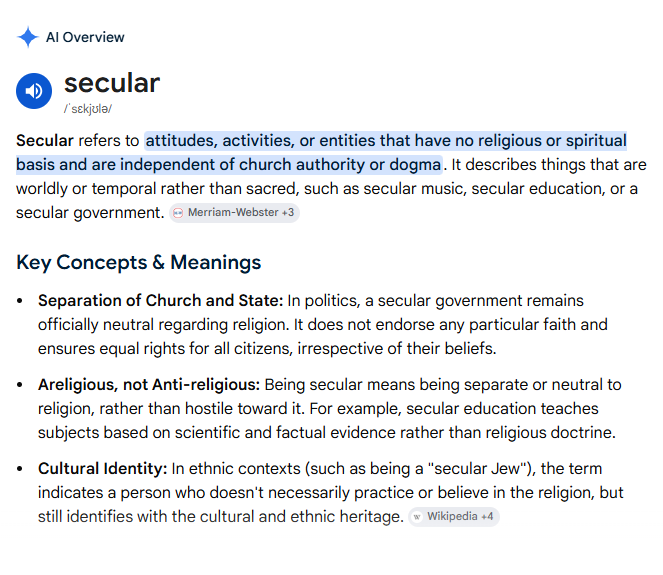
This is the definition Google’s AI Overview gives when you put in ‘secular’.
And really?
Secular exactly what this curriculum is.
It’s not aggressively anti-Christian, or pushing atheism. It’s not even really pushing Mormon doctrine directly either.
But it also isn’t pointing children clearly toward the biblical gospel.
Because as Christians, the gospel is not some tiny side issue we tack onto life after the “real learning” is done.
The gospel IS the center.
It’s the whole point.
And if homeschool curriculum takes up hours of our children’s lives every single day, why on earth would we intentionally choose curriculum that avoids clearly teaching the most important truth in existence?
“It’s My Job to Teach Theology, Not Curriculum”
This is where people usually object and say something like:
“It’s MY job to teach theology, not a math curriculum.”
And honestly?
I think that argument completely falls apart if you think about it for more than about thirty seconds.
Because that’s like saying:
“It’s my job to teach my children about God, so I’m not going to use a Bible.”
No.
As parents, we use:
books,
conversations,
curriculum,
devotionals,
church,
songs,
and resources…
…to HELP disciple our children.
The question is not:
“Should parents disciple their kids?”
Of course they should.
The question is:
“Why would we choose curriculum that avoids clearly pointing to Jesus when there are so many options that DO?”
That’s the real issue.
Education Is Never Neutral
And honestly, I think a lot of Christian homeschool families have accidentally accepted this strange modern idea that education is somehow neutral.
But it isn’t.
Nothing is neutral.
Every curriculum points somewhere.
Every curriculum has a worldview.
Every curriculum teaches values.
Every curriculum shapes the imagination.
Every curriculum tells children what matters.
Every curriculum points toward some vision of truth, morality, beauty, humanity, and purpose.
Even when it claims not to.
And honestly?
I think that’s one of the biggest hidden dangers of The Good and the Beautiful.
Because it FEELS Christian enough that many parents stop asking deeper questions.
It feels spiritually safe.
But what it actually teaches most strongly is:
morality,
beauty,
kindness,
character,
and generic spirituality.
And while those things are good, they are not the gospel.
That’s not Christianity.
That’s moralism.
Or honestly, something closer to humanism wrapped in Christian aesthetics.
And yes, I know people will get upset reading that.
But I genuinely think Christian homeschoolers need to stop confusing:
“good values”
with
“biblical Christianity.”
Because they are not the same thing.
A child can grow up:
polite,
kind,
artistic,
gentle,
environmentally conscious,
respectful,
and morally behaved…
…and still not understand the gospel.
And as Christians, that should deeply concern us.
One of the most common comments I get under my videos is this:
“I don’t need my curriculum to teach my kids theology. That’s my responsibility as a parent.”
Another parent wrote:
“We use our own Bible curriculum and WE make our homeschool Christ centered.”
And another said:
“Academics are not intrinsically attached to values and morals.”
But honestly?
I completely disagree with that last statement.
Academics ARE attached to worldview.
Always.
History teaches worldview.
Science teaches worldview.
Literature teaches worldview.
Language teaches worldview.
Even mathematics reflects worldview assumptions about order, logic, and truth.
Education is never neutral.
Ever.
That’s actually why Christian homeschooling exists in the first place.
If education were neutral, there would be no reason to homeschool Christianly at all.
And honestly, I think some Christian homeschoolers accidentally undermine their own entire argument for homeschooling when they say:
“Curriculum doesn’t matter spiritually.”
Because if curriculum doesn’t spiritually matter…
then why not just use secular curriculum for everything?
Why not public school?
Clearly we DO believe worldview matters.
The only question is:
how much?
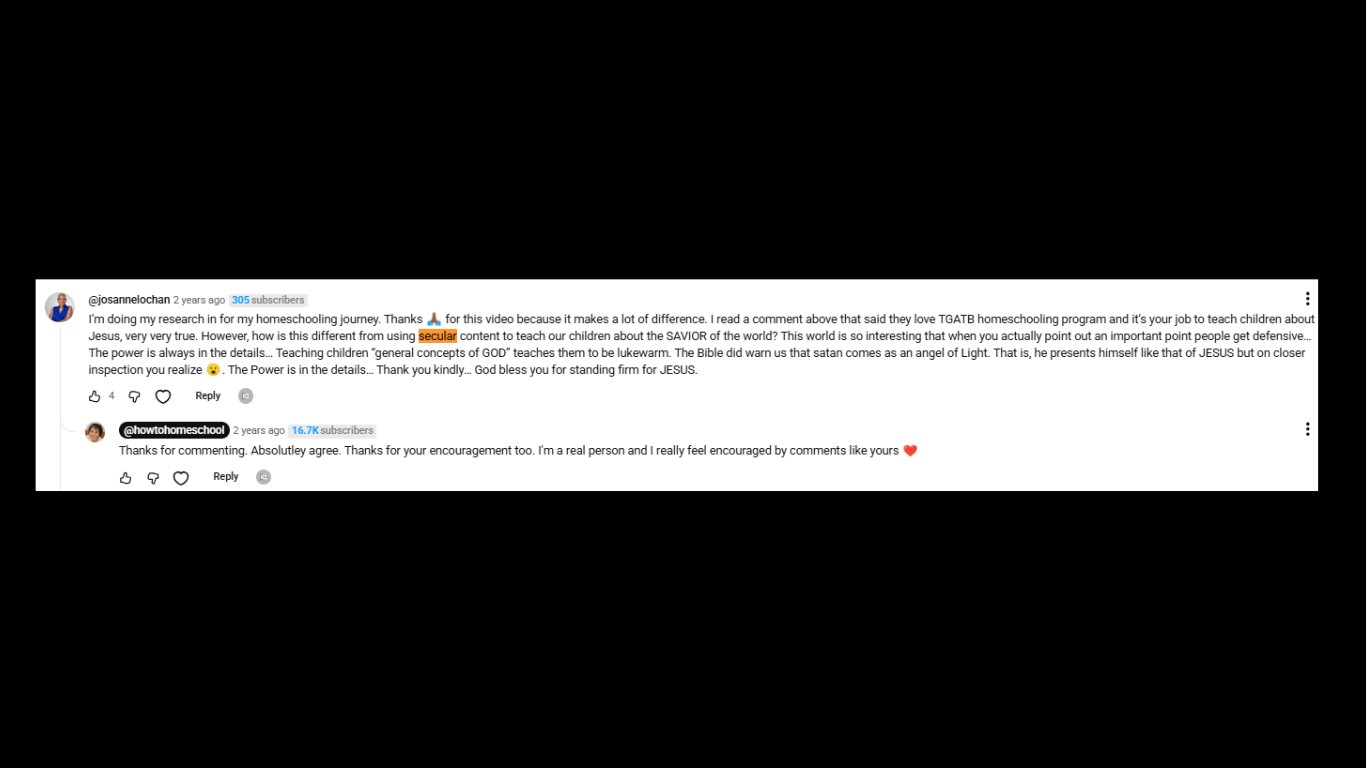
The Good and The Beautiful isn't even lukewarm Christianity. It's no Christianity at all.
Is The Good and the Beautiful Teaching Mormonism?
Now, I want to say something carefully here because this really matters.
I do not believe The Good and the Beautiful is secretly trying to convert children to Mormonism.
I really don’t.
In fact, one of the most interesting things about the curriculum is actually how carefully it avoids strong doctrine altogether. And many supporters of the curriculum genuinely see that as one of its strengths.
One parent commented under my video:
“The reason there are people of so many denominations is to ensure there aren't any one denomination pushing their ideas.”
Another wrote:
“It’s not up to the curriculum to teach your kids doctrine.”
And really, that’s exactly where my concern begins.
Because if a curriculum advertises itself as Christian, why does it feel so careful to avoid clear theology? Why is the gospel so vague?
Why does it seem designed to avoid defining Christian truth strongly enough that almost anybody from almost any religious background can comfortably use it?
Now obviously, I’m not saying every math lesson needs to turn into a mini sermon. That might become exhausting really quickly.
But there’s a massive difference between awkward forced preaching and a curriculum that naturally integrates a biblical worldview throughout everyday learning.
And I think programs like BJU Press, Generations, MasterBooks, and Notgrass do this really well. They naturally connect history, science, literature, spelling, and everyday life back to Scripture and the gospel without making things feel weird or preachy.
That’s one of the reasons we personally use BJU Press.
The video teachers consistently weave biblical worldview throughout the lessons in a really natural way, and because the program is teacher-led and quite independent, my children can do much of it themselves while still hearing Christian truth regularly throughout the day.
That matters enormously to me.
Can Christian Families Still Use The Good and the Beautiful?
Now before people accuse me of fearmongering, let me say this very clearly: I do not think using The Good and the Beautiful automatically destroys children’s faith.
God is bigger than curriculum.
There are many wonderful Christian families using this curriculum right now, and many of those parents are doing an incredible job discipling their children through:
church,
family devotions,
apologetics,
Bible study,
and intentional conversations at home.
But here’s the thing I keep coming back to.
If genuinely Christian homeschool curriculum already exists, why intentionally choose curriculum that avoids clearly teaching the gospel when there are so many alternatives that don’t?
That’s the question I can never quite get past.
And over the years I’ve noticed something really interesting. A lot of Christian homeschool moms who strongly defend The Good and the Beautiful at first eventually begin feeling uneasy about it later.
Not all of them.
But enough that it’s become noticeable.
I’ve had mothers message me saying they later felt convicted, regretted spending years using it, or realised the curriculum wasn’t actually helping point their children toward Christ as much as they originally thought.
And I think many of those parents eventually realise something important:
Wholesome is not the same thing as Christian.
That’s really the heart of my whole argument.
“But It’s Beautiful and Wholesome!”
One objection I see a lot is, “But It’s Beautiful and Wholesome!”.
And really, it so is!
A lot of moms are exhausted. They’re burned out from chaos, overwhelmed by modern culture, and desperately looking for something that feels good, safe, and wholesome for their children.
The Good and the Beautiful absolutely nails that feeling.
But beautiful aesthetics alone do not make something Christian.
If they did, then lots of secular philosophies throughout history would qualify too.
Because Christianity is not fundamentally about:
cottagecore aesthetics,
nice manners,
peaceful artwork,
kindness,
or soft watercolor pages.
Christianity is about Christ crucified and risen.
That’s the center.
“But It Uses Bible Verses!”
And yes — it absolutely does. But simply quoting Bible verses does not automatically make something Christian. After all, even Satan quoted Scripture.
So the real question isn’t:
“Does the curriculum mention God?”
The real question is:
“Does it clearly teach the gospel?”
And I don’t think it does.
“But It Doesn’t Teach Mormonism!”
And really, I mostly agree with that. At least not overtly. But ironically, that’s partly my issue.
Because the curriculum feels intentionally designed to remove clear theology almost entirely so that:
Mormons,
Jehovah’s Witnesses,
Catholics,
Protestants,
Muslims,
and generic spiritual families…
…can all comfortably use it together. And really? That’s not really Christian discipleship. That’s theological minimalism.
“You’re Judging People.”
No.
I’m evaluating curriculum. There’s a big difference.
Christian homeschoolers evaluate curriculum constantly:
academically,
morally,
financially,
politically,
educationally,
and developmentally.
So why would theology suddenly become the one area we’re supposedly not allowed to evaluate?
That makes no sense to me.
“It’s My Job to Teach the Gospel.”
And yes — absolutely.
Parents ARE responsible for discipling their children.
But that doesn’t mean curriculum suddenly becomes spiritually irrelevant.
In fact, I’d argue the opposite: Christian curriculum should HELP point children toward Christ — not carefully avoid doing so.
Nobody says:
“It’s my job to teach reading, so I won’t use a reading curriculum.”
Resources help parents teach. That’s completely normal.
“At Least It’s Better Than Public School.”
In many ways, that’s probably true.
I completely understand why families fleeing the public school system are drawn to The Good and the Beautiful.
It’s:
affordable,
beautiful,
open-and-go,
easy to use,
and free from a lot of progressive ideology parents are worried about.
I genuinely understand the attraction.
But “better than public school” is not the same standard as:
distinctly Christian.
And personally, I think Christian homeschoolers should aim a lot higher than merely “less bad than public school.”
Better Christian Alternatives to The Good and the Beautiful
Really, one reason I feel strongly about this is because homeschool families have SO many options available now - in fact, let’s talk about them.
Because there are genuinely good Christian curriculums out there today for almost every type of family.
Let’s take a look at the popular ones…
The Good and the Beautiful vs Generations Curriculum
Generations Curriculum is another affordable Christian alternative that’s is completely bible saturated!
It’s creationist, family-oriented, intentionally biblical, and much clearer theologically than TGATB.
Pricing is generally moderate ($300-600), depending on subjects and grade levels, and usually falls within a similar range to MasterBooks.
Academically, I’d place it somewhere in the moderate range overall — not as rigorous as Abeka, but definitely more worldview-driven than TGATB.
See the video below for a more detailed comparison. This is one of my favorite Christian homeschool curriculum picks!
The Good and the Beautiful vs BJU Press
This is what we personally use.
BJU Press is strongly Christian, academically solid, teacher-led, and much more intentional about biblical worldview integration throughout every subject.
The video teachers are warm and engaging, and they naturally connect learning back to Scripture without making things feel forced.
Pricing is usually around:
$350–$700+ depending on subjects,
with full online packages costing more.
It’s definitely more expensive than TGATB, but also far more explicitly Christian.
But there are more affordable options…like this next one.
The Good and the Beautiful vs MasterBooks
MasterBooks is probably the gentlest true Christian alternative.
It’s affordable, open-and-go, creationist, family-friendly, and intentionally gospel-centered.
Academically, though, it’s definitely on the easier side overall.
Pricing usually ranges around:
$250–$650 for full curriculum,
plus optional MasterBooks Academy video courses around $25–$60 each.
Really, many overwhelmed or burned-out homeschool families absolutely love it.
The Good and the Beautiful vs Abeka
Abeka is basically the opposite personality-wise.
It’s rigorous, structured, workbook-heavy, academically demanding, and strongly Christian.
The academics are significantly stronger than TGATB overall, but honestly, many families burn out trying to keep up with the workload.
Pricing usually ranges around:
$1350–$1400+ for full video programs.
Academically excellent. Potentially exhausting.
The Good and the Beautiful vs Sonlight
Sonlight is literature-rich, discussion-heavy, and built around living books. It creates some of the best homeschool memories I’ve seen.
But it’s also:
reading-heavy,
mom-intensive,
and sometimes includes secular perspectives alongside Christian ones.
Pricing is usually around:
$800–$1200 depending on the package.
Wonderful for book-loving families and reusability in subsequent years.
The Good and the Beautiful vs Heart of Dakota
Heart of Dakota feels much gentler and more intentionally Christian overall.
It’s Charlotte Mason-inspired, family-oriented, beautiful, and strongly biblical in worldview.
Pricing usually lands around:
$500–$900 depending on packages.
If families love the beauty and gentleness of TGATB but want stronger Christian integration, this is one worth looking into.
And really?
There are SO many good homeschool options available now.
That’s partly why I struggle so much with the argument:
“But TGATB is all there is.”
Because it simply isn’t true anymore.
Free Option
There’s also Easy Peasy All-in-One, an independent homeschool curriculum that’s completely free!
Or check out some more free curriculums here!
The Spiritual Danger I Think Christian Families Should Consider
Now before I finish, I want to say something difficult but important.
I don’t think it’s ridiculous to say there are spiritual forces behind distortion of the gospel.
Because Scripture itself says that.
Satan’s goal has always been:
distortion,
confusion,
half-truths,
counterfeit spirituality,
and replacing the gospel with something softer, safer, and less offensive.
And really?
What could be more dangerous than a version of Christianity that removes the actual gospel while still keeping:
morality,
beauty,
kindness,
spirituality,
and uplifting feelings?
That’s genuinely frightening when you think about it deeply.
Because eventually you end up with:
Christianity without Christ.
And I think modern culture LOVES that version.
A Jesus who inspires, affirms, beautifies, and moralises… but never confronts sin, repentance, grace, judgment, salvation, or the exclusivity of the gospel.
That version of Christianity is incredibly popular.
But it isn’t biblical Christianity.
And again, I’m not accusing everyone involved with this curriculum of malicious intent.
Not at all.
But I do think Christians need discernment.
Because sometimes things that look spiritually safe are actually spiritually shallow.
And that’s my deepest issue with The Good and the Beautiful.
Not that it’s ugly. Not that it’s academically terrible. Not that it’s secretly indoctrinating children into Mormonism.
But it wraps itself in Christian aesthetics while carefully avoiding the gospel itself.
And as a Christian homeschool mother, I simply can’t get past that.
Because if my children are spending thousands of hours doing curriculum across their childhood, I want those hours consistently pointing them toward Jesus Christ clearly and unapologetically.
Not vaguely. Not symbolically. Not just through generic goodness and beautiful feelings.
Clearly.
Because at the end of the day, homeschool curriculum is not just shaping academics.
It’s shaping hearts.
Final Verdict: Why I Wouldn’t Use The Good and the Beautiful
Now look — if you’ve read this entire article and still love The Good and the Beautiful, I’m genuinely not trying to attack you.
Really.
I completely understand why homeschool moms are drawn to it.
I understand the beauty. I understand how peaceful it feels. I understand the appeal of free curriculum when money is tight. And compared to a lot of modern secular curriculum out there, I understand why many Christian parents feel relieved when they first discover it.
Because when you first flip through the books, your immediate reaction is basically:
“Finally… something wholesome.”
And in a world where so much curriculum feels chaotic, ugly, secular, or politically loaded, I understand why that feeling is powerful.
But personally?
I just can’t get past the missing gospel.
Because at the end of the day, as Christians, we’re not mainly trying to raise:
polite kids,
well-behaved kids,
artistic kids,
academically successful kids,
or children who simply have “good values.”
We’re trying to raise children who know Christ.
And if I’m spending thousands of hours homeschooling my children across their childhood, I want those hours consistently pointing them toward Jesus clearly and unapologetically.
Not vaguely. Not symbolically. Not merely through generic goodness and beautiful feelings.
Clearly.
That’s one reason we personally use BJU Press as our main curriculum. I love that the teachers naturally weave biblical worldview throughout every subject while still keeping the program engaging, independent, and academically solid.
And honestly, Christian homeschoolers today are incredibly blessed because we have SO many options now.
We really don’t have to settle.
There are genuinely Christian curriculums available that are:
beautiful,
affordable,
open-and-go,
academically solid,
and intentionally centered on Christ.
So while I absolutely respect the families using The Good and the Beautiful — and while I think there are genuinely lovely things about the curriculum itself — I still personally would not call it a Christian homeschool curriculum.
Because at the end of the day, homeschool curriculum isn’t just shaping academics.
It’s shaping hearts.
And that matters too much to me to compromise on.