If you’re thinking about buying BJU Press, you might be wondering whether it’s actually going to work for your family as well as it looks on the sales page.
You can spend hours reading reviews and still have no idea what the lessons will look like when you’re teaching multiple children, trying to keep up with the house, and wondering if you’re supposed to do every single thing in the teacher’s manual.
And when you’re spending hundreds of dollars on curriculum, getting that decision wrong can mean months of extra prep, frustrated children, and eventually having to buy something else.
I’m a second-generation Christian homeschool mum of three kiddos, and I’ve used BJU Press for five years now.
There are things I absolutely love about it — but also mistakes I made and things I wish I’d understood before starting.
So I’m going to show you what it’s really like to use, what you can simplify, and the trade-offs you need to consider before buying.
By the end, you’ll have a much clearer idea of whether BJU Press is right for your family, and if you do choose it, how to make it work in your everyday homeschool without feeling like you have to do everything perfectly.
This post contains affiliate links. If you buy through them, I may earn a commission at no extra cost to you.
1. The school-quality curriculum that doesn’t have to take a school-length day
One of the reasons I chose BJU was the quality of the academics, but I quickly learned that using a school curriculum at home doesn’t mean you have to recreate a school day.
So how do we get through our work without spending the whole day at the table?
If you treat every activity and written answer as compulsory, you can turn a curriculum you love into an exhausting day. I know, because I initially tried to do far too much.
The academics gave me confidence, but I had to stop treating the teacher’s manual as a list of things we must complete. We choose what actually helps the children learn, and we leave out unnecessary repetition.
That’s how we’ve made BJU work around our family rather than building our entire day around the curriculum. It’s not that the books automatically produce short days. The adaptations make the difference.
After five years of using BJU Press, I love that my children are learning from the same curriculum I’d find at our local top-quality private Christian school, but the reason Luke can work for around three hours a day, at a Grade 3–4 level, and we can have three to four months off at the end of the year is that we adapt the curriculum instead of trying to complete every single thing.

My son doing Grade 3 ‘Online with Books’ Math. We love the manipulatives that comes with BJU Math!
2. How we decide what to skip without skipping learning ✏️
Of course, hearing that we skip so much work can sound a little alarming when you’ve paid for a strong academic curriculum. How do you know what can go without accidentally leaving gaps in your child’s learning?
Imagine your child can explain a science concept perfectly, but there are another eight written questions waiting. Do they need to write them all? Not necessarily.
I check understanding first. If they can explain the concept or complete a few questions accurately, we can move on. If they’re still confused, we practise.
For example, instead of writing every history answer, I might ask the questions orally. The child still demonstrates what they know, but we’re not turning every subject into a handwriting lesson.
The same applies to maths and videos. We move past unnecessary review when the concept is understood. But if a child is guessing, rushing, or working sloppily, we stop and address that. Skipping work should never mean lowering our standards.
We check whether the children understand the concept, then do many history and science answers orally instead of writing them, skip roughly 75 percent of that written work, and move past unnecessary maths or video lessons rather than treating all 180 maths lessons as compulsory, while still expecting our children to work carefully, honestly, and to the glory of God.

3. Books, video lessons, and the teaching workload you’re actually buying
But simplifying the lessons is only part of the equation, because the version of BJU you buy can make a huge difference to how much teaching you personally have to do.
What does the workload actually look like when you choose books, videos, or a mixture of both?
Two families can buy the same grade, but one mum teaches every lesson herself while the other uses prerecorded teachers.
Those are very different days.
I use videos for much of our core work because I’m also working from home and managing other children.
Luke can work more independently now, while Penny needs shorter blocks and more involvement. So don’t assume buying videos means every child will suddenly work independently.
Teaching some subjects offline
I also teach some subjects myself, including Bible.
The new Teacher Edition Companions make that easier because they gather the workbook page, textbook page, and optional understanding questions in one place. I can prepare an offline lesson without wading through the enormous teacher’s manuals.
And screen time is worth considering. Our children still do workbook work, use manipulatives, discuss lessons, and take breaks. Videos are teaching support, not simply hours of passive watching.
Buying BJU’s video lessons and buying only the books create very different workloads for Mum, so I use videos for much of our core work but choose some subjects to teach myself, and the new Teacher Edition Companions make offline lessons much easier by giving me the workbook page, textbook page, and optional understanding questions on one page instead of making me wade through the enormous teacher’s manuals.
If you want help building a homeschool system that fits your family, the Homeschool Parenting Program can save you the years it took me to work out mine. And Curriculum Confidence gives you detailed information on popular Christian homeschool curricula so you can choose with more confidence.
4. Adapting for the child who needs something different
Even with the right teaching support, there will be times when a child simply isn’t ready to move through a subject at the pace the curriculum suggests. What do you do when the lesson is causing tears, but you still want your child to learn well?
Luke struggled with reading in Grade 2, and pushing through the planned pace wasn’t helping. So we slowed down.
High standards don’t mean continuing when a child is too upset to learn. Sometimes you need to stop, work out what’s difficult, and approach it differently.
Adapting spelling without replacing the curriculum
Writing also made spelling difficult for Luke.
We kept the same BJU spelling lists, but now he uses spelling blocks instead of writing every word. He’s still practising the spelling, without that particular writing difficulty getting in the way.
The question is: what am I actually trying to teach? If it’s spelling, let’s practise spelling. If it’s handwriting, we can work on that separately. We don’t need every subject to become a handwriting lesson.
When Luke struggled with reading in Grade 2, we slowed down, and when writing made spelling difficult, we kept BJU’s spelling lists but let him use spelling blocks instead, which has helped him finally start enjoying spelling—so I want to keep high standards while finding another way to teach when a child is struggling rather than pushing past tears.
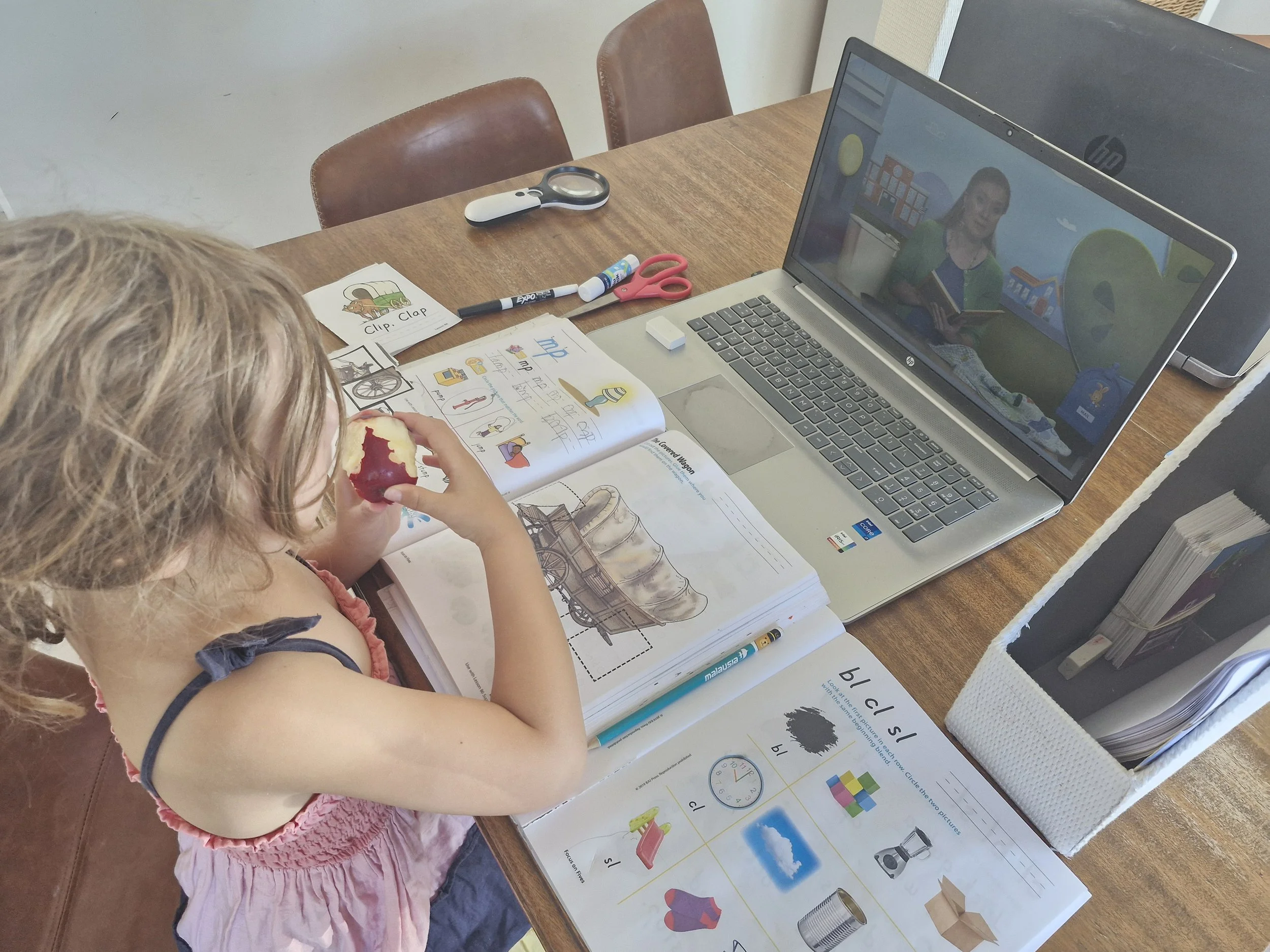
My daughter, Penny, doing Kindergarten Phonics with BJU.
5. Know what kind of homeschool BJU is designed to support
And sometimes the issue isn’t that a child is struggling with the work—it’s that the curriculum’s style doesn’t match the kind of homeschool you want. So what sort of day is BJU actually designed to support, and what would you need to add yourself?
If you’re imagining nature study, tea time, and hands-on projects as the main part of your day, BJU probably isn’t going to provide that experience for you.
It’s traditional and academically strong. We enjoy the early maths manipulatives, but most other subjects are much less hands-on. We add our own nature time in the afternoons because we value it.
If you want more hands-on learning built into the curriculum, I’d look at My Father’s World. For our current season, though, fewer projects are a benefit. I suspect I’m allergic to glue and glitter. I haven’t had myself medically tested.
BJU is a traditional, academically strong curriculum rather than a gentle, nature-study-led approach, with plenty of maths manipulatives in the early years but much less hands-on work in other subjects, so we add our own afternoon nature time, and I’d point families wanting a more hands-on approach toward My Father’s World—although with a toddler swiping things off the table, I’m quite happy to avoid the glue and glitter.
6. The Christian worldview is part of the curriculum, not an optional extra 📖
For our family, though, the style of the curriculum is only one part of the decision. If you’re choosing BJU because you want a genuinely Christian education, what should you expect from its worldview, and what still needs to happen in your own home?
Some curricula add an occasional Bible verse to otherwise secular material.
BJU’s Christian worldview is woven throughout, and that’s one of the reasons I love it.
But if you don’t share those beliefs, you need to know that before buying. The worldview isn’t something you can simply skip without changing the curriculum substantially.
And even though I value that teaching, I don’t want to outsource discipleship to a textbook. We still need to pray with our children, read Scripture, and talk about the gospel in our own home.
On difficult days, we can maintain high expectations while extending grace. Completing every workbook page isn’t the measure of whether we’ve had a faithful homeschool day.
BJU is unapologetically Christian and teaches that Jesus is the Son of God, our Saviour, and that we can have a relationship with God through repentance and following Him, which I love, but that worldview won’t suit every family, and I still want our own homeschool to be grounded in daily prayer, Bible reading, and continually extending grace and telling our children the gospel.
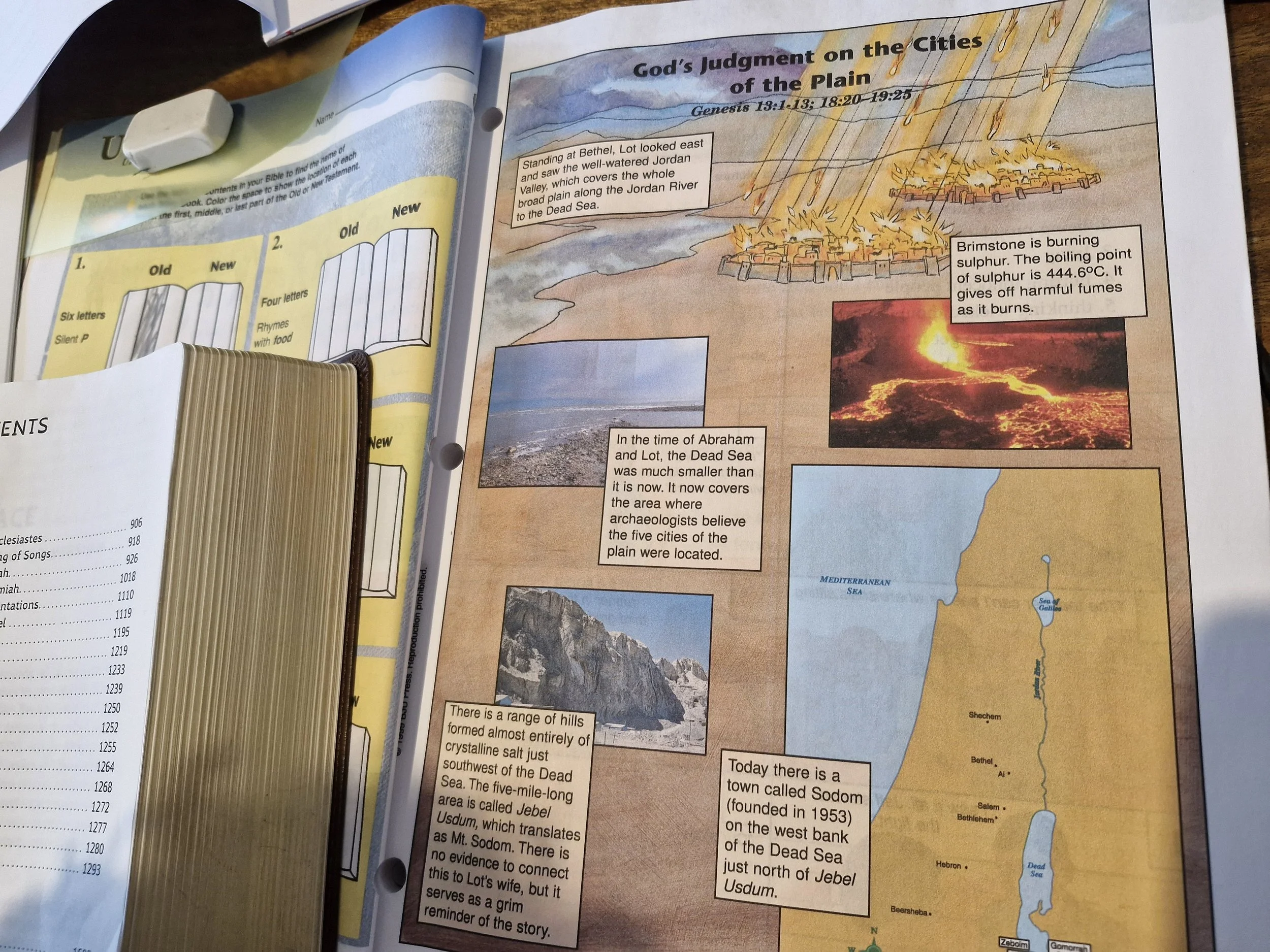
BJU Press Bible Curriculum Workbook page.
7. You don’t have to buy or use every subject
Once you know BJU fits your family’s values and teaching style, there’s still the question of how much of it you actually need to buy. Do you have to commit to every subject for the whole year, or can you choose what works best for each child?
Imagine buying a complete grade and feeling obligated to use every subject, even when one isn’t working. You don’t have to do that.
We used another reading curriculum for Luke in Grade 3, and now he’s already started his Grade 4 BJU reading. Changing one subject doesn’t mean abandoning the whole curriculum.
But check the prices before buying. A complete grade can come with a substantial discount, so compare that with the cost of the individual subjects you actually intend to use.
We’ve used another reading curriculum for Luke in Grade 3 and are returning to BJU reading for Grade 4, which he’s already started, so you don’t have to use every subject every year—but because BJU gives a substantial discount when you buy a complete grade, compare the full-grade price with buying individual subjects before deciding what makes sense for your family.
8. Check the buying details and decide what the cost is worth to you 💰
And before you finally place an order, there are two practical questions that can save you from an expensive mistake. Are you buying the right materials, and is the support you’re paying for actually worth the cost in your family?
A second-hand bundle might look like a bargain until you discover the books don’t match the video course you bought. So check the editions and compatibility before purchasing.
What is the teaching support worth to your family?
Then consider what the price actually buys you. For me, video teaching and reduced preparation make it possible to work from home while homeschooling. That support is worth paying for in our season.
But if you have more time to teach or a smaller budget, books alone might be the better choice. You need to weigh the academic quality, worldview, workload, and price against your own family’s needs.
Before buying second-hand books, make sure the editions match the video course you intend to use, and when weighing the price of BJU, consider what the teaching support, reduced preparation, and ability to work from home are worth to your family, because a parent with a smaller budget or more time to teach may reasonably make a different choice.
If you decide BJU Press is right for your family, you can explore the options through my affiliate link (it doesn’t cost more to purchase through this, but we get a small amount to help with our homeschool - thank you!).
And if you’re still comparing curricula, Curriculum Confidence can help you make that decision with more confidence.
Still comparing Christian homeschool curricula?
Now that you know what to look out for before buying BJU Press, you might be wondering whether it’s actually the best curriculum for your family.
Because after 31 years of being involved in homeschooling, I’ve found that some of my favourite Christian curricula are much cheaper, some are more hands-on, and some make life a whole lot easier for busy mums.
In my post on my favourite Christian homeschool curricula, I explain who each one may suit and which one I keep coming back to, so you can choose the right curriculum for your family with confidence.