Timberdoodle Curriculum Review: Too Much Stuff or Worth It?
Timberdoodle is either going to feel like the most exciting homeschool curriculum you have ever opened—or a very expensive pile of educational stuff your children barely use.
There does not seem to be much middle ground here.
Parents searching for Timberdoodle curriculum reviews are usually not looking for another glossy description of everything inside the box.
They want to hear from real homeschooling parents who have actually used it in their homes.
For this review, I examined feedback from around 20 parents who have used Timberdoodle, identified the experiences that appeared repeatedly, and distilled their feedback into this article.
Some families absolutely loved it.
Some admitted they purchased far more than they needed.
Several somehow managed to feel both things at the same time.
So, is Timberdoodle worth the money?
My verdict is: it depends.
Let’s look at what Timberdoodle is, what parents genuinely love about it, and why that enormous box might either transform your homeschool or quietly take over your dining room.
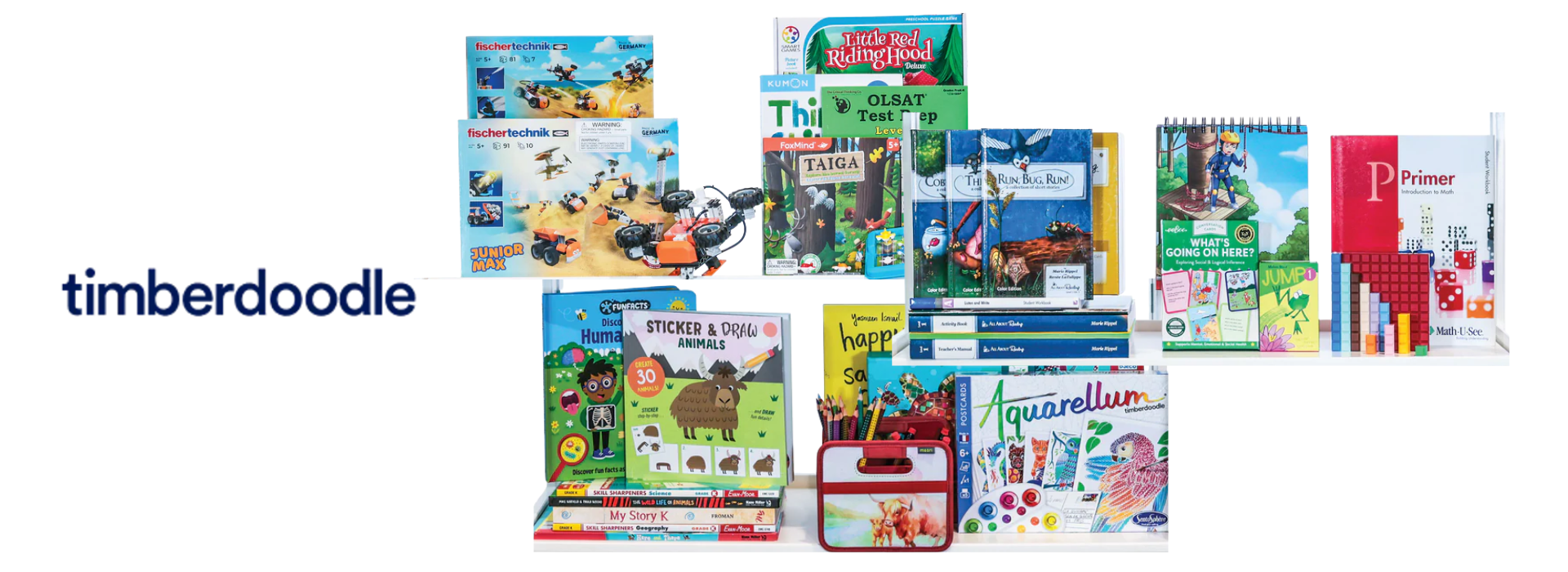
📦 What Is Timberdoodle Curriculum?
Timberdoodle is a family-owned homeschool company that creates complete curriculum kits for children from preschool through Grade 12.
However, Timberdoodle does not write every subject itself.
Instead, the company researches and selects resources from many different publishers and combines them into carefully curated grade-level packages.
A kit may include math, reading, spelling, writing, science, history, art, STEM activities, logic puzzles, educational games, manipulatives and critical-thinking resources.
In other words, Timberdoodle is less like one traditional curriculum publisher and more like a highly enthusiastic homeschooler who has researched everything, purchased the best-looking options and somehow fitted them all into one box.
Families can choose between Classic kits containing Christian material and nonreligious kits.
Each grade also has different package levels, generally called Basic, Complete and Elite.
The Basic package provides the core essentials.
The Complete package adds subjects and hands-on materials.
The Elite package includes the extras Timberdoodle believes will create the fullest experience.
You can also customize a kit when a particular resource does not suit your child.
That flexibility matters because very few children arrive conveniently designed to match every component of a preselected grade-level package.
If you want to take a look at thier kindergarten pack, see the video below.
🎲 What Makes Timberdoodle Different?
The most obvious difference is that Timberdoodle makes homeschooling feel fun.
This is not a curriculum built entirely around textbooks, lectures and filling in progressively smaller blanks.
It includes:
⭐ puzzles,
⭐ building activities,
⭐ art supplies,
⭐ games,
⭐ thinking challenges,
⭐ STEM projects and
⭐ manipulatives.
One parent described the included workbooks as engaging and said her children especially loved the large number of games and activities.
Another family used Timberdoodle for kindergarten and reported that they were still using some of the materials years later.
That reusability helps soften the initial price because many games, puzzles, art tools, and manipulatives can be passed down to younger siblings.
Of course, keeping every reusable item also means finding somewhere to store every reusable item.
Your children may finish kindergarten, but the collection of oddly shaped educational objects apparently graduates with them.
✅ Timberdoodle Is Excellent for Hands-On Learners
The greatest strength of Timberdoodle is its commitment to hands-on, interactive learning.
Children are not only asked to read about concepts but also to build, manipulate, solve, draw, play and experiment.
This can be wonderful for children who struggle to stay engaged with traditional textbook lessons.
A child who groans when presented with another worksheet may become surprisingly cooperative when the lesson involves a puzzle, science kit or strategy game.
This makes Timberdoodle particularly appealing for active learners, creative children and students who need variety.
It can also work well for younger children who learn best when lessons feel like play.
For some families, the activities are not merely decorative extras but the very things that make their children want to come back to school the following day.
That is a significant advantage.
A curriculum can be academically impressive, beautifully organized, and highly recommended, but none of that is especially useful when your child disappears behind the sofa every time you open it.
🌈 The Materials Are Colourful and Engaging
Many Timberdoodle selections are visually attractive and designed to hold a child’s attention.
Parents frequently mention the colorful workbooks, interesting games, and unusual learning tools.
The curriculum does not look like someone photocopied a tax return and labeled it fourth-grade science.
For children who are strongly motivated by:
✅ beautiful books,
✅ novelty, and
✅ variety, this can make a substantial difference.
The materials can help learning feel like something the child gets to explore rather than something being administered to them.
However, visual appeal is not the same as academic suitability, so parents should still examine the core math and language arts selections carefully.
A gorgeous workbook can still be the wrong level for your child.
It is simply a much more cheerful wrong level.
🧠 Timberdoodle Includes Strong Thinking-Skills Resources
Timberdoodle places a noticeable emphasis on logic, problem-solving and critical thinking.
The kits often contain puzzles, thinking games and activities that are not always included in conventional all-in-one curricula.
These resources can encourage children to persist through problems, recognize patterns and approach challenges creatively.
Parents who want more than basic workbook completion may appreciate this aspect of the program.
The games can also provide opportunities for siblings and parents to learn together.
Just remember that “family learning game” occasionally means “a beautiful bonding experience” and occasionally means “someone is crying because an eight-year-old changed the rules.”

All About Reading is included in the Timberdoodle packages.
📚 Timberdoodle Uses Established Curriculum Publishers
Because Timberdoodle curates rather than producing everything itself, its kits can contain respected resources from established publishers.
Depending on the year and grade, families may find programs such as:
✅ Math-U-See,
✅ Notgrass and
✅ Life of Fred among the selections.
This means you are not purchasing an untested collection of random educational toys.
You are receiving a combination of recognized core programs and Timberdoodle’s chosen supplementary materials.
However, it also means that there is no single “Timberdoodle teaching method” running consistently through every subject.
Your math curriculum may use one philosophy while your reading program uses another.
Some families love this eclectic approach because they can benefit from the strengths of several publishers.
Other families prefer the greater consistency of buying most subjects from one curriculum company.

Notgrass is included in the Timberdoodle packages.
🧭 It Can Reassure New Homeschooling Parents
One parent explained that using an all-in-one package helped during her first two years of homeschooling because she did not have to wonder whether she was doing enough.
This is one of Timberdoodle’s biggest advantages.
New homeschooling parents can become paralyzed by the sheer number of available choices.
They need math, reading, writing, science, and history, but then someone mentions logic, coding, art, geography, Latin, emotional intelligence, and a wooden puzzle apparently essential for healthy brain development.
Suddenly, selecting a kindergarten curriculum feels like assembling a university degree.
Timberdoodle removes much of that decision fatigue by showing parents what a full year could include.
Even when families eventually modify the schedule, the kit gives them a clear and reassuring starting point.
🛠️ You Can Customize the Kit
Timberdoodle’s customization options are another major strength.
Families can change components when their child needs a different level or when they already own a particular resource.
This is especially useful when a child is working across several grades.
A student may need third-grade language arts, fourth-grade science and fifth-grade math because children rarely respect the tidy grade labels printed on curriculum catalogues.
Customization can also prevent you from paying twice for reusable products you already own.
However, parents should take the time to examine each item instead of assuming the complete package will automatically be a perfect fit.
The ability to customize only saves money when you actually use it.
📵 Timberdoodle Is a Strong Low-Screen Option
Timberdoodle is an appealing choice for families who want to reduce screen time.
Most of the learning takes place through physical books, workbooks, games, manipulatives and practical activities.
Parents who dislike online curricula or do not want their children sitting in front of a computer for several hours may see this as a major benefit.
The physical materials also make it easier to homeschool without reliable internet access.
This can suit families who travel, although traveling with the entire Elite package may require either selective packing or a small cargo trailer.
⚠️ The Biggest Timberdoodle Complaint: There Is So Much Stuff
The most consistent concern in the parent feedback was overwhelm.
One mother using the Elite package said she initially felt overwhelmed by the amount of material.
She also admitted that her family was not using every item.
They eventually found a comfortable routine when she stopped forcing herself to complete everything and allowed the family to move at its own pace.
That is probably the most important lesson for anyone buying Timberdoodle.
You do not have to use every single item in the box.
The curriculum is a collection of resources, not a legally binding agreement requiring your child to finish every puzzle before summer.
Many families seem happiest when they identify the strongest core subjects, select the extras their children genuinely enjoy and release themselves from the pressure to use everything else.
Unfortunately, parents often find this difficult after spending a substantial amount of money.
Unused curriculum has an uncanny ability to stare accusingly at you from the shelf.
💰 Timberdoodle Can Be Expensive
Timberdoodle kits require a significant upfront investment, particularly at the Complete and Elite levels.
You are purchasing an entire year of books, curriculum programs, games, art resources, STEM tools and manipulatives at once.
For families who use nearly everything, the package may represent good value.
For families who use the math, reading program and three favourite games, it can become an extremely expensive way to discover that their child dislikes sticker mosaics.
The cost is easier to justify when the included resources are reused by several siblings.
It is harder to justify when your child ignores half the kit and spends the year repeatedly playing with one magnetic puzzle.
🛒 You Are Paying for Convenience
A significant portion of Timberdoodle’s value comes from its research and curation.
The company has compared products, selected complementary resources, organized them by grade and placed them into a single package.
That saves parents a considerable amount of time.
Instead of spending weeks reading curriculum reviews and opening 47 browser tabs, you can order one kit and begin.
For busy or inexperienced parents, that convenience may be worth paying for.
However, experienced homeschoolers sometimes realize they can recreate a similar program for less by buying individual products during sales or purchasing them second-hand.
Several parents use Timberdoodle’s kit lists as inspiration and then source the materials elsewhere.
This approach can save money, but it also returns all the research, ordering and organization to the parent.
Timberdoodle is therefore not necessarily overpriced, but you are paying someone else to do the curriculum hunting for you.
🗂️ The Schedule May Not Suit Every Family
Timberdoodle includes planning support and checklists to help families organize the year.
Structured parents may appreciate having each resource divided into manageable weekly assignments.
However, no premade schedule can perfectly anticipate illnesses, toddlers, appointments, learning difficulties, unexpected holidays or the child who takes three days to complete one “quick” art project.
Some families follow the schedule closely.
Others use it as a general guide.
Parents who become stressed by unfinished boxes should approach the schedule carefully because a curriculum planner is supposed to serve your family, not silently judge it.
👩🏫 It May Require More Parent Involvement
Although Timberdoodle encourages children to take ownership of their work, it is primarily an offline collection of books and hands-on resources.
It does not generally provide video teachers who present every lesson and guide the child through the course.
This means younger students may need a parent to explain lessons, organize activities, locate supplies and oversee projects.
Hands-on learning can be wonderfully effective, but it is not always hands-off for the parent.
Sometimes “engaging activity” means your child is engaged while you search the house for glue, scissors and the one plastic component that vanished after the previous lesson.
Personally, I prefer video-based lessons because they allow my children to work much more independently.
That independence matters in a home with several children, a toddler and work that also needs to be completed.
Families who actively enjoy teaching, playing educational games and completing projects together may love Timberdoodle’s approach.
Families who need their children to complete most lessons independently may prefer a more teacher-led video curriculum.
🧸 Who Is Timberdoodle Best For?
Timberdoodle is particularly well suited to hands-on learners who become bored with traditional textbooks and worksheets.
It is also a strong option for younger children who enjoy colourful materials, games, puzzles, art and STEM activities.
New homeschooling parents may appreciate having a full year assembled for them.
Families trying to reduce screen time may love the offline format.
Parents who enjoy eclectic homeschooling and selecting strong resources from several publishers are also likely to appreciate Timberdoodle.
Most importantly, it suits families who can look at a large package and say, “We will use what helps us,” rather than, “We must finish every object in this box or kindergarten has defeated us.”
🚫 Who Should Probably Skip Timberdoodle?
Timberdoodle may not suit families seeking the cheapest possible homeschool curriculum.
It may also frustrate parents who want a minimal, calm and highly streamlined school day.
Families with limited storage should think carefully before purchasing the largest package.
Parents who dislike crafts, games and projects may end up paying for many resources they would never have selected individually.
Students who prefer consistent textbook lessons may find the constant variety distracting rather than engaging.
Finally, families who need video teachers and a high level of student independence may be better served by a curriculum designed around online instruction.
⭐ Final Timberdoodle Curriculum Review
Timberdoodle is not necessarily overpriced, but it is very easy to overbuy.
The company offers an exciting, creative and thoughtfully selected collection of homeschool resources.
Its kits can be fantastic for children who love puzzles, experiments, art, games, building and hands-on learning.
Parents repeatedly praise the engaging materials, customization and ability to reuse many items with younger siblings.
However, the same abundance that makes Timberdoodle exciting can also make it overwhelming.
The happiest families appear to be those who stop treating every component as compulsory.
Timberdoodle should feel like a well-stocked educational toolbox, not a mountain your family must climb before June.
So, should you Keep It, Skip It or It Depends?
✅ Keep It if you have a hands-on child, enjoy variety, want less screen time and value having someone else choose quality resources for you.
❌ Skip It if you want maximum independence, minimal clutter or the lowest possible cost.
🤔 It Depends if you're tempted to buy the biggest kit simply because it contains more. Sometimes the best Timberdoodle package is simply the one your family will actually use.
One final thought...
Timberdoodle isn't the only excellent hands-on homeschool curriculum available.
If you're looking for a curriculum that gets children building, experimenting, creating and learning through play, there are several fantastic alternatives that may suit your family even better.
👉 Read my guide to the Best Hands-On Homeschool Curriculum (or watch the video below) where I compare Timberdoodle with other popular hands-on programs, explain who each one suits best, and help you choose the right fit for your homeschool instead of simply the most popular one.